Nigeria Non-ferrous Metal Market Summary
The nigeria non-ferrous metal market was estimated at USD 238 Million in 2025 and is projected to reach USD 261 Million by 2032, growing at a CAGR of 1.5% from 2026 to 2032.
Nigeria Non-ferrous Metal Market Year-wise Growth Rate and Key Drivers
This graph highlights how the Nigeria Non-ferrous Metal Market has steadily grown over the past five years, supported by major growth factors.
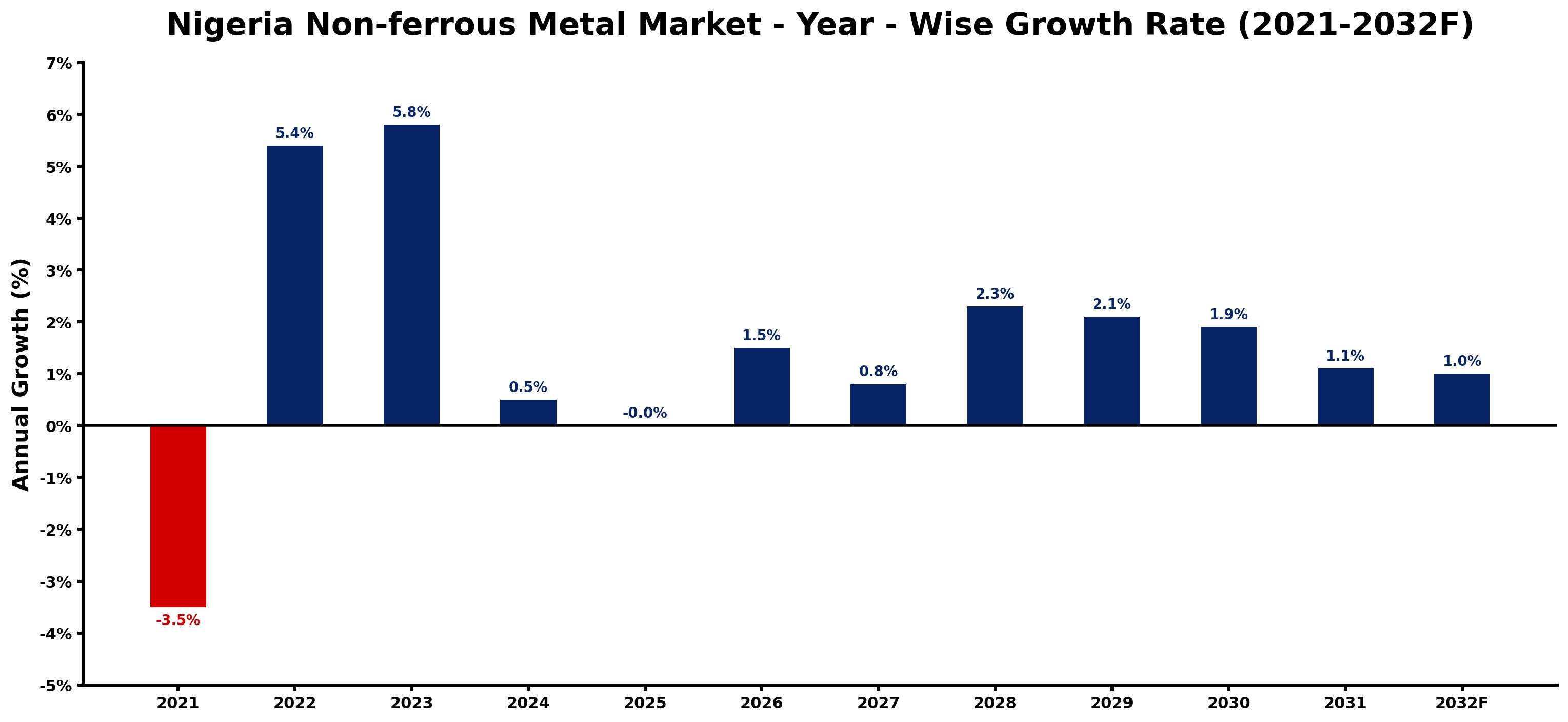
The table below presents the year wise growth rates along with the key drivers influencing the market
| Year | Growth Rate | Major Drivers |
| 2021 | -3.5% | Deteriorating foreign exchange stability led to increased import costs, inhibiting market growth and investment. |
| 2022 | 5.4% | Expansion in renewable energy projects creates significant copper and aluminum requirements. |
| 2023 | 5.8% | Local manufacturing initiatives incentivize sourcing non-ferrous metals nationwide, boosting domestic production. |
| 2024 | 0.5% | Infrastructure developments necessitate higher quality materials, enhancing non-ferrous metal usage. |
| 2025 | -0.0% | Emergence of electric vehicles spurs a surge in copper and aluminum consumption. |
| 2026 | 1.5% | Technological progress in recycling methods increases non-ferrous metal availability and sustainability. |
| 2027 | 0.8% | Investment in industrial parks attracts international players to Nigeria's non-ferrous market. |
| 2028 | 2.3% | Urbanization trends drive demand for sophisticated building materials across Nigerian cities. |
| 2029 | 2.1% | Partnerships with foreign investors enhance access to advanced non-ferrous metal technologies. |
| 2030 | 1.9% | Environmental awareness motivates shifts towards more sustainable non-ferrous metal sourcing methods. |
| 2031 | 1.1% | Rising population intensifies demand for housing, significantly boosting non-ferrous metal consumption. |
| 2032 | 1.0% | Digital transformation in supply chains optimizes distribution channels for non-ferrous metal industries. |
Note - Market size estimations and growth projections presented in this report are based on 6Wresearch's advanced forecasting approach, validated with industry datasets as of June 2026.
Nigeria Non-ferrous Metal Market Synopsis
The Nigeria Non-ferrous Metal Market is projected to reach 1.5% and witness significant growth during the forecast period (2026-2032). This growth trajectory is largely supported by escalating investments from both government and private sectors. The increasing pace of infrastructure development across Nigeria, along with the soaring demand for aluminum and other non-ferrous metals from various industries, serves as pivotal drivers for this market. Additionally, the Nigerian government's favorable policies aimed at attracting foreign investment are expected to enhance the growth potential of the Nigeria Non-ferrous Metal Market.
Nigeria Non-ferrous Metal Market Growth Drivers
Several key factors are contributing to the growth of the Nigeria Non-ferrous Metal Market. Primarily, the ongoing expansion in the construction and infrastructure sectors has resulted in a heightened demand for non-ferrous metals such as aluminum and copper. These materials are integral to many construction applications due to their lightweight properties and resistance to corrosion. Furthermore, the increasing installation of renewable energy systems has led to an upsurge in the need for metals like cobalt and nickel, which are crucial for battery manufacturing.
- Investment trends reveal that both local and international stakeholders are increasingly channeling funds into production capacity and technological innovations within the non-ferrous metal sector.
- The rising disposable income among consumers is facilitating higher consumption of electronic goods, indirectly boosting demand for copper and aluminum used in these products.
- Technological advancements, particularly in manufacturing processes such as 3D printing, are enhancing the applicability of non-ferrous metals like zinc and titanium, opening new avenues for market expansion.
- The automotive industry's shift towards electric and hybrid vehicles is creating a significant demand for lightweight metals, representing a lucrative opportunity for growth in the non-ferrous sector.
- The increasing emphasis on green energy solutions and sustainable practices among various industries is driving up the demand for neodymium, vital for wind turbine manufacturing, thus enhancing revenue prospects.
Nigeria Non-ferrous Metal Market Challenges and Restraints
Despite the positive outlook of the Nigeria Non-ferrous Metal Market, certain challenges may impact its growth. Fluctuations in raw material prices pose a risk to manufacturers, affecting profitability and investment decisions. Additionally, the lack of adequate infrastructure and logistical support can hinder the efficient distribution of non-ferrous metals, leading to supply chain disruptions. Furthermore, regulatory hurdles may slow down the implementation of new projects within the sector.
- Infrastructure deficits in transportation and warehousing create bottlenecks that can delay project timelines and increase costs for producers.
- Dependence on imports for certain non-ferrous metal components can expose the market to global price volatility and foreign exchange fluctuations.
- Competition from alternative materials in certain applications can limit the market share for non-ferrous metals, particularly in cost-sensitive industries.
- Environmental regulations may impose additional compliance costs for mining and processing operations, affecting overall market feasibility.
- The industry may face a skills gap, as the rapid adoption of new technologies requires a workforce with specialized training, which is currently lacking.
Nigeria Non-ferrous Metal Market Government Investment and Initiatives
The Nigerian government has been proactive in establishing a conducive environment for the growth of the non-ferrous metal industry. Policy frameworks have been introduced to attract foreign investment, such as tax incentives and reduced tariffs on imported machinery essential for metal production. Furthermore, public spending on infrastructure projects, including roads, bridges, and energy systems, is significantly impacting the demand for non-ferrous metals. Initiatives aimed at improving technological capabilities and encouraging research and development within the sector are also noteworthy. These government-led efforts are pivotal for stimulating investment and promoting sustainable practices within the Nigeria Non-ferrous Metal Market.
Nigeria Non-ferrous Metal Market Latest Developments (May 2025 - June 2026)
The period from May 2025 to June 2026 saw several significant developments in the Nigeria Non-ferrous Metal Market. Notably, the government's commitment to enhancing infrastructure led to the inauguration of new projects aimed at improving mining operations and processing facilities. The sector also experienced a surge in innovation, as various industry stakeholders began exploring advanced production techniques that reduce environmental impact. Moreover, partnerships were formed between local producers and international technology firms to facilitate knowledge transfer, thus enhancing local manufacturing capacities. The increasing global focus on sustainability prompted investments in cleaner technologies, as firms adapted to meet evolving regulatory requirements and consumer preferences.
Nigeria Non-ferrous Metal Market - Key Attractiveness of the Report
- 10 Years of Market Numbers
- Historical Data Starting from 2022 to 2025
- Base Year: 2025
- Forecast Data until 2032
- Key Performance Indicators Impacting the Market
- Major Upcoming Developments and Projects
Key Highlights of the Report:
- Nigeria Non-ferrous Metal Market Outlook
- Market Size of Nigeria Non-ferrous Metal Market, 2025
- Forecast of Nigeria Non-ferrous Metal Market, 2032F
- Historical Data and Forecast of Nigeria Non-ferrous Metal Revenues & Volume for the Period 2022-2032F
- Nigeria Non-ferrous Metal Market Trend Evolution
- Nigeria Non-ferrous Metal Market Drivers and Challenges
- Nigeria Non-ferrous Metal Price Trends
- Nigeria Non-ferrous Metal Porter's Five Forces
- Nigeria Non-ferrous Metal Industry Life Cycle
- Historical Data and Forecast of Nigeria Non-ferrous Metal Market Revenues & Volume By Types for the Period 2022-2032F
- Historical Data and Forecast of Nigeria Non-ferrous Metal Market Revenues & Volume By Aluminum for the Period 2022-2032F
- Historical Data and Forecast of Nigeria Non-ferrous Metal Market Revenues & Volume By Copper for the Period 2022-2032F
- Historical Data and Forecast of Nigeria Non-ferrous Metal Market Revenues & Volume By Lead for the Period 2022-2032F
- Historical Data and Forecast of Nigeria Non-ferrous Metal Market Revenues & Volume By Tin for the Period 2022-2032F
- Historical Data and Forecast of Nigeria Non-ferrous Metal Market Revenues & Volume By Nickel for the Period 2022-2032F
- Historical Data and Forecast of Nigeria Non-ferrous Metal Market Revenues & Volume By Titanium for the Period 2022-2032F
- Historical Data and Forecast of Nigeria Non-ferrous Metal Market Revenues & Volume By Zinc for the Period 2022-2032F
- Historical Data and Forecast of Nigeria Non-ferrous Metal Market Revenues & Volume By Applications for the Period 2022-2032F
- Historical Data and Forecast of Nigeria Non-ferrous Metal Market Revenues & Volume By Automobile Industry for the Period 2022-2032F
- Historical Data and Forecast of Nigeria Non-ferrous Metal Market Revenues & Volume By Electronic Power Industry for the Period 2022-2032F
- Historical Data and Forecast of Nigeria Non-ferrous Metal Market Revenues & Volume By Construction Industry for the Period 2022-2032F
- Historical Data and Forecast of Nigeria Non-ferrous Metal Market Revenues & Volume By Other for the Period 2022-2032F
- Nigeria Non-ferrous Metal Import Export Trade Statistics
- Market Opportunity Assessment By Types
- Market Opportunity Assessment By Applications
- Nigeria Non-ferrous Metal Top Companies Market Share
- Nigeria Non-ferrous Metal Competitive Benchmarking By Technical and Operational Parameters
- Nigeria Non-ferrous Metal Company Profiles
- Nigeria Non-ferrous Metal Key Strategic Recommendations






































