Nigeria Oil and Gas Lubricants Market (2025-2031) | Companies, Segmentation, Share, Value, Forecast, Analysis, Trends, Size & Revenue, Competitive Landscape, Outlook, Growth, Industry
Market Forecast By Location (Onshore, Offshore), By Product Type (Grease, Coolant/Anti-freezer, Engine Oils, Hydraulic Fluids, Other Product Types), By Sector (Upstream, Midstream, Downstream) And Competitive Landscape
| Product Code: ETC8630869 | Publication Date: Sep 2024 | Updated Date: Nov 2025 | Product Type: Market Research Report | |
| Publisher: 6Wresearch | Author: Dhaval Chaurasia | No. of Pages: 75 | No. of Figures: 35 | No. of Tables: 20 |
Nigeria Oil And Gas Lubricants Market Top 5 Importing Countries and Market Competition (HHI) Analysis
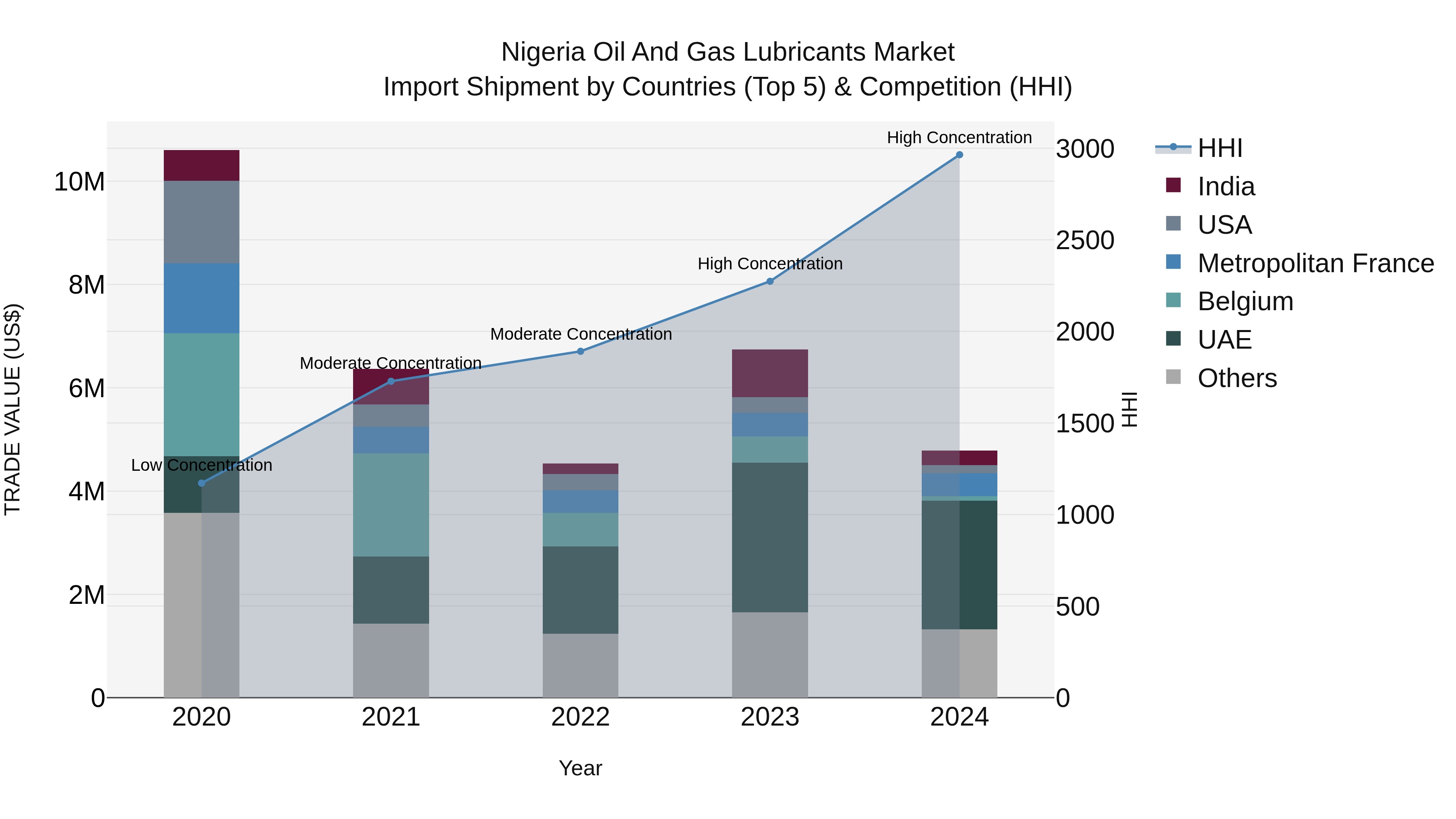
Despite a challenging environment with a negative CAGR and a significant decline in growth rate in 2024, Nigeria continues to rely on imports of oil and gas lubricants from key exporting countries such as UAE, Metropolitan France, Liberia, India, and Egypt. The high Herfindahl-Hirschman Index (HHI) indicates a concentrated market, highlighting the dominance of these top exporters. As Nigeria navigates these dynamics, there may be opportunities for strategic partnerships and initiatives to enhance the lubricants sector`s resilience and competitiveness in the global market.
Nigeria Oil and Gas Lubricants Market Synopsis
The Nigeria Oil and Gas Lubricants Market is a key sector within the country`s energy industry, driven by the demand for high-quality lubricants in the exploration, production, and transportation of oil and gas. With Nigeria being a major oil-producing nation, the market for lubricants is significant, catering to the maintenance and efficient operation of machinery and equipment used in the sector. Key players in the market offer a wide range of lubricants tailored to meet the specific needs of the oil and gas industry, including products for drilling operations, compressor systems, and hydraulic machinery. The market is also influenced by factors such as regulatory policies, technological advancements, and the overall performance of the oil and gas sector in Nigeria.
Nigeria Oil and Gas Lubricants Market Trends
The Nigeria Oil and Gas Lubricants Market is experiencing several key trends. One major trend is the increasing demand for environmentally friendly and sustainable lubricants in response to growing environmental concerns. Companies are focusing on developing lubricants that are biodegradable and have minimal impact on the environment. Another trend is the shift towards synthetic lubricants, which offer superior performance and longer-lasting benefits compared to traditional mineral-based lubricants. Additionally, there is a growing emphasis on digitalization and technology integration in lubricant products, with companies incorporating IoT sensors and monitoring systems to optimize equipment performance and maintenance schedules. Overall, the Nigeria Oil and Gas Lubricants Market is evolving towards more sustainable, high-performance solutions with a strong focus on technological advancements.
Nigeria Oil and Gas Lubricants Market Challenges
The Nigeria Oil and Gas Lubricants Market faces several challenges, including the presence of counterfeit products leading to quality concerns and potential damage to equipment. Additionally, fluctuating global oil prices impact the overall cost of production and subsequently influence the demand for lubricants in the market. Infrastructure constraints, such as inadequate storage facilities and transportation networks, also pose challenges in ensuring timely and efficient distribution of lubricants to end-users across the country. Regulatory uncertainties and political instability further add to the complexities faced by companies operating in the sector, impacting investment decisions and overall market growth potential. Addressing these challenges requires collaboration between industry stakeholders, government bodies, and regulatory authorities to implement effective quality control measures, improve infrastructure, and provide a conducive business environment for the oil and gas lubricants market in Nigeria.
Nigeria Oil and Gas Lubricants Market Investment Opportunities
The Nigeria Oil and Gas Lubricants Market offers several investment opportunities for potential investors. With the country being one of the largest oil producers in Africa, the demand for lubricants in the oil and gas sector is consistently high. Investing in the production and distribution of high-quality lubricants tailored to the specific needs of the oil and gas industry can be lucrative. Additionally, there is a growing trend towards environmentally friendly lubricants in Nigeria, presenting an opportunity for investors to capitalize on the shift towards sustainable practices. Partnering with local oil and gas companies to provide customized lubricant solutions can also be a strategic investment approach in this market. Overall, the Nigeria Oil and Gas Lubricants Market offers a promising landscape for investors seeking opportunities in the energy sector.
Jordan Agar Market Government Policies
The Nigerian government has implemented various policies to regulate the Oil and Gas Lubricants Market. These include the National Oil Spill Detection and Response Agency (NOSDRA) Act, which aims to prevent and manage oil spills in the country. Additionally, the Department of Petroleum Resources (DPR) regulates the importation, production, and distribution of lubricants to ensure quality and safety standards are met. The Nigerian Content Development and Monitoring Board (NCDMB) promotes local content in the oil and gas sector, encouraging the use of locally produced lubricants. These policies are designed to protect the environment, promote local industry participation, and ensure the efficient and sustainable growth of the oil and gas lubricants market in Nigeria.
Nigeria Oil and Gas Lubricants Market Future Outlook
The future outlook for the Nigeria Oil and Gas Lubricants Market appears promising due to the country`s strategic position as a major oil producer and exporter. With increasing industrialization and infrastructure development driving demand for lubricants in the oil and gas sector, the market is expected to experience steady growth in the coming years. Additionally, investments in exploration and production activities, coupled with the government`s focus on improving the business environment for oil and gas companies, are likely to further boost the demand for lubricants. However, challenges such as fluctuating oil prices, regulatory uncertainties, and environmental concerns may pose some risks to the market`s growth potential. Overall, the Nigeria Oil and Gas Lubricants Market is poised for expansion, driven by the country`s oil-rich resources and growing energy needs.
Key Highlights of the Report:
- Nigeria Oil and Gas Lubricants Market Outlook
- Market Size of Nigeria Oil and Gas Lubricants Market, 2024
- Forecast of Nigeria Oil and Gas Lubricants Market, 2031
- Historical Data and Forecast of Nigeria Oil and Gas Lubricants Revenues & Volume for the Period 2021- 2031
- Nigeria Oil and Gas Lubricants Market Trend Evolution
- Nigeria Oil and Gas Lubricants Market Drivers and Challenges
- Nigeria Oil and Gas Lubricants Price Trends
- Nigeria Oil and Gas Lubricants Porter's Five Forces
- Nigeria Oil and Gas Lubricants Industry Life Cycle
- Historical Data and Forecast of Nigeria Oil and Gas Lubricants Market Revenues & Volume By Location for the Period 2021- 2031
- Historical Data and Forecast of Nigeria Oil and Gas Lubricants Market Revenues & Volume By Onshore for the Period 2021- 2031
- Historical Data and Forecast of Nigeria Oil and Gas Lubricants Market Revenues & Volume By Offshore for the Period 2021- 2031
- Historical Data and Forecast of Nigeria Oil and Gas Lubricants Market Revenues & Volume By Product Type for the Period 2021- 2031
- Historical Data and Forecast of Nigeria Oil and Gas Lubricants Market Revenues & Volume By Grease for the Period 2021- 2031
- Historical Data and Forecast of Nigeria Oil and Gas Lubricants Market Revenues & Volume By Coolant/Anti-freezer for the Period 2021- 2031
- Historical Data and Forecast of Nigeria Oil and Gas Lubricants Market Revenues & Volume By Engine Oils for the Period 2021- 2031
- Historical Data and Forecast of Nigeria Oil and Gas Lubricants Market Revenues & Volume By Hydraulic Fluids for the Period 2021- 2031
- Historical Data and Forecast of Nigeria Oil and Gas Lubricants Market Revenues & Volume By Other Product Types for the Period 2021- 2031
- Historical Data and Forecast of Nigeria Oil and Gas Lubricants Market Revenues & Volume By Sector for the Period 2021- 2031
- Historical Data and Forecast of Nigeria Oil and Gas Lubricants Market Revenues & Volume By Upstream for the Period 2021- 2031
- Historical Data and Forecast of Nigeria Oil and Gas Lubricants Market Revenues & Volume By Midstream for the Period 2021- 2031
- Historical Data and Forecast of Nigeria Oil and Gas Lubricants Market Revenues & Volume By Downstream for the Period 2021- 2031
- Nigeria Oil and Gas Lubricants Import Export Trade Statistics
- Market Opportunity Assessment By Location
- Market Opportunity Assessment By Product Type
- Market Opportunity Assessment By Sector
- Nigeria Oil and Gas Lubricants Top Companies Market Share
- Nigeria Oil and Gas Lubricants Competitive Benchmarking By Technical and Operational Parameters
- Nigeria Oil and Gas Lubricants Company Profiles
- Nigeria Oil and Gas Lubricants Key Strategic Recommendations
Frequently Asked Questions About the Market Study (FAQs):
6Wresearch actively monitors the Nigeria Oil and Gas Lubricants Market and publishes its comprehensive annual report, highlighting emerging trends, growth drivers, revenue analysis, and forecast outlook. Our insights help businesses to make data-backed strategic decisions with ongoing market dynamics. Our analysts track relevent industries related to the Nigeria Oil and Gas Lubricants Market, allowing our clients with actionable intelligence and reliable forecasts tailored to emerging regional needs.
Yes, we provide customisation as per your requirements. To learn more, feel free to contact us on sales@6wresearch.com
1 Executive Summary |
2 Introduction |
2.1 Key Highlights of the Report |
2.2 Report Description |
2.3 Market Scope & Segmentation |
2.4 Research Methodology |
2.5 Assumptions |
3 Nigeria Oil and Gas Lubricants Market Overview |
3.1 Nigeria Country Macro Economic Indicators |
3.2 Nigeria Oil and Gas Lubricants Market Revenues & Volume, 2021 & 2031F |
3.3 Nigeria Oil and Gas Lubricants Market - Industry Life Cycle |
3.4 Nigeria Oil and Gas Lubricants Market - Porter's Five Forces |
3.5 Nigeria Oil and Gas Lubricants Market Revenues & Volume Share, By Location, 2021 & 2031F |
3.6 Nigeria Oil and Gas Lubricants Market Revenues & Volume Share, By Product Type, 2021 & 2031F |
3.7 Nigeria Oil and Gas Lubricants Market Revenues & Volume Share, By Sector, 2021 & 2031F |
4 Nigeria Oil and Gas Lubricants Market Dynamics |
4.1 Impact Analysis |
4.2 Market Drivers |
4.2.1 Increasing demand for oil and gas lubricants in Nigeria due to growth in the oil and gas industry |
4.2.2 Advancements in technology leading to the development of high-performance lubricants |
4.2.3 Government initiatives and investments in the oil and gas sector to drive production and exploration activities |
4.3 Market Restraints |
4.3.1 Fluctuating oil prices impacting investment and expenditure in the oil and gas sector |
4.3.2 Regulatory challenges and compliance requirements affecting the production and distribution of oil and gas lubricants |
4.3.3 Competition from alternative energy sources impacting the demand for traditional oil and gas lubricants |
5 Nigeria Oil and Gas Lubricants Market Trends |
6 Nigeria Oil and Gas Lubricants Market, By Types |
6.1 Nigeria Oil and Gas Lubricants Market, By Location |
6.1.1 Overview and Analysis |
6.1.2 Nigeria Oil and Gas Lubricants Market Revenues & Volume, By Location, 2021- 2031F |
6.1.3 Nigeria Oil and Gas Lubricants Market Revenues & Volume, By Onshore, 2021- 2031F |
6.1.4 Nigeria Oil and Gas Lubricants Market Revenues & Volume, By Offshore, 2021- 2031F |
6.2 Nigeria Oil and Gas Lubricants Market, By Product Type |
6.2.1 Overview and Analysis |
6.2.2 Nigeria Oil and Gas Lubricants Market Revenues & Volume, By Grease, 2021- 2031F |
6.2.3 Nigeria Oil and Gas Lubricants Market Revenues & Volume, By Coolant/Anti-freezer, 2021- 2031F |
6.2.4 Nigeria Oil and Gas Lubricants Market Revenues & Volume, By Engine Oils, 2021- 2031F |
6.2.5 Nigeria Oil and Gas Lubricants Market Revenues & Volume, By Hydraulic Fluids, 2021- 2031F |
6.2.6 Nigeria Oil and Gas Lubricants Market Revenues & Volume, By Other Product Types, 2021- 2031F |
6.3 Nigeria Oil and Gas Lubricants Market, By Sector |
6.3.1 Overview and Analysis |
6.3.2 Nigeria Oil and Gas Lubricants Market Revenues & Volume, By Upstream, 2021- 2031F |
6.3.3 Nigeria Oil and Gas Lubricants Market Revenues & Volume, By Midstream, 2021- 2031F |
6.3.4 Nigeria Oil and Gas Lubricants Market Revenues & Volume, By Downstream, 2021- 2031F |
7 Nigeria Oil and Gas Lubricants Market Import-Export Trade Statistics |
7.1 Nigeria Oil and Gas Lubricants Market Export to Major Countries |
7.2 Nigeria Oil and Gas Lubricants Market Imports from Major Countries |
8 Nigeria Oil and Gas Lubricants Market Key Performance Indicators |
8.1 Percentage of oil and gas exploration and production activities in Nigeria utilizing advanced lubricants |
8.2 Number of government contracts and investments in the oil and gas sector supporting the lubricants market |
8.3 Rate of adoption of environmentally friendly lubricants in the oil and gas industry in Nigeria |
9 Nigeria Oil and Gas Lubricants Market - Opportunity Assessment |
9.1 Nigeria Oil and Gas Lubricants Market Opportunity Assessment, By Location, 2021 & 2031F |
9.2 Nigeria Oil and Gas Lubricants Market Opportunity Assessment, By Product Type, 2021 & 2031F |
9.3 Nigeria Oil and Gas Lubricants Market Opportunity Assessment, By Sector, 2021 & 2031F |
10 Nigeria Oil and Gas Lubricants Market - Competitive Landscape |
10.1 Nigeria Oil and Gas Lubricants Market Revenue Share, By Companies, 2024 |
10.2 Nigeria Oil and Gas Lubricants Market Competitive Benchmarking, By Operating and Technical Parameters |
11 Company Profiles |
12 Recommendations |
13 Disclaimer |
Pricing
- Single User License$ 1,995
- Department License$ 2,400
- Site License$ 3,120
- Global License$ 3,795

Search
Thought Leadership and Analyst Meet





Our Clients








Related Reports
- Germany Breakfast Food Market (2026-2032) | Industry, Share, Growth, Size, Companies, Value, Analysis, Revenue, Trends, Forecast & Outlook
- Australia Briquette Market (2025-2031) | Growth, Size, Revenue, Forecast, Analysis, Trends, Value, Share, Industry & Companies
- Vietnam System Integrator Market (2025-2031) | Size, Companies, Analysis, Industry, Value, Forecast, Growth, Trends, Revenue & Share
- ASEAN and Thailand Brain Health Supplements Market (2025-2031) | Strategy, Consumer Insights, Analysis, Investment Trends, Opportunities, Growth, Size, Share, Industry, Revenue, Segments, Value, Segmentation, Supply, Forecast, Restraints, Outlook, Competition, Drivers, Trends, Demand, Pricing Analysis, Competitive, Strategic Insights, Companies, Challenges
- ASEAN Bearings Market (2025-2031) | Strategy, Consumer Insights, Analysis, Investment Trends, Opportunities, Growth, Size, Share, Industry, Revenue, Segments, Value, Segmentation, Supply, Forecast, Restraints, Outlook, Competition, Drivers, Trends, Demand, Pricing Analysis, Competitive, Strategic Insights, Companies, Challenges
- Europe Flooring Market (2025-2031) | Outlook, Share, Industry, Trends, Forecast, Companies, Revenue, Size, Analysis, Growth & Value
- Saudi Arabia Manlift Market (2025-2031) | Outlook, Size, Growth, Trends, Companies, Industry, Revenue, Value, Share, Forecast & Analysis
- Uganda Excavator, Crane, and Wheel Loaders Market (2025-2031) | Strategy, Consumer Insights, Analysis, Investment Trends, Opportunities, Growth, Size, Share, Industry, Revenue, Segments, Value, Segmentation, Supply, Forecast, Restraints, Outlook, Competition, Drivers, Trends, Demand, Pricing Analysis, Competitive, Strategic Insights, Companies, Challenges
- Rwanda Excavator, Crane, and Wheel Loaders Market (2025-2031) | Strategy, Consumer Insights, Analysis, Investment Trends, Opportunities, Growth, Size, Share, Industry, Revenue, Segments, Value, Segmentation, Supply, Forecast, Restraints, Outlook, Competition, Drivers, Trends, Demand, Pricing Analysis, Competitive, Strategic Insights, Companies, Challenges
- Kenya Excavator, Crane, and Wheel Loaders Market (2025-2031) | Strategy, Consumer Insights, Analysis, Investment Trends, Opportunities, Growth, Size, Share, Industry, Revenue, Segments, Value, Segmentation, Supply, Forecast, Restraints, Outlook, Competition, Drivers, Trends, Demand, Pricing Analysis, Competitive, Strategic Insights, Companies, Challenges
Industry Events and Analyst Meet

Stationery & Paper Expo Saudi Arabia 2026

Kids & Toys Expo Saudi Arabia 2026

Gifts & Homeware Expo Saudi Arabia 2026

Smart Home Expo 2026

Industrial Facilities Management Expo 2025
Whitepaper
- Middle East & Africa Commercial Security Market Click here to view more.
- Middle East & Africa Fire Safety Systems & Equipment Market Click here to view more.
- GCC Drone Market Click here to view more.
- Middle East Lighting Fixture Market Click here to view more.
- GCC Physical & Perimeter Security Market Click here to view more.
6WResearch In News
- Doha a strategic location for EV manufacturing hub: IPA Qatar
- Demand for luxury TVs surging in the GCC, says Samsung
- Empowering Growth: The Thriving Journey of Bangladesh’s Cable Industry
- Demand for luxury TVs surging in the GCC, says Samsung
- Video call with a traditional healer? Once unthinkable, it’s now common in South Africa
- Intelligent Buildings To Smooth GCC’s Path To Net Zero


