Nigeria Optical Projector Market Size, Share & Growth Rate
The Nigeria Optical Projector Market was estimated at USD 189 Million in 2025 and is projected to reach USD 256 Million by 2032, growing at a CAGR of 4.4% from 2026 to 2032. This growth trajectory is propelled by a surge in the adoption of advanced projection technologies across education, corporate, and entertainment sectors. As institutions increasingly recognize the value of visual aids for effective communication, the demand for high-quality optical projectors is set to rise, leading to robust market expansion.
Nigeria Optical Projector Market Year-wise Growth Rate and Key Drivers
This graph highlights how the Nigeria Optical Projector Market has steadily grown over the years, supported by major growth factors.
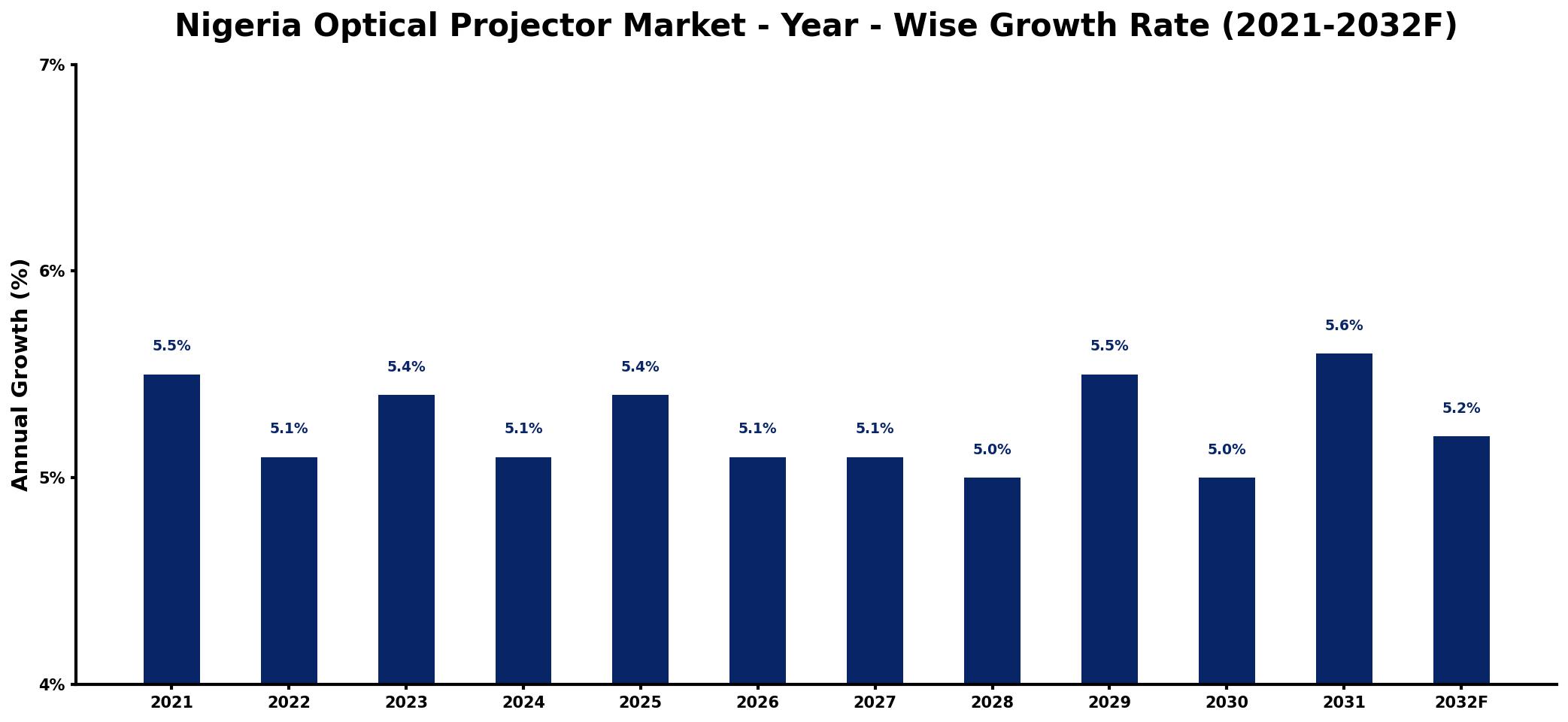
The table below presents the year‑wise growth rates along with the key drivers influencing the market
| Year | Growth Rate | Major Drivers |
| 2021 | 5.5% | Rising consumer electronics demand |
| 2022 | 5.1% | Increased educational technology investments |
| 2023 | 5.4% | Growing corporate presentation needs |
| 2024 | 5.1% | Expansion of home entertainment market |
| 2025 | 5.4% | Surge in event management services |
| 2026 | 5.1% | Development of smart city projects |
| 2027 | 5.1% | Enhanced digital advertising strategies |
| 2028 | 5.0% | Growth in remote learning solutions |
| 2029 | 5.5% | Increase in cultural event productions |
| 2030 | 5.0% | Boost in virtual reality applications |
| 2031 | 5.6% | rising export shipment volumes |
| 2032 | 5.2% | Rising popularity of immersive experiences |
Note: Market size estimations and growth projections presented in this report are based on 6Wresearch's proprietary forecasting methodology, utilizing the latest available industry data, government publications, and primary research inputs.
Nigeria Optical Projector Market Synopsis
The Nigerian landscape is witnessing a paradigm shift in how presentations are delivered, moving from traditional means to modern optical projectors. With a growing focus on enhancing educational infrastructure and digital learning, institutions are keen to invest in innovative solutions that foster engagement and knowledge transfer.
Furthermore, as businesses adopt digital strategies, the use of projectors in corporate settings is gaining traction. Boardrooms are becoming more sophisticated, necessitating reliable and advanced projection systems to ensure effective presentations and communication across various platforms.
Nigeria Optical Projector Market Key Takeaways
- Significant investment in education and business sectors is fueling the demand for optical projectors in Nigeria.
- Technological advancements in projectors, such as improved brightness and resolution, are enhancing user experience.
- Government initiatives aimed at upgrading digital infrastructure are creating opportunities for projector vendors.
- Challenges related to affordability and limited awareness hinder the broader adoption of projector technologies.
- The market presents opportunities for suppliers to introduce cost-effective and innovative projection solutions.
Evaluation of Restraints in Nigeria Optical Projector Market
The Nigeria Optical Projector Market, while poised for growth, faces significant challenges that restrict its full potential. One of the primary obstacles is the high cost associated with importing projector technologies, compounded by fluctuating currency values and high tariffs. These financial barriers render projectors less accessible for many educational institutions and small to medium-sized businesses. Additionally, there exists a notable gap in awareness regarding the full capabilities of modern projector technology. This limited understanding prevents many potential users from realizing the benefits of investing in advanced optical projectors, thereby slowing market penetration.
Nigeria Optical Projector Market Trends
A noticeable trend in the Nigerian optical projector market is the shift towards eco-friendly, energy-efficient models. As sustainability becomes a priority for many organizations, the demand for projectors that minimize energy consumption is increasing. Moreover, interactive projectors are gaining popularity, particularly in educational settings where they enhance student participation and engagement. Innovations in wireless connectivity and compatibility with various multimedia formats are also shaping how users integrate projectors into their presentations, making them more versatile than ever.
Nigeria Optical Projector Market Opportunities
The optical projector market in Nigeria presents numerous opportunities for growth and investment. As educational institutions continue to seek modern teaching aids, suppliers have the potential to fill gaps with innovative and tailored solutions. Furthermore, the corporate sector's demand for high-quality presentation tools opens avenues for advanced projectors that facilitate seamless integration with digital platforms. The government's push towards digital literacy and technology in education also sets the stage for projector vendors to engage more actively with schools and universities, enhancing their market footprint.
Government Initiatives in the Nigeria Optical Projector Market
The Nigerian government is actively implementing initiatives to enhance digital learning and educational infrastructure. This includes potential policies aimed at increasing investment in multimedia facilities across educational institutions and public venues. By fostering an environment conducive to technology adoption, the government creates a favorable landscape for the optical projector market to thrive, encouraging public-private partnerships and investment in quality projection equipment that meets regulatory standards for safety and performance.
Future Insights of the Nigeria Optical Projector Market
Looking ahead to the period between 2026 and 2032, the Nigeria Optical Projector Market is set for substantial growth driven by ongoing technological advancements and increasing digital adoption across various sectors. As educational institutions and businesses continue to prioritize effective communication tools, the demand for high-quality projectors will intensify. Moreover, as the government pushes forward with policies aimed at improving educational infrastructure, market players are likely to see enhanced opportunities to cater to a more aware and tech-savvy customer base, thus propelling the market into a new phase of development.
Nigeria Optical Projector Market Latest Developments (2025 - 2026)
Recent developments in the Nigeria optical projector market indicate a growing interest from local businesses in adopting digital solutions that enhance productivity and presentation quality. There is an observable increase in workshops and seminars aimed at educating stakeholders on the benefits and applications of modern optical projectors. Additionally, collaborations between educational institutions and technology vendors are on the rise, suggesting a concerted effort to integrate advanced projection technologies into classrooms and training environments.
Nigeria Optical Projector Market - Key Attractiveness of the Report
- 10 Years of Market Numbers
- Historical Data Starting from 2022 to 2025
- Base Year: 2025
- Forecast Data until 2032
- Key Performance Indicators Impacting the Market
- Major Upcoming Developments and Projects
Key Highlights of the Report:
- Nigeria Optical Projector Market Outlook
- Market Size of Nigeria Optical Projector Market, 2025
- Forecast of Nigeria Optical Projector Market, 2032
- Historical Data and Forecast of Nigeria Optical Projector Revenues & Volume for the Period 2022-2032F
- Nigeria Optical Projector Market Trend Evolution
- Nigeria Optical Projector Market Drivers and Challenges
- Nigeria Optical Projector Price Trends
- Nigeria Optical Projector Porter's Five Forces
- Nigeria Optical Projector Industry Life Cycle
- Historical Data and Forecast of Nigeria Optical Projector Market Revenues & Volume By Type for the Period 2022-2032F
- Historical Data and Forecast of Nigeria Optical Projector Market Revenues & Volume By Digital Light Processing (DLP) for the Period 2022-2032F
- Historical Data and Forecast of Nigeria Optical Projector Market Revenues & Volume By Liquid Crystal Display (LCD) for the Period 2022-2032F
- Historical Data and Forecast of Nigeria Optical Projector Market Revenues & Volume By Liquid Crystal on Silicon (LCoS) for the Period 2022-2032F
- Historical Data and Forecast of Nigeria Optical Projector Market Revenues & Volume By Application for the Period 2022-2032F
- Historical Data and Forecast of Nigeria Optical Projector Market Revenues & Volume By Residential for the Period 2022-2032F
- Historical Data and Forecast of Nigeria Optical Projector Market Revenues & Volume By Commercial for the Period 2022-2032F
- Historical Data and Forecast of Nigeria Optical Projector Market Revenues & Volume By Industrial for the Period 2022-2032F
- Nigeria Optical Projector Import Export Trade Statistics
- Market Opportunity Assessment By Type
- Market Opportunity Assessment By Application
- Nigeria Optical Projector Top Companies Market Share
- Nigeria Optical Projector Competitive Benchmarking By Technical and Operational Parameters
- Nigeria Optical Projector Company Profiles
- Nigeria Optical Projector Key Strategic Recommendations






































