Nigeria Photosensitive Semiconductor Device Market Size, Share & Growth Rate
The Nigeria Photosensitive Semiconductor Device Market was estimated at USD 1053 Million in 2025 and is projected to reach USD 1958 Million by 2032, growing at a CAGR of 9.3% from 2026 to 2032. This robust growth is driven by the surging demand for consumer electronics such as smartphones and digital cameras, coupled with the increasing prevalence of security systems across urban areas. As urbanization accelerates and the middle-class population expands, the need for advanced technologies in various sectors further propels the market's positive trajectory.
Nigeria Photosensitive Semiconductor Device Market Year-wise Growth Rate and Key Drivers
This graph highlights how the Nigeria Photosensitive Semiconductor Device Market has steadily grown over the years, supported by major growth factors.
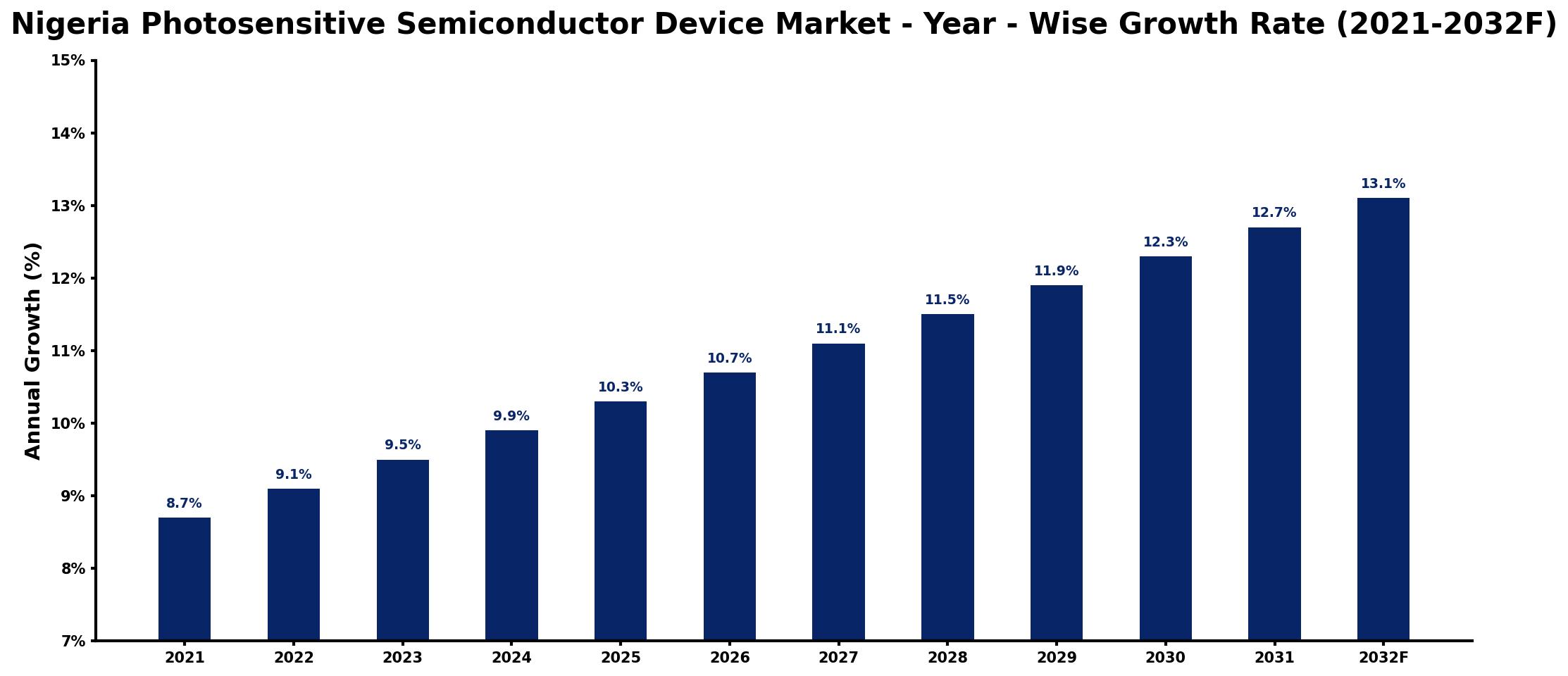
The table below presents the year‑wise growth rates along with the key drivers influencing the market
| Year | Growth Rate | Major Drivers |
| 2021 | 8.7% | Rising renewable energy investments |
| 2022 | 9.1% | Increased adoption in agriculture |
| 2023 | 9.5% | Expansion of smart grid technologies |
| 2024 | 9.9% | Growing demand for energy efficiency |
| 2025 | 10.3% | Surge in automotive electronics applications |
| 2026 | 10.7% | Enhanced focus on environmental sustainability |
| 2027 | 11.1% | Rapid urbanization driving infrastructure growth |
| 2028 | 11.5% | Technological advancements in automation |
| 2029 | 11.9% | Increase in telecommunications infrastructure |
| 2030 | 12.3% | Boost in consumer electronics market |
| 2031 | 12.7% | Growing interest in IoT solutions |
| 2032 | 13.1% | Emerging trends in smart cities |
Note: Market size estimations and growth projections presented in this report are based on 6Wresearch's proprietary forecasting methodology, utilizing the latest available industry data, government publications, and primary research inputs.
Nigeria Photosensitive Semiconductor Device Market Synopsis
The Nigerian market for photosensitive semiconductor devices is on the rise, largely influenced by advancements in technology and rising consumer expectations for quality and efficiency. As automotive manufacturers integrate these components into advanced driver-assistance systems, the market is witnessing a transformative shift that enhances both safety and performance.
Moreover, the healthcare sector is increasingly utilizing photosensitive devices for diagnostics and monitoring, revealing a significant cross-industry adoption. This diversification of applications reflects the growing importance of photosensitive technologies, embedding them further into everyday life and industrial processes.
Nigeria Photosensitive Semiconductor Device Market Key Takeaways
- The market is characterized by rapid technological advancements in image sensors and photodiodes.
- Urbanization and a growing middle class are critical drivers of demand for advanced electronics.
- Increased focus on energy-efficient solutions is promoting the adoption of these devices.
- Security concerns are leading to higher demand for surveillance and biometric systems.
- Regulatory support for local manufacturing is expected to bolster market growth.
Evaluation of Restraints in Nigeria Photosensitive Semiconductor Device Market
The Nigeria Photosensitive Semiconductor Device Market faces challenges primarily linked to its dependence on imports, as local manufacturing capabilities remain limited. This reliance renders the market susceptible to global supply chain disruptions, which can impact availability and pricing of critical components. Additionally, inconsistent power supply and infrastructural issues pose significant hurdles, affecting the performance and reliability of photosensitive devices. Furthermore, the slow adoption of advanced technologies among local consumers and businesses, combined with regulatory obstacles, hampers market expansion opportunities.
Nigeria Photosensitive Semiconductor Device Market Trends
Current trends in the Nigeria Photosensitive Semiconductor Device Market are leaning towards enhanced performance capabilities, particularly in high-resolution imaging and sensitivity in photodiodes. There's an increasing inclination towards integrating artificial intelligence and the Internet of Things into products, which creates a demand for smarter, more efficient photosensitive devices. The automotive sector's shift towards safety and automation underscores the necessity for advanced driver-assistance technologies, further embedding photosensitive devices into everyday automotive applications.
Nigeria Photosensitive Semiconductor Device Market Opportunities
The expanding consumer electronics market offers enticing investment avenues for photosensitive semiconductor device manufacturers. With Nigerias automotive industry poised for growth and the government's promotion of local manufacturing, opportunities for establishing domestic production facilities abound. This presents a unique chance for investors interested in engaging with innovative companies focused on R&D and advanced technology applications in the fields of IoT and artificial intelligence.
Government Initiatives in the Nigeria Photosensitive Semiconductor Device Market
The Nigerian government has rolled out various initiatives aimed at fostering the growth of the Photosensitive Semiconductor Device Market. The National Industrial Revolution Plan (NIRP) emphasizes local manufacturing and incentivizes companies with tax breaks and import duty waivers to stimulate industry participation. Additionally, regulatory bodies like the National Information Technology Development Agency (NITDA) are instrumental in promoting technological advancements, creating a favorable environment for semiconductor development.
Future Insights of the Nigeria Photosensitive Semiconductor Device Market
Looking ahead to 2026-2032, the Nigeria Photosensitive Semiconductor Device Market is poised for significant expansion. Increasing demand for consumer electronics and the integration of IoT devices in both industrial and domestic applications will drive this growth. Furthermore, advancements in semiconductor technologies that lead to more efficient and cost-effective devices will play a pivotal role. However, stakeholders must navigate potential challenges, such as fluctuating raw material prices and counterfeiting issues, to fully capitalize on the market's potential.
Nigeria Photosensitive Semiconductor Device Market Latest Developments (2025 - 2026)
Recent developments in the Nigeria Photosensitive Semiconductor Device Market indicate a rising focus on enhancing local manufacturing capabilities. Many companies are exploring partnerships aimed at boosting production efficiency and reducing reliance on imports. Additionally, technological innovations in photonic devices are gaining traction, aimed at improving the performance metrics of various applications in consumer electronics and automotive sectors.
Nigeria Photosensitive Semiconductor Device Market - Key Attractiveness of the Report
- 10 Years of Market Numbers
- Historical Data Starting from 2022 to 2025
- Base Year: 2025
- Forecast Data until 2032
- Key Performance Indicators Impacting the Market
- Major Upcoming Developments and Projects
Key Highlights of the Report:
- Nigeria Photosensitive Semiconductor Device Market Outlook
- Market Size of Nigeria Photosensitive Semiconductor Device Market, 2025
- Forecast of Nigeria Photosensitive Semiconductor Device Market, 2032
- Historical Data and Forecast of Nigeria Photosensitive Semiconductor Device Revenues & Volume for the Period 2022-2032F
- Nigeria Photosensitive Semiconductor Device Market Trend Evolution
- Nigeria Photosensitive Semiconductor Device Market Drivers and Challenges
- Nigeria Photosensitive Semiconductor Device Price Trends
- Nigeria Photosensitive Semiconductor Device Porter's Five Forces
- Nigeria Photosensitive Semiconductor Device Industry Life Cycle
- Historical Data and Forecast of Nigeria Photosensitive Semiconductor Device Market Revenues & Volume By Device for the Period 2022-2032F
- Historical Data and Forecast of Nigeria Photosensitive Semiconductor Device Market Revenues & Volume By Photocell for the Period 2022-2032F
- Historical Data and Forecast of Nigeria Photosensitive Semiconductor Device Market Revenues & Volume By Photodiode for the Period 2022-2032F
- Historical Data and Forecast of Nigeria Photosensitive Semiconductor Device Market Revenues & Volume By Phototransistor for the Period 2022-2032F
- Historical Data and Forecast of Nigeria Photosensitive Semiconductor Device Market Revenues & Volume By Photoresistor for the Period 2022-2032F
- Historical Data and Forecast of Nigeria Photosensitive Semiconductor Device Market Revenues & Volume By Photo IC for the Period 2022-2032F
- Historical Data and Forecast of Nigeria Photosensitive Semiconductor Device Market Revenues & Volume By End User for the Period 2022-2032F
- Historical Data and Forecast of Nigeria Photosensitive Semiconductor Device Market Revenues & Volume By Automotive and Transportation for the Period 2022-2032F
- Historical Data and Forecast of Nigeria Photosensitive Semiconductor Device Market Revenues & Volume By Consumer Electronics for the Period 2022-2032F
- Historical Data and Forecast of Nigeria Photosensitive Semiconductor Device Market Revenues & Volume By Aerospace and Defence for the Period 2022-2032F
- Historical Data and Forecast of Nigeria Photosensitive Semiconductor Device Market Revenues & Volume By Healthcare for the Period 2022-2032F
- Historical Data and Forecast of Nigeria Photosensitive Semiconductor Device Market Revenues & Volume By Industrial for the Period 2022-2032F
- Historical Data and Forecast of Nigeria Photosensitive Semiconductor Device Market Revenues & Volume By Security and Survelliance for the Period 2022-2032F
- Nigeria Photosensitive Semiconductor Device Import Export Trade Statistics
- Market Opportunity Assessment By Device
- Market Opportunity Assessment By End User
- Nigeria Photosensitive Semiconductor Device Top Companies Market Share
- Nigeria Photosensitive Semiconductor Device Competitive Benchmarking By Technical and Operational Parameters
- Nigeria Photosensitive Semiconductor Device Company Profiles
- Nigeria Photosensitive Semiconductor Device Key Strategic Recommendations






































