Nigeria Plastic Waste Management Market Size, Share & Growth Rate
The Nigeria Plastic Waste Management Market was estimated at USD 493 Million in 2025 and is projected to reach USD 666 Million by 2032, growing at a CAGR of 4.4% from 2026 to 2032. This growth trajectory is primarily fueled by increasing public awareness regarding environmental sustainability, as well as the implementation of stringent regulations aimed at reducing plastic waste. Additionally, the rising adoption of innovative recycling technologies and waste-to-energy initiatives is helping to shape a more sustainable plastic waste management landscape in Nigeria.
Nigeria Plastic Waste Management Market Year-wise Growth Rate and Key Drivers
This graph highlights how the Nigeria Plastic Waste Management Market has steadily grown over the years, supported by major growth factors.
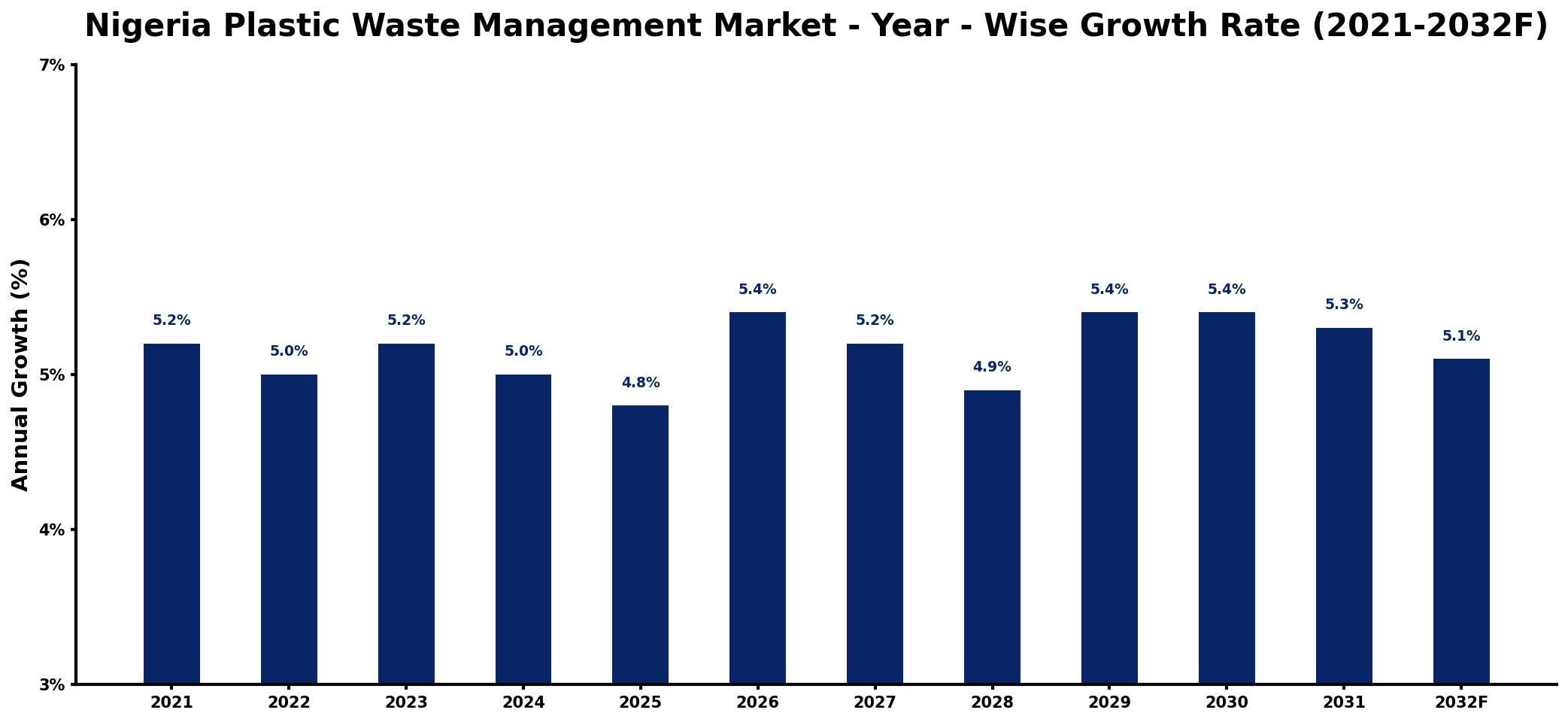
The table below presents the year‑wise growth rates along with the key drivers influencing the market
| Year | Growth Rate | Major Drivers |
| 2021 | 5.2% | Increased investment in recycling infrastructure |
| 2022 | 5.0% | Growing public awareness campaigns |
| 2023 | 5.2% | Expansion of eco-friendly initiatives |
| 2024 | 5.0% | Rising demand for sustainable solutions |
| 2025 | 4.8% | Enhanced regulatory compliance requirements |
| 2026 | 5.4% | Development of advanced recycling technologies |
| 2027 | 5.2% | Surge in corporate sustainability commitments |
| 2028 | 4.9% | Strengthening community engagement efforts |
| 2029 | 5.4% | Boost in international partnerships formed |
| 2030 | 5.4% | Heightened consumer preference for alternatives |
| 2031 | 5.3% | Increase in government funding allocations |
| 2032 | 5.1% | Emergence of innovative recycling startups |
Note: Market size estimations and growth projections presented in this report are based on 6Wresearch's proprietary forecasting methodology, utilizing the latest available industry data, government publications, and primary research inputs.
Nigeria Plastic Waste Management Market Synopsis
In recent years, the Nigeria Plastic Waste Management market has gained significant momentum, largely driven by a shift in consumer attitudes towards environmental responsibility. Stakeholders are increasingly prioritizing the development of effective waste collection and recycling mechanisms. As a result, the market is now poised for greater expansion, with a clearer focus on integrating circular economy principles to combat the plastic waste crisis.
Looking forward, the market is expected to evolve further, with more companies investing in advanced recycling facilities and innovative disposal solutions. Collaborative efforts between public and private sectors will play a crucial role in enhancing waste management infrastructure, thereby addressing the critical challenges of plastic pollution in Nigeria.
Nigeria Plastic Waste Management Market Key Takeaways
- The market is projected to grow significantly, fueled by increased environmental awareness and regulatory frameworks.
- Investment opportunities abound in recycling technologies and waste management infrastructure.
- Public-private partnerships are essential for improving waste collection and management practices.
- Consumer demand for eco-friendly products is pushing companies to adopt sustainable practices.
- Regulatory initiatives, such as the Extended Producer Responsibility program, are gaining traction to hold manufacturers accountable.
Evaluation of Restraints in Nigeria Plastic Waste Management Market
Despite the positive outlook, the Nigeria Plastic Waste Management market faces several constraints that may hinder its growth. Inadequate infrastructure for waste collection and recycling presents a major obstacle, limiting the effectiveness of waste management efforts. Additionally, the general population's limited awareness regarding proper waste disposal practices exacerbates the problem, contributing to high levels of pollution. Furthermore, the informal nature of many waste collection operations, coupled with insufficient resources for large-scale recycling facilities, poses a challenge to achieving a sustainable waste management ecosystem.
Nigeria Plastic Waste Management Market Trends
Several trends are currently shaping the Nigeria Plastic Waste Management market. A growing emphasis on circular economy principles is evident, with stakeholders actively seeking innovative solutions such as recycling, upcycling, and waste-to-energy technologies. Additionally, heightened consumer awareness around the environmental impact of plastic waste is leading to increased demand for eco-friendly products and packaging. The market is also witnessing a surge in collaborations among various sectors to enhance waste management infrastructure and improve public awareness campaigns regarding waste disposal.
Nigeria Plastic Waste Management Market Opportunities
The Nigeria Plastic Waste Management Market presents a wealth of investment opportunities for stakeholders looking to engage in sustainable practices. Areas such as recycling facilities, waste collection and sorting infrastructure, and plastic-to-fuel technologies are ripe for development. Companies focused on sustainable product design and extended producer responsibility programs can find attractive prospects in this evolving landscape. Overall, the market promises not only financial returns but also meaningful contributions to mitigating environmental challenges associated with plastic waste.
Government Initiatives in the Nigeria Plastic Waste Management Market
The Nigerian government has taken proactive steps to address the pressing issue of plastic waste management. Through the National Environmental Standards and Regulations Enforcement Agency (NESREA), it enforces regulations aimed at enhancing waste management practices, including the Extended Producer Responsibility (EPR) program. Recent bans on the production and use of thin plastic bags demonstrate the governments commitment to reducing environmental impact. Ongoing campaigns promoting recycling and waste separation reflect the government's holistic approach towards improving plastic waste management in Nigeria.
Future Insights of the Nigeria Plastic Waste Management Market
The future outlook for the Nigeria Plastic Waste Management Market is promising, underpinned by a collective drive towards sustainability and enhanced waste management practices. Innovations in technology and rising collaborations between public and private entities are likely to strengthen the markets infrastructure. As regulatory measures continue to evolve and public awareness rises, there will be an increased emphasis on efficient recycling and disposal solutions. This shift is expected to accelerate investments in advanced waste management strategies and technologies, fostering a more sustainable approach to plastic waste in Nigeria.
Nigeria Plastic Waste Management Market Latest Developments (2025 - 2026)
In the past year, there has been a marked focus on innovative waste management technologies, with new initiatives being launched to address Nigeria's plastic pollution challenges. Collaborative efforts between local governments and private sectors have been pivotal in enhancing recycling capacities and improving waste collection efficiency. Awareness campaigns aimed at educating the public about sustainable waste disposal practices have also gained traction, further solidifying the shift towards a more environmentally responsible approach to plastic waste management in the country.
Nigeria Plastic Waste Management Market - Key Attractiveness of the Report
- 10 Years of Market Numbers
- Historical Data Starting from 2022 to 2025
- Base Year: 2025
- Forecast Data until 2032
- Key Performance Indicators Impacting the Market
- Major Upcoming Developments and Projects
Key Highlights of the Report:
- Nigeria Plastic Waste Management Market Outlook
- Market Size of Nigeria Plastic Waste Management Market, 2025
- Forecast of Nigeria Plastic Waste Management Market, 2032
- Historical Data and Forecast of Nigeria Plastic Waste Management Revenues & Volume for the Period 2022-2032F
- Nigeria Plastic Waste Management Market Trend Evolution
- Nigeria Plastic Waste Management Market Drivers and Challenges
- Nigeria Plastic Waste Management Price Trends
- Nigeria Plastic Waste Management Porter's Five Forces
- Nigeria Plastic Waste Management Industry Life Cycle
- Historical Data and Forecast of Nigeria Plastic Waste Management Market Revenues & Volume By Source for the Period 2022-2032F
- Historical Data and Forecast of Nigeria Plastic Waste Management Market Revenues & Volume By Industrial Waste for the Period 2022-2032F
- Historical Data and Forecast of Nigeria Plastic Waste Management Market Revenues & Volume By Municipal Waste for the Period 2022-2032F
- Historical Data and Forecast of Nigeria Plastic Waste Management Market Revenues & Volume By Material for the Period 2022-2032F
- Historical Data and Forecast of Nigeria Plastic Waste Management Market Revenues & Volume By Polyethylene for the Period 2022-2032F
- Historical Data and Forecast of Nigeria Plastic Waste Management Market Revenues & Volume By Polypropylene for the Period 2022-2032F
- Historical Data and Forecast of Nigeria Plastic Waste Management Market Revenues & Volume By Polyethylene Terephthalate for the Period 2022-2032F
- Historical Data and Forecast of Nigeria Plastic Waste Management Market Revenues & Volume By Polystyrene for the Period 2022-2032F
- Historical Data and Forecast of Nigeria Plastic Waste Management Market Revenues & Volume By Others for the Period 2022-2032F
- Historical Data and Forecast of Nigeria Plastic Waste Management Market Revenues & Volume By Product Type for the Period 2022-2032F
- Historical Data and Forecast of Nigeria Plastic Waste Management Market Revenues & Volume By Packaging for the Period 2022-2032F
- Historical Data and Forecast of Nigeria Plastic Waste Management Market Revenues & Volume By Construction for the Period 2022-2032F
- Historical Data and Forecast of Nigeria Plastic Waste Management Market Revenues & Volume By Automotive for the Period 2022-2032F
- Historical Data and Forecast of Nigeria Plastic Waste Management Market Revenues & Volume By Electrical & Electronics for the Period 2022-2032F
- Historical Data and Forecast of Nigeria Plastic Waste Management Market Revenues & Volume By Others for the Period 2022-2032F
- Historical Data and Forecast of Nigeria Plastic Waste Management Market Revenues & Volume By Treatment Method for the Period 2022-2032F
- Historical Data and Forecast of Nigeria Plastic Waste Management Market Revenues & Volume By Collection for the Period 2022-2032F
- Historical Data and Forecast of Nigeria Plastic Waste Management Market Revenues & Volume By Recycling for the Period 2022-2032F
- Historical Data and Forecast of Nigeria Plastic Waste Management Market Revenues & Volume By Disposal for the Period 2022-2032F
- Nigeria Plastic Waste Management Import Export Trade Statistics
- Market Opportunity Assessment By Source
- Market Opportunity Assessment By Material
- Market Opportunity Assessment By Product Type
- Market Opportunity Assessment By Treatment Method
- Nigeria Plastic Waste Management Top Companies Market Share
- Nigeria Plastic Waste Management Competitive Benchmarking By Technical and Operational Parameters
- Nigeria Plastic Waste Management Company Profiles
- Nigeria Plastic Waste Management Key Strategic Recommendations






































