Nigeria Prepaid Cards Market Top 5 Importing Countries and Market Competition (HHI) Analysis
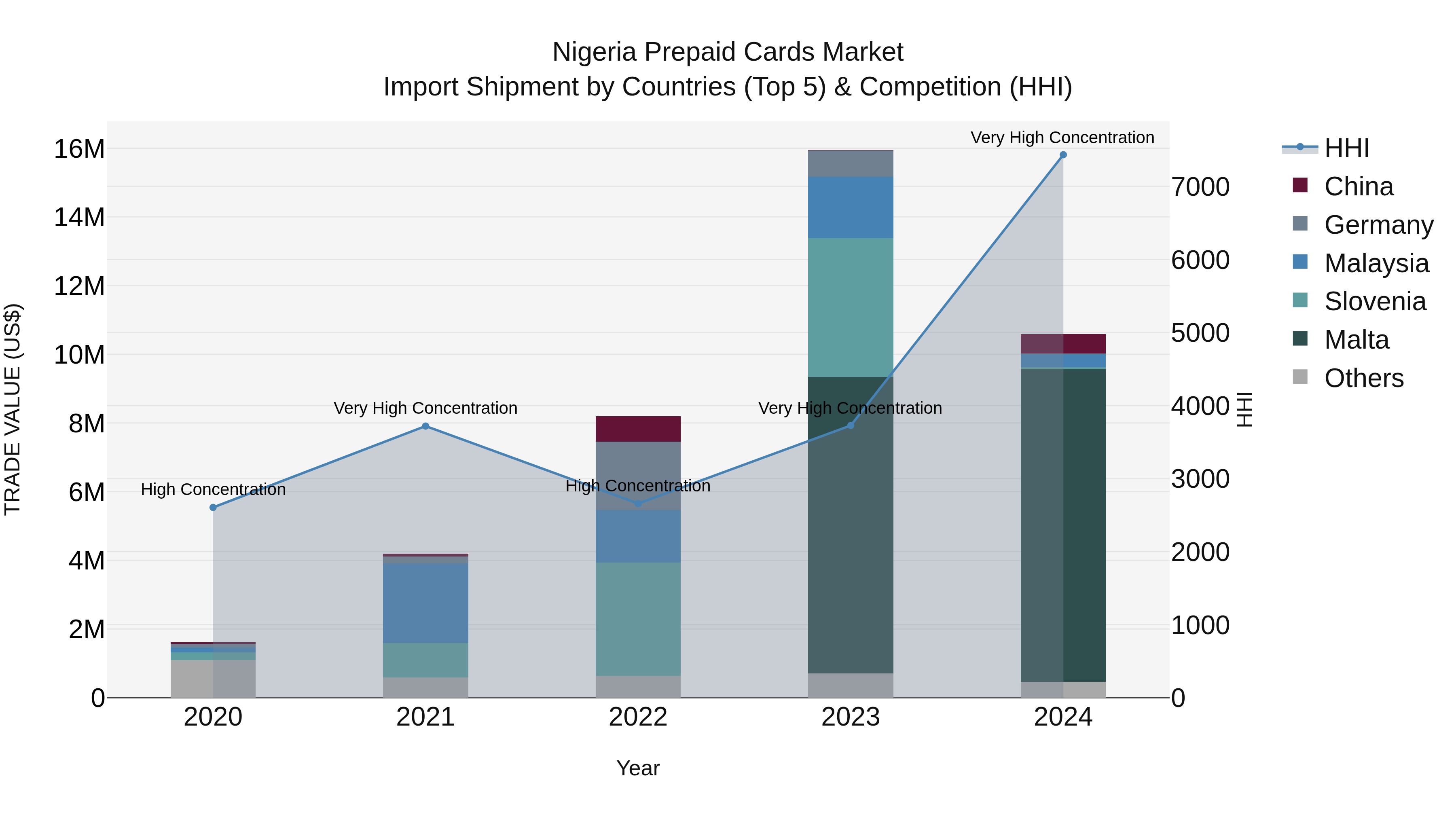
The Nigeria prepaid cards import market in 2024 continued to be dominated by a few key exporting countries, including Malta, China, Malaysia, USA, and South Korea. The high Herfindahl-Hirschman Index (HHI) indicates a concentrated market structure. Despite the impressive compound annual growth rate (CAGR) of 60.1% from 2020 to 2024, there was a significant decline in growth rate from 2023 to 2024, with a decrease of -33.58%. This suggests a potential shift or adjustment in market dynamics that importers and stakeholders should monitor closely for future business strategies.
Nigeria Prepaid Cards Market Growth Rate
According to 6Wresearch internal database and industry insights, the Nigeria Prepaid Cards Market is projected to grow at a compound annual growth rate (CAGR) of 10.5% during the forecast period from 2026 to 2032.
Topics Covered in the Nigeria Prepaid Cards Market Report
The Nigeria Prepaid Cards Market report thoroughly covers the market by offering type, card type, and end user providing an unbiased and detailed analysis of ongoing market trends, opportunities, challenges, and market drivers, helping stakeholders align their strategies with current and future market dynamics.
Nigeria Prepaid Cards Market Highlights
| Report Name | Nigeria Prepaid Cards Market |
| Forecast period | 2026–2032 |
| CAGR | 10.5% |
| Growing Sector | Prepaid Cards |
Nigeria Prepaid Cards Market Synopsis
The Nigeria Prepaid Cards Market is experiencing significant growth as more people in the country use cashless payment methods which people need as they want payment methods that are both safe and easy to use. The market expansion receives additional support from the rising use of prepaid cards which people use for e-commerce, government disbursements, payrolls and incentives. Prepaid card market development receives backing from financial inclusion programs which create investment opportunities and drive product innovation as these cards enable people to manage their money without needing a bank account.
Evaluation of Growth Drivers in the Nigeria Prepaid Cards Market
Below mentioned are some prominent drivers and their impact on the market dynamics:
| Drivers | Primary Segments Affected | Why It Matters (Evidence) |
| Growing Demand for Digital Payments | General Purpose Card, Gift Card, Government Benefit/Disbursement Card | Prepaid cards are increasingly used for secure digital payments, especially for e-commerce transactions and online services. |
| Financial Inclusion Initiatives | Government Benefit/Disbursement Card, Corporate, Retail | Government programs aimed at increasing financial inclusion are expanding prepaid card usage in underserved communities. |
| Increase in Payroll & Incentive Cards | Incentive/Payroll Card, Corporate | Companies are opting for prepaid cards to handle payroll and incentive disbursements, boosting payment efficiency. |
| Government Focus on Digital Payments | Government Benefit/Disbursement Card, Retail | Authorities view this as a step toward higher financial and legal transparency, as well as greater accessibility. |
| Growth of E-Commerce | General Purpose Card, Gift Card, Corporate | The surge in e-commerce is driving demand for prepaid cards as a secure and preferred payment method. |
The Nigeria Prepaid Cards Market Size is projected to grow at a CAGR of 10.5% from 2026 to 2032. The rising trend of prepaid card usage for payroll, incentive payments and government disbursements continue to grow as people now prefer to use cashless payment systems which government programs enable them to access. The e-commerce industry growth creates this trend as it offers businesses and consumers a secure and flexible payment solution that functions as a trustworthy system. Prepaid cards function as a dependable solution for handling financial transactions as their usage increases with the demand for efficient cashless payment methods which help people adopt digital payment systems.
Evaluation of Restraints in the Nigeria Prepaid Cards Market
Below mentioned are some major restraints and their influence on the market dynamics:
| Restraints | Primary Segments Affected | What This Means (Evidence) |
| Low Financial Literacy | General Purpose Card, Gift Card, Corporate | Lack of understanding of prepaid card benefits can limit their widespread adoption. |
| Lack of Infrastructure | General Purpose Card, Government Benefit/Disbursement Card | In rural areas, inadequate digital infrastructure may slow the adoption of prepaid cards. |
| High Transaction Fees | General Purpose Card, Incentive/Payroll Card | High transaction fees might be regarded as unfavorable for price-conscious consumers, reducing the attractiveness of prepaid cards. |
| Regulatory and Compliance Issues | All Segments | Strict regulatory measures and compliance requirements could raise operational costs for prepaid card issuers. |
| Security Concerns | General Purpose Card, Gift Card, Corporate | Concerns over fraud and misuse of prepaid cards may limit their use among cautious consumers. |
Nigeria Prepaid Cards Market Challenges
The Nigeria Prepaid Cards Industry faces challenges through two main factors which include low financial literacy and infrastructure gaps that exist in underserved regions. Users will avoid using prepaid card solutions owing to their security concerns and expensive transaction fees. The market needs to solve these problems through three main activities which include financial literacy improvement, infrastructure development, creation of secure and affordable consumer solutions. Moreover, the parties involved in this process include government agencies, card issuing companies and financial institutions those who need to work together to solve these problems.
Nigeria Prepaid Cards Market Trends
Here are some major trends changing the Nigeria Prepaid Cards Market Growth dynamics:
- Shift Toward Cashless Payments: The people of Nigeria are increasingly adopting cashless payment methods as they have become more aware of cashless payment systems and since infrastructure improvements have made these systems more accessible.
- Government-Led Financial Inclusion Initiatives: The Nigerian government is focusing on increasing financial inclusion through prepaid card solutions, particularly for low-income groups and those without access to traditional banking services.
- Surge in E-Commerce Transactions: Prepaid cards now serve as the most popular payment option for online shopping as e-commerce continues to expand. The payment method provides two advantages for online shopping it delivers protection for customers and it enables them to make purchases.
Investment Opportunities in the Nigeria Prepaid Cards Market
The Nigeria Prepaid Cards Market presents several investment opportunities, including:
- Development of Prepaid Card Solutions: The company develops advanced prepaid card products which will be used in e-commerce payments, payroll systems and government disbursement processes.
- Expansion of Financial Inclusion Programs: The organization works to spread prepaid card usage in remote areas which will help people access financial services.
- E-Commerce Integration: The corporation involves in developing prepaid card solutions for online shopping. These prepaid cards include all enhanced security features along with the compatibility to recent online shopping web platforms.
Top 5 Leading Players in the Nigeria Prepaid Cards Market
Below is the list of prominent companies leading the Nigeria Prepaid Cards Market Share:
1. Zenith Bank
| Company Name | Zenith Bank |
| Headquarters | Lagos, Nigeria |
| Established | 1990 |
| Website | - |
Zenith Bank remains the top issuer in Nigeria by circulation numbers for 2026. The bank offers a diverse range of prepaid solutions, including the Zenith Mastercard and Visa prepaid cards, which are widely used for international web transactions, POS payments, and travel.
2. United Bank for Africa (UBA)
| Company Name | United Bank for Africa (UBA) |
| Headquarters | Lagos, Nigeria |
| Established | 1949 |
| Website | Click Here |
UBA is a pioneer in the prepaid space with its "Africard," a Visa-branded card that does not require a bank account. It is a preferred choice for cross-border e-commerce and freelancers due to its seamless integration with international platforms like PayPal and Amazon.
3. Interswitch (Verve)
| Company Name | Interswitch (Verve) |
| Headquarters | Lagos, Nigeria |
| Established | 2002 |
| Website | Click Here |
Interswitch operates Verve, the most used domestic payment card scheme in Nigeria. Their prepaid offerings are essential for local transactions, government social investment disbursements, and closed-loop transport systems like the Lagos BRT (cowry card) network.
4. Chipper Cash
| Company Name | Chipper Cash |
| Headquarters | San Francisco, California, USA (Major Nigeria Operations) |
| Established | 2018 |
| Website | Click Here |
As a leading fintech, Chipper Cash provides virtual and physical Visa prepaid cards that have gained massive traction in 2026. These cards are highly favored by the tech-savvy population for paying for global subscriptions such as Netflix, Starlink, and Apple Music.
5. ALAT by Wema
| Company Name | ALAT by Wema |
| Headquarters | Lagos, Nigeria |
| Established | 2017 (Wema Bank established 1945) |
| Website | Click Here |
ALAT, Nigeria's first fully digital bank, offers a popular virtual dollar prepaid card. It allows users to fund their cards directly from their Naira accounts to perform international transactions on Shopify, Amazon, and various advertising platforms without the limitations of traditional debit cards.
Government Regulations Introduced in the Nigeria Prepaid Cards Market
According to Nigerian government data, the Central Bank of Nigeria (CBN) regulates the prepaid card market, setting guidelines for issuance, usage, and security. These regulations enhance financial transaction security and encourage the adoption of prepaid cards for e-commerce, payroll, and government benefits. In partnership with financial institutions, the Nigerian government is improving access to prepaid card solutions, fostering financial inclusion, and ensuring the safety of consumer funds. The government operates programs through two specific initiatives which include the Npower program that provides prepaid card payments and the Cashless Nigeria Policy which promotes digital payment methods to decrease cash usage.
Future Insights of the Nigeria Prepaid Cards Market
The Nigeria Prepaid Cards Market shows positive prospects owing to digital payment improvements together with government programs and e-commerce expansion drive market growth. The market will experience continuous development as financial inclusion programs and growing needs for secure cashless payment methods create demand. Furthermore, the market will expand through the development of new prepaid card solutions which businesses, retail stores and government entities will use. The demand for prepaid cards will grow throughout the upcoming years since more people begin using digital payment methods.
Market Segmentation Analysis
The report offers a comprehensive study of the following market segments and their leading categories:
By Offering - General Purpose Card to Dominate the Market
According to Ritika Kalra, Senior Research Analyst, 6Wresearch, the Nigeria Prepaid Cards Market will be dominated by General Purpose Cards as these cards can be used for all types of personal and business financial needs. The cards provide consumers with flexible options as they can be used to make online purchases, pay bills and manage their finances.
By Card Type - Open Loop Card to Dominate the Market
Open Loop Cards are expected to dominate the market, given their broad acceptance across various platforms and merchants, both domestically and internationally. These cards provide users with the ability to make payments without being limited to a specific network.
By End User - Retail to Dominate the Market
The retail sector will emerge as the top end-user segment since e-commerce expansion will increase demand for prepaid cards which function as safe and easy payment methods for online shopping.
Key Attractiveness of the Report
- 10 Years of Market Numbers.
- Historical Data Starting from 2022 to 2025.
- Base Year: 2025.
- Forecast Data until 2032.
- Key Performance Indicators Impacting the Market.
- Major Upcoming Developments and Projects.
Key Highlights of the Report:
- Nigeria Prepaid Cards Market Outlook
- Market Size of Nigeria Prepaid Cards Market, 2025
- Forecast of Nigeria Prepaid Cards Market, 2032
- Historical Data and Forecast of Nigeria Prepaid Cards Revenues & Volume for the Period 2022-2032
- Nigeria Prepaid Cards Market Trend Evolution
- Nigeria Prepaid Cards Market Drivers and Challenges
- Nigeria Prepaid Cards Price Trends
- Nigeria Prepaid Cards Porter's Five Forces
- Nigeria Prepaid Cards Industry Life Cycle
- Historical Data and Forecast of Nigeria Prepaid Cards Market Revenues & Volume By Offering for the Period 2022-2032
- Historical Data and Forecast of Nigeria Prepaid Cards Market Revenues & Volume By General Purpose Card for the Period 2022-2032
- Historical Data and Forecast of Nigeria Prepaid Cards Market Revenues & Volume By Gift Card for the Period 2022-2032
- Historical Data and Forecast of Nigeria Prepaid Cards Market Revenues & Volume By Government Benefit/Disbursement Card for the Period 2022-2032
- Historical Data and Forecast of Nigeria Prepaid Cards Market Revenues & Volume By Incentive/Payroll Card for the Period 2022-2032
- Historical Data and Forecast of Nigeria Prepaid Cards Market Revenues & Volume By Others for the Period 2022-2032
- Historical Data and Forecast of Nigeria Prepaid Cards Market Revenues & Volume By Card Type for the Period 2022-2032
- Historical Data and Forecast of Nigeria Prepaid Cards Market Revenues & Volume By Closed Loop Card for the Period 2022-2032
- Historical Data and Forecast of Nigeria Prepaid Cards Market Revenues & Volume By Open Loop Card for the Period 2022-2032
- Historical Data and Forecast of Nigeria Prepaid Cards Market Revenues & Volume By End User for the Period 2022-2032
- Historical Data and Forecast of Nigeria Prepaid Cards Market Revenues & Volume By Retail for the Period 2022-2032
- Historical Data and Forecast of Nigeria Prepaid Cards Market Revenues & Volume By Corporate for the Period 2022-2032
- Historical Data and Forecast of Nigeria Prepaid Cards Market Revenues & Volume By Government/Public Sector for the Period 2022-2032
- Nigeria Prepaid Cards Import Export Trade Statistics
- Market Opportunity Assessment By Offering
- Market Opportunity Assessment By Card Type
- Market Opportunity Assessment By End User
- Nigeria Prepaid Cards Top Companies Market Share
- Nigeria Prepaid Cards Competitive Benchmarking By Technical and Operational Parameters
- Nigeria Prepaid Cards Company Profiles
- Nigeria Prepaid Cards Key Strategic Recommendations
Market Covered
The report offers a comprehensive study of the subsequent market segments:
By Offering
- General Purpose Card
- Gift Card
- Government Benefit/Disbursement Card
- Incentive/Payroll Card
- Others
By Card Type
- Closed Loop Card
- Open Loop Card
By End User
- Retail
- Corporate
- Government/Public Sector






































