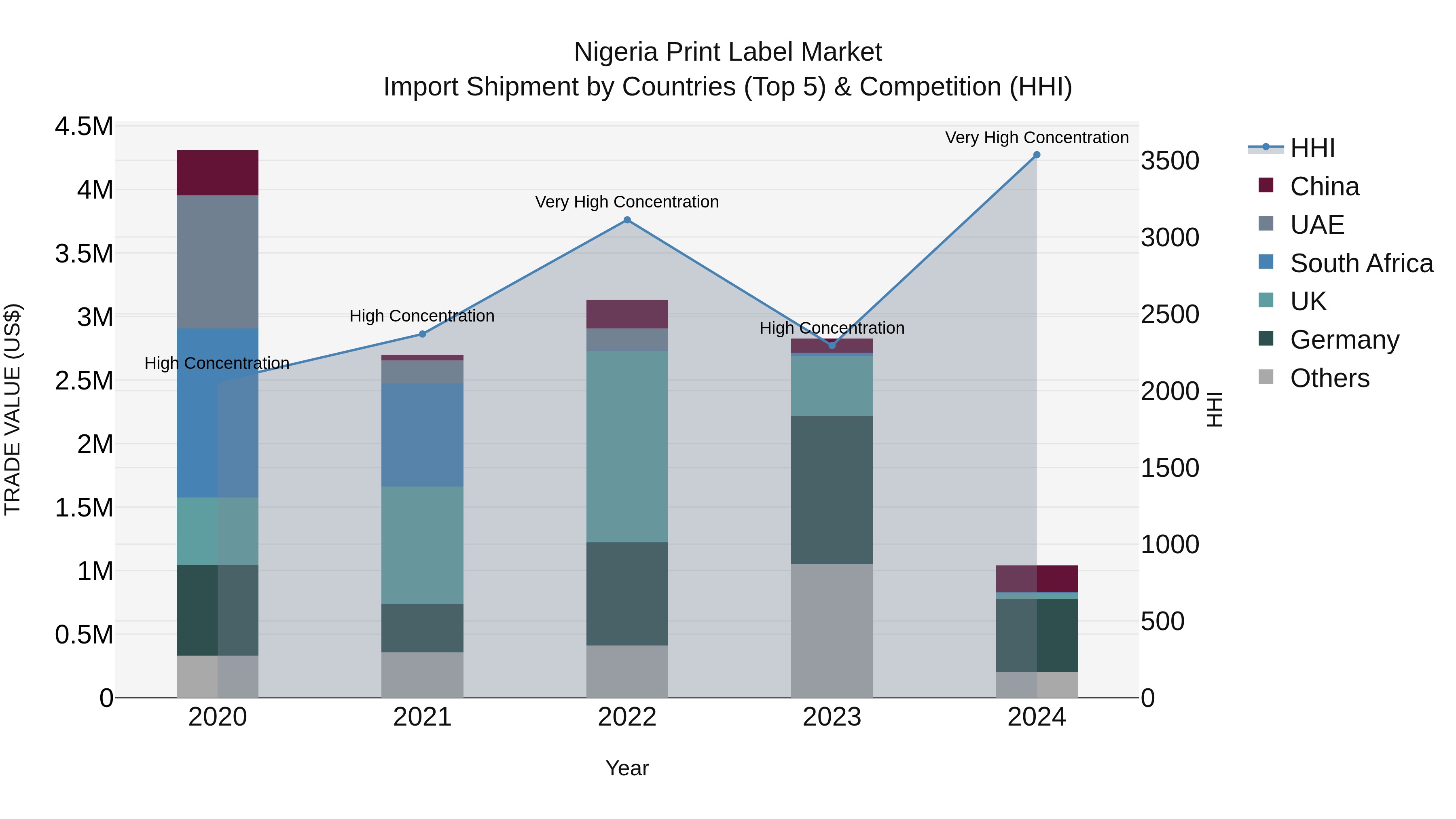
Nigeria Print Label Market Top 5 Importing Countries and Market Competition (HHI) Analysis
The Nigeria print label import market witnessed a significant shift in concentration levels from high to very high in 2024, with top exporting countries being Germany, China, India, South Korea, and the UK. The market experienced a steep decline in CAGR from 2020 to 2024 at -29.89%, indicating challenging conditions. Furthermore, the growth rate plummeted by -63.16% from 2023 to 2024, suggesting a rapid contraction in the industry during this period. Stakeholders should closely monitor these trends and adapt strategies to navigate the evolving landscape of the Nigeria print label import market.
Nigeria Print Label Market Growth Rate
According to 6Wresearch internal database and industry insights, the Nigeria Print Label Market is projected to grow at a compound annual growth rate (CAGR) of 7.4% during the forecast period (2026-2032).
Topics Covered in the Nigeria Print Label Market Report
The Nigeria Print Label Market report thoroughly covers the market by Print Process, Label Format and End-User. The market report provides an unbiased and detailed analysis of ongoing market trends, opportunities/high growth areas, and market drivers, which help stakeholders devise and align their market strategies according to the current and future market dynamics.
Nigeria Print Label Market Highlights
| Report Name |
Nigeria Print Label Market |
| Forecast period | 2026-2032 |
| CAGR | 7.4% |
| Market Size |
Pressure-Sensitive Labels |
Nigeria Print Label Market Synopsis
Nigeria Print Label Market is witnessing consistent growth driven by expanding consumer goods industries, increasing urbanization, and the growing importance of branding and product differentiation across retail shelves, as manufacturers are increasingly adopting innovative labeling solutions to enhance product visibility while ensuring compliance with packaging standards, and at the same time, advancements in printing technologies combined with the rising demand for sustainable and cost-efficient label materials are further contributing to the steady evolution of the market landscape.
Evaluation of Growth Drivers in the Nigeria Print Label Market
Below mentioned are some prominent drivers and their influence on the market dynamics:
| Drivers | Primary Segments Affected | Why it Matters (Evidence) |
| Growth in FMCG Sector | Flexography, Food & Beverage | Increased packaged goods demand drives high-volume label production. |
| Retail & E-commerce Expansion | Labeling Technology | Necessity of product identification and tracking drives label demands. |
| Advances in Printing Technology | Printing Technologies | Increase in demand for customized digital printing services. |
| Growing Preference for Sustainable Packaging | Materials & Products | Green labeling becomes popular among eco-conscious brands. |
| Increasing Demand for Healthcare Products | Pharmaceutical Labeling | Regulatory compliance fuels growth in label production. |
Nigeria Print Label Market is expected to grow at the CAGR of 7.4% during the forecast period of 2026-2032. Growth is driven by expanding FMCG consumption, increasing product branding requirements, and technological advancements in printing processes that enhance efficiency and quality, while additional support from retail sector expansion and rising awareness about sustainable packaging solutions is further strengthening market penetration across multiple end-user industries.
Evaluation of Restraints in the Nigeria Print Label Market
Below mentioned are some major restraints and their influence on the market dynamics:
| Restraints | Primary Segments Affected | What This Means (Evidence) |
| High Cost of Raw Materials | All Types, Industrial | Fluctuating prices impact production costs and profit margins. |
| Inadequate Access to Modern Printing Machinery | Inkjet, Screen | Companies find it difficult to embrace new printing technologies. |
| Logistical Challenges | Flexography, Logistics | Delayed delivery of materials impacts production time. |
| Environmental Protection Rules | Sleeves, Cosmetics | Conformity adds to manufacturing expenses. |
| Labor Skill Gap | All Categories | The shortage of skilled labor influences productivity and quality |
Nigeria Print Label Market Challenges
Irrespective of massive growth and development, the Nigeria Print Label Market faces several challenges such as high dependency on imported raw materials, limited access to advanced printing technologies, and a shortage of skilled professionals, which collectively restrict operational efficiency and scalability, while in addition, fluctuating costs and logistical constraints further hinder smooth production cycles, ultimately impacting Market Growth despite strong demand from various end-user industries and continuous technological evolution.
Nigeria Print Label Market Trends
Key trends shaping the Nigeria Print Label Market include:
- Increased Use of Digital Printing – The trend of digital printing is becoming popular among manufacturers as it facilitates quick turnover, customizing the products according to customer needs, and reducing wastage.
- Increase in Sustainable Label Manufacturing – There is an increasing trend among manufacturers to use sustainable materials in the production of labels.
- Increase in Smart Labels Usage – There is an increase in the use of smart labels, with the addition of features like QR codes and RFID technology.
- Rise in Demand for Pressure Sensitive Labels – Pressure sensitive labels are becoming increasingly popular owing to their versatility.
Investment Opportunities in the Nigeria Print Label Market
The following can be considered some of the business opportunities available to investments:
- Investment in Latest Digital Printing Technology – Investing in the latest technology in digital printing to cater to specific requirements.
- Producing Eco-friendly Labels – Production of eco-friendly labels to meet regulatory and customer requirements.
- Logistic Labels – Solutions for managing labels and barcodes for growth in the logistic and e-commerce industries.
- Package Innovations – Collaborating with FMCGs to offer innovative packaging and labeling solutions.
Top 5 Leading Players in the Nigeria Print Label Market
Key companies operating in the Nigeria Print Label Market include:
1. Avery Dennison Corporation
| Company Name | Avery Dennison Corporation |
|---|---|
| Established Year | 1935 |
| Headquarters | California, United States |
| Official Website | Click Here |
Avery Dennison Corporation specializes in pressure-sensitive materials and labeling solutions, offering innovative and sustainable products tailored for various industries, while continuously enhancing product visibility and supply chain efficiency through advanced labeling technologies and global expertise.
2. CCL Industries Inc.
| Company Name | CCL Industries Inc. |
|---|---|
| Established Year | 1951 |
| Headquarters | Toronto, Canada |
| Official Website | Click Here |
CCL Industries provides high-quality label solutions across multiple sectors including food, healthcare, and consumer goods, focusing on innovation, customization, and advanced printing technologies to meet diverse packaging and branding requirements globally.
3. Multi-Color Corporation
| Company Name | Multi-Color Corporation |
|---|---|
| Established Year | 1916 |
| Headquarters | Ohio, United States |
| Official Website | Click Here |
Multi-Color Corporation delivers premium labeling solutions with a strong emphasis on decorative and functional labels, supporting brand owners with high-quality printing services and innovative packaging enhancements across multiple industries.
4. Huhtamaki Oyj
| Company Name | Huhtamaki Oyj |
|---|---|
| Established Year | 1920 |
| Headquarters | Espoo, Finland |
| Official Website | Click Here |
Huhtamaki offers sustainable packaging and labeling solutions, focusing on eco-friendly innovations and advanced materials that align with global environmental standards while ensuring durability and visual appeal in label applications.
5. Constantia Flexibles
| Company Name | Constantia Flexibles |
|---|---|
| Established Year | 2004 |
| Headquarters | Vienna, Austria |
| Official Website | Click Here |
Constantia Flexibles specializes in flexible packaging and labeling solutions, providing high-performance materials and printing capabilities that cater to evolving market needs while supporting sustainability and product protection requirements.
Government Regulations Introduced in the Nigeria Print Label Market
According to Nigerian Government Data, Labeling requirements were set up by the National Agency for Food and Drug Administration and Control (NAFDAC) in 2021, ensuring provision of clear information on the products as well as their traceability and safety, impacting the general labeling practice within various sectors, while at the same time projects like the Nigerian Industrial Revolution Plan stress importance of domestic production and packaging, and policies advocating use of sustainable packaging practices make it increasingly common to use environmentally friendly labels.
Future Insights of the Nigeria Print Label Market
The Market is expected to witness significant advancements as increasing industrialization, rising consumer demand for packaged goods, and technological innovations in printing processes continue to shape the market landscape, while the integration of smart labeling technologies and growing emphasis on sustainability are likely to open new growth avenues, and investments in infrastructure along with expanding end-user industries will further strengthen Nigeria Print Label Market Growth in the coming years.
Market Segmentation Analysis
The report offers a comprehensive study of the subsequent market segments and their leading categories:
Flexography to Dominate the Market – By Print Process
According to Gaurav, Senior Research Analyst, 6Wresearch, Flexography is expected to dominate the Nigeria Print Label Industry due to its cost-effectiveness, high-speed production capabilities, and suitability for large-scale packaging needs, particularly in the food and beverage sector, where demand for durable and high-quality labels continues to rise with expanding consumer markets.
Pressure-Sensitive Labels to Dominate the Market – By Label Format
Pressure-sensitive labels are anticipated to lead the Nigeria Print Label Market owing to their versatility, ease of application, and compatibility with a wide range of packaging materials, which makes them highly preferred across industries such as FMCG, healthcare, and logistics, where efficiency and flexibility are crucial.
Food Industry to Dominate the Market – By End-User
It is expected that the food industry will account for a significant portion of the Nigeria Print Label Market Share owing to the rising consumption of packaged foods as well as the regulations concerning product labelling.
Key Attractiveness of the Report
- 10 Years of Market Numbers.
- Historical Data Starting from 2022 to 2025.
- Base Year: 2025.
- Forecast Data until 2032.
- Key Performance Indicators Impacting the Market.
- Major Upcoming Developments and Projects.
Key Highlights of the Report:
- Nigeria Print Label Market Outlook
- Market Size of Nigeria Print Label Market, 2025
- Forecast of Nigeria Print Label Market, 2032
- Historical Data and Forecast of Nigeria Print Label Revenues & Volume for the Period 2022 - 2032
- Nigeria Print Label Market Trend Evolution
- Nigeria Print Label Market Drivers and Challenges
- Nigeria Print Label Price Trends
- Nigeria Print Label Porter's Five Forces
- Nigeria Print Label Industry Life Cycle
- Historical Data and Forecast of Nigeria Print Label Market Revenues & Volume By Print Process for the Period 2022 - 2032
- Historical Data and Forecast of Nigeria Print Label Market Revenues & Volume By Offset lithography for the Period 2022 - 2032
- Historical Data and Forecast of Nigeria Print Label Market Revenues & Volume By Gravure for the Period 2022 - 2032
- Historical Data and Forecast of Nigeria Print Label Market Revenues & Volume By Flexography for the Period 2022 - 2032
- Historical Data and Forecast of Nigeria Print Label Market Revenues & Volume By Screen for the Period 2022 - 2032
- Historical Data and Forecast of Nigeria Print Label Market Revenues & Volume By Letterpress for the Period 2022 - 2032
- Historical Data and Forecast of Nigeria Print Label Market Revenues & Volume By Electrophotography for the Period 2022 - 2032
- Historical Data and Forecast of Nigeria Print Label Market Revenues & Volume By Inkjet for the Period 2022 - 2032
- Historical Data and Forecast of Nigeria Print Label Market Revenues & Volume By Label Format for the Period 2022 - 2032
- Historical Data and Forecast of Nigeria Print Label Market Revenues & Volume By Wet-glue labels for the Period 2022 - 2032
- Historical Data and Forecast of Nigeria Print Label Market Revenues & Volume By Pressure-sensitive labels for the Period 2022 - 2032
- Historical Data and Forecast of Nigeria Print Label Market Revenues & Volume By Linerless labels for the Period 2022 - 2032
- Historical Data and Forecast of Nigeria Print Label Market Revenues & Volume By Multi-part tracking labels for the Period 2022 - 2032
- Historical Data and Forecast of Nigeria Print Label Market Revenues & Volume By In-mold labels for the Period 2022 - 2032
- Historical Data and Forecast of Nigeria Print Label Market Revenues & Volume By Sleeves for the Period 2022 - 2032
- Historical Data and Forecast of Nigeria Print Label Market Revenues & Volume By End-User for the Period 2022 - 2032
- Historical Data and Forecast of Nigeria Print Label Market Revenues & Volume By Food for the Period 2022 - 2032
- Historical Data and Forecast of Nigeria Print Label Market Revenues & Volume By Beverage for the Period 2022 - 2032
- Historical Data and Forecast of Nigeria Print Label Market Revenues & Volume By Healthcare for the Period 2022 - 2032
- Historical Data and Forecast of Nigeria Print Label Market Revenues & Volume By Cosmetics for the Period 2022 - 2032
- Historical Data and Forecast of Nigeria Print Label Market Revenues & Volume By Household for the Period 2022 - 2032
- Historical Data and Forecast of Nigeria Print Label Market Revenues & Volume By Industrial for the Period 2022 - 2032
- Historical Data and Forecast of Nigeria Print Label Market Revenues & Volume By Logistics for the Period 2022 - 2032
- Historical Data and Forecast of Nigeria Print Label Market Revenues & Volume By Other for the Period 2022 - 2032
- Nigeria Print Label Import Export Trade Statistics
- Market Opportunity Assessment By Print Process
- Market Opportunity Assessment By Label Format
- Market Opportunity Assessment By End-User
- Nigeria Print Label Top Companies Market Share
- Nigeria Print Label Competitive Benchmarking By Technical and Operational Parameters
- Nigeria Print Label Company Profiles
- Nigeria Print Label Key Strategic Recommendations
Market Covered
The report offers a comprehensive study of the subsequent market segments:
By Print Process
- Offset lithography
- Gravure
- Flexography
- Screen
- Letterpress
- Electrophotography
- Inkjet
By Label Format
- Wet-glue labels
- Pressure-sensitive labels
- Linerless labels
- Multi-part tracking labels
- In-mold labels
- Sleeves
By End-User
- Food
- Beverage
- Healthcare
- Cosmetics
- Household
- Industrial
- Logistics
- Other






































