Nigeria Pulp Market Top 5 Importing Countries and Market Competition (HHI) Analysis
In 2024, Nigeria continued to rely on pulp imports, with key suppliers including Sweden, China, UAE, New Zealand, and Singapore. The market remained highly concentrated, as indicated by the high Herfindahl-Hirschman Index (HHI). The industry experienced a significant decline in compound annual growth rate (CAGR) of -22.46% from 2020 to 2024, with a further decrease in growth rate from 2023 to 2024 at -22.99%. These trends suggest challenges and fluctuations in the Nigerian pulp import market, highlighting the need for strategic planning and adaptation by industry players.
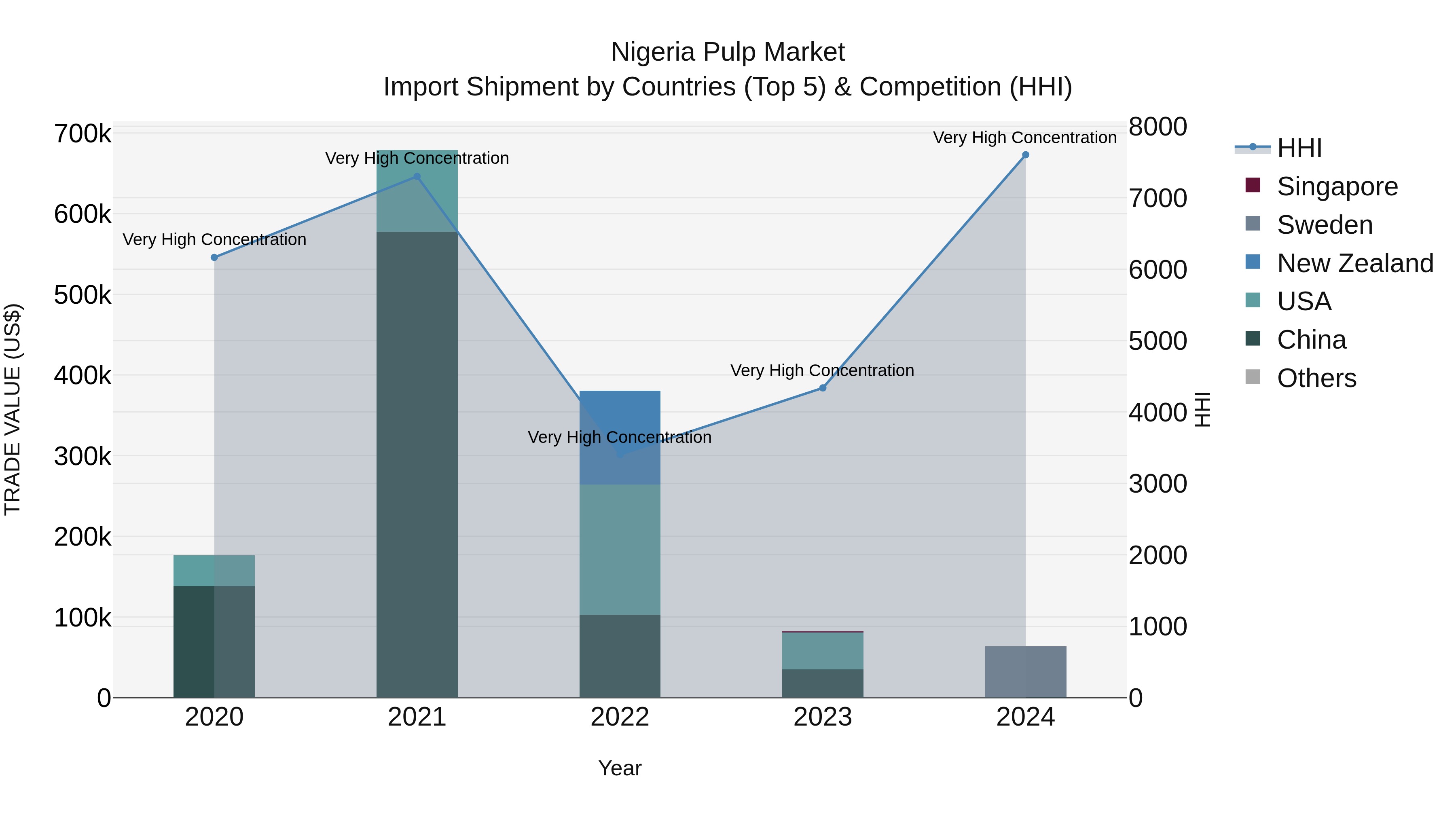
Nigeria Pulp Market Overview
The pulp market in Nigeria is developing as the demand for paper products, including packaging and writing paper, increases. Pulp, the raw material for paper production, is derived from wood or recycled paper. Market growth is supported by the expanding packaging industry, urbanization, and the need for sustainable paper production methods.
Drivers of the market
The Nigeria pulp market is propelled by the growing demand for paper and packaging materials across various industries, including publishing, printing, and consumer goods. Pulp is a primary raw material used in the production of paper, cardboard, tissue, and packaging products. Factors such as increasing literacy rates, rising e-commerce activities, and growing consumer packaged goods consumption contribute to market growth. Moreover, the expansion of the education sector, investments in packaging infrastructure, and advancements in pulp manufacturing technologies further stimulate the demand for pulp in Nigeria. Additionally, the focus on sustainable sourcing, recycling, and eco-friendly packaging solutions drives market expansion.
Challenges of the market
The pulp market in Nigeria faces challenges such as limited domestic production capacity and dependence on imported products. Many industries, including paper and packaging, rely on pulp as a key raw material. However, supply chain disruptions and quality control issues impact market reliability and availability. Additionally, environmental regulations and concerns about deforestation pose barriers to market expansion.
Government Policy of the market
The Nigeria government promotes the growth of the pulp market through policies that support the forestry and paper manufacturing sectors. The NIRP includes incentives for the establishment of pulp mills, sustainable forestry practices, and tax breaks for local manufacturers. The government also provides subsidies and grants for research and development to enhance the competitiveness of the Nigeria pulp industry.
Key Highlights of the Report:
- Nigeria Pulp Market Outlook
- Market Size of Nigeria Pulp Market, 2024
- Forecast of Nigeria Pulp Market, 2031
- Historical Data and Forecast of Nigeria Pulp Revenues & Volume for the Period 2021-2031
- Nigeria Pulp Market Trend Evolution
- Nigeria Pulp Market Drivers and Challenges
- Nigeria Pulp Price Trends
- Nigeria Pulp Porter's Five Forces
- Nigeria Pulp Industry Life Cycle
- Historical Data and Forecast of Nigeria Pulp Market Revenues & Volume By Types for the Period 2021-2031
- Historical Data and Forecast of Nigeria Pulp Market Revenues & Volume By Chemical Pulp for the Period 2021-2031
- Historical Data and Forecast of Nigeria Pulp Market Revenues & Volume By Mechanical & Semi Chemical Pulp for the Period 2021-2031
- Historical Data and Forecast of Nigeria Pulp Market Revenues & Volume By Non Wood Pulp for the Period 2021-2031
- Historical Data and Forecast of Nigeria Pulp Market Revenues & Volume By Applications for the Period 2021-2031
- Historical Data and Forecast of Nigeria Pulp Market Revenues & Volume By Corrugating Materials for the Period 2021-2031
- Historical Data and Forecast of Nigeria Pulp Market Revenues & Volume By Printing & Writing for the Period 2021-2031
- Historical Data and Forecast of Nigeria Pulp Market Revenues & Volume By Carton Board for the Period 2021-2031
- Historical Data and Forecast of Nigeria Pulp Market Revenues & Volume By Tissue for the Period 2021-2031
- Historical Data and Forecast of Nigeria Pulp Market Revenues & Volume By Newsprint for the Period 2021-2031
- Historical Data and Forecast of Nigeria Pulp Market Revenues & Volume By Wrapping Paper for the Period 2021-2031
- Historical Data and Forecast of Nigeria Pulp Market Revenues & Volume By Kraft Paper for the Period 2021-2031
- Nigeria Pulp Import Export Trade Statistics
- Market Opportunity Assessment By Types
- Market Opportunity Assessment By Applications
- Nigeria Pulp Top Companies Market Share
- Nigeria Pulp Competitive Benchmarking By Technical and Operational Parameters
- Nigeria Pulp Company Profiles
- Nigeria Pulp Key Strategic Recommendations






































