Nigeria Security Door Market Top 5 Importing Countries and Market Competition (HHI) Analysis
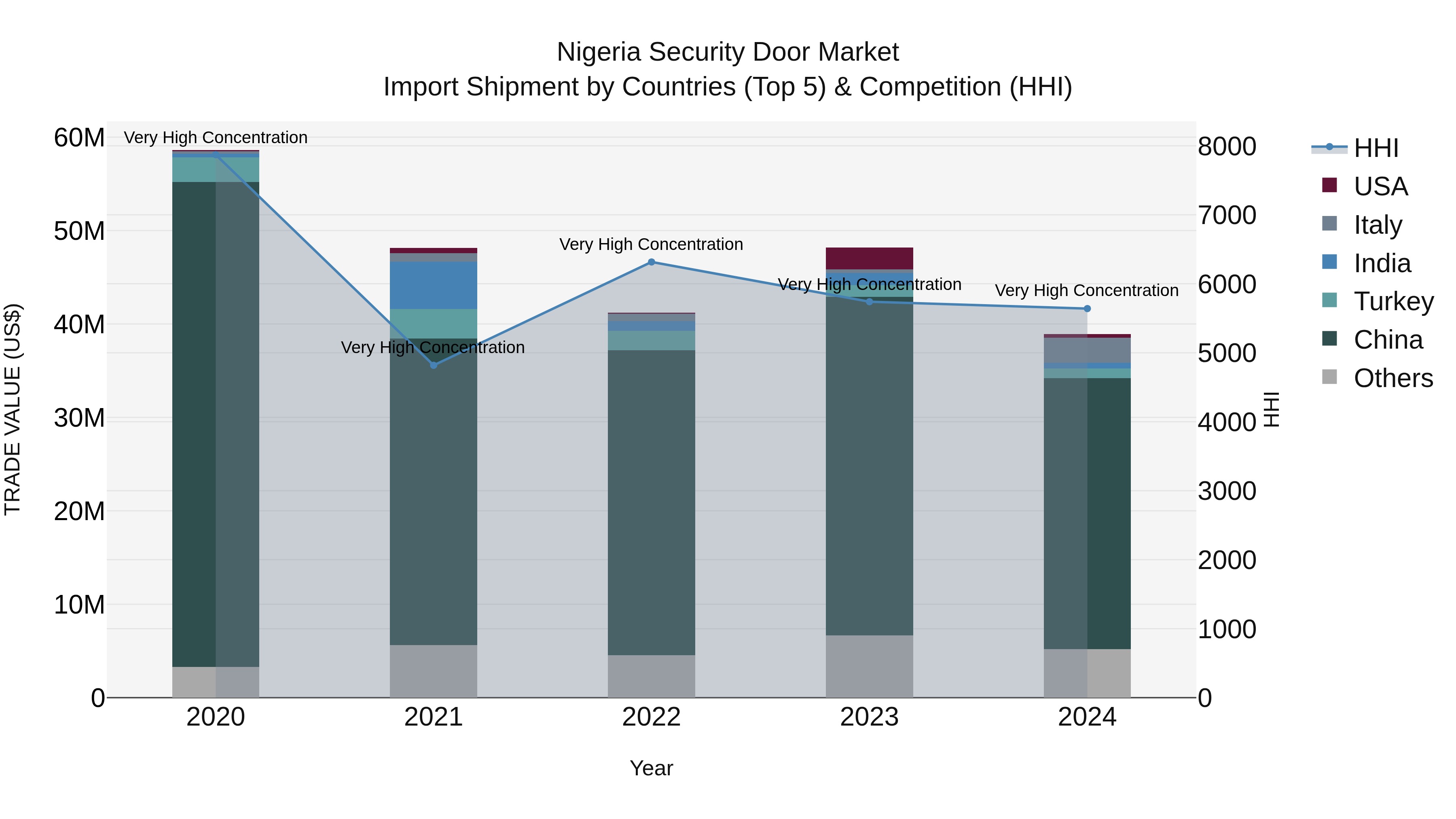
Despite a decline in the growth rate of Nigeria`s security door import shipments in 2024, the market continues to be dominated by imports from China, Italy, Austria, Spain, and Turkey. The high Herfindahl-Hirschman Index (HHI) suggests a concentrated market with limited competition. The negative compound annual growth rate (CAGR) from 2020 to 2024 indicates challenges in the industry, while the substantial drop in growth rate from 2023 to 2024 highlights potential recent hurdles. Stakeholders should closely monitor market dynamics and explore strategies to navigate these complexities for future success.
Nigeria Security Door Market Synopsis
The Nigeria security door market is experiencing growth driven by increasing concerns over safety and security. Factors such as rising crime rates, urbanization, and a growing middle-class population are boosting the demand for security doors in residential and commercial buildings. The market offers a wide range of options including steel doors, aluminum doors, and wooden doors with enhanced security features such as multi-locking systems, reinforced frames, and advanced locking mechanisms. Key players in the market are focusing on product innovation, customization, and expanding their distribution networks to cater to the diverse needs of consumers. The market is also witnessing a trend towards smart security doors integrated with technology such as biometric access control and remote monitoring systems to provide enhanced security solutions.
Nigeria Security Door Market Trends
The Nigeria Security Door Market is experiencing a growing demand for technologically advanced and aesthetically pleasing security doors. Consumers are increasingly prioritizing safety and security in their homes and commercial spaces, leading to a rise in the adoption of features such as biometric access control systems, smart locks, and reinforced materials for enhanced protection against break-ins and intrusions. Additionally, there is a noticeable shift towards more customizable options in terms of design, color, and finish to complement the overall aesthetics of the property. The market is also witnessing a surge in eco-friendly and sustainable security door solutions, reflecting a broader sustainability trend in the construction and home improvement sectors. Overall, the Nigeria Security Door Market is evolving to meet the evolving needs and preferences of consumers seeking both security and style in their door choices.
Nigeria Security Door Market Challenges
The Nigeria Security Door Market faces several challenges, including competition from low-cost and lower-quality imported doors, which can make it difficult for local manufacturers to compete. Another challenge is the issue of counterfeiting, where substandard and fake security doors are being sold in the market, damaging the reputation of genuine manufacturers. Additionally, the high cost of production due to factors such as raw material prices, labor costs, and energy expenses poses a challenge for manufacturers in maintaining competitive pricing. Furthermore, the market also grapples with inconsistent government policies, which can impact the industry`s growth and stability. Overall, these challenges require strategic planning, innovation, and quality control measures to ensure the sustainability and growth of the Nigeria Security Door Market.
Nigeria Security Door Market Investment Opportunities
The Nigeria security door market presents promising investment opportunities due to the growing demand for enhanced security solutions in residential and commercial properties. With increasing concerns about safety and security, there is a rising need for high-quality security doors that offer protection against break-ins and intrusions. Investing in this market can be lucrative as the construction industry continues to expand, driving the demand for security doors. Additionally, advancements in technology have led to the development of innovative security door solutions, further attracting investment opportunities in this sector. Partnering with established manufacturers or entering into distribution agreements to bring reliable and innovative security door products to the Nigerian market can be a strategic investment move with long-term growth potential.
Jordan Agar Market Government Policies
The government of Nigeria has implemented various policies to regulate the security door market in the country. These policies aim to ensure the quality and safety standards of security doors, as well as promote local manufacturing and reduce reliance on imports. The Nigerian government has introduced import restrictions and tariffs on security doors to encourage domestic production and stimulate economic growth. Additionally, there are regulations in place to prevent the entry of substandard or counterfeit security doors into the market, protecting consumers and promoting fair competition among manufacturers. Overall, the government`s policies in Nigeria`s security door market are focused on enhancing product quality, supporting local industries, and safeguarding the interests of both businesses and consumers.
Nigeria Security Door Market Future Outlook
The Nigeria Security Door Market is expected to witness steady growth in the coming years due to increasing concerns regarding thefts and burglaries, coupled with rising urbanization and infrastructure development in the country. The market is projected to benefit from a growing middle-class population that is increasingly investing in home security measures. Additionally, advancements in technology, such as smart security doors with features like biometric authentication and remote monitoring capabilities, are likely to drive market growth. However, challenges such as competition from alternative security solutions and economic uncertainties may impact the market dynamics. Overall, the Nigeria Security Door Market is poised for expansion as consumers prioritize safety and security in their residential and commercial spaces.
Key Highlights of the Report:
- Nigeria Security Door Market Outlook
- Market Size of Nigeria Security Door Market, 2024
- Forecast of Nigeria Security Door Market, 2031
- Historical Data and Forecast of Nigeria Security Door Revenues & Volume for the Period 2021 - 2031
- Nigeria Security Door Market Trend Evolution
- Nigeria Security Door Market Drivers and Challenges
- Nigeria Security Door Price Trends
- Nigeria Security Door Porter's Five Forces
- Nigeria Security Door Industry Life Cycle
- Historical Data and Forecast of Nigeria Security Door Market Revenues & Volume By Product Type for the Period 2021 - 2031
- Historical Data and Forecast of Nigeria Security Door Market Revenues & Volume By Wood Security Door for the Period 2021 - 2031
- Historical Data and Forecast of Nigeria Security Door Market Revenues & Volume By Metal Security Door for the Period 2021 - 2031
- Historical Data and Forecast of Nigeria Security Door Market Revenues & Volume By Industry for the Period 2021 - 2031
- Historical Data and Forecast of Nigeria Security Door Market Revenues & Volume By Individual Purchaser for the Period 2021 - 2031
- Historical Data and Forecast of Nigeria Security Door Market Revenues & Volume By Corporate Buyers for the Period 2021 - 2031
- Historical Data and Forecast of Nigeria Security Door Market Revenues & Volume By Channel for the Period 2021 - 2031
- Historical Data and Forecast of Nigeria Security Door Market Revenues & Volume By Direct Sales for the Period 2021 - 2031
- Historical Data and Forecast of Nigeria Security Door Market Revenues & Volume By Distributor for the Period 2021 - 2031
- Nigeria Security Door Import Export Trade Statistics
- Market Opportunity Assessment By Product Type
- Market Opportunity Assessment By Industry
- Market Opportunity Assessment By Channel
- Nigeria Security Door Top Companies Market Share
- Nigeria Security Door Competitive Benchmarking By Technical and Operational Parameters
- Nigeria Security Door Company Profiles
- Nigeria Security Door Key Strategic Recommendations






































