Nigeria Transport Packaging Market Summary
The nigeria transport packaging market was estimated at USD 400 Million in 2025 and is projected to reach USD 534 Million by 2032, growing at a CAGR of 5.0% from 2026 to 2032.
Nigeria Transport Packaging Market Year-wise Growth Rate and Key Drivers
This graph highlights how the Nigeria Transport Packaging Market has steadily grown over the past five years, supported by major growth factors.
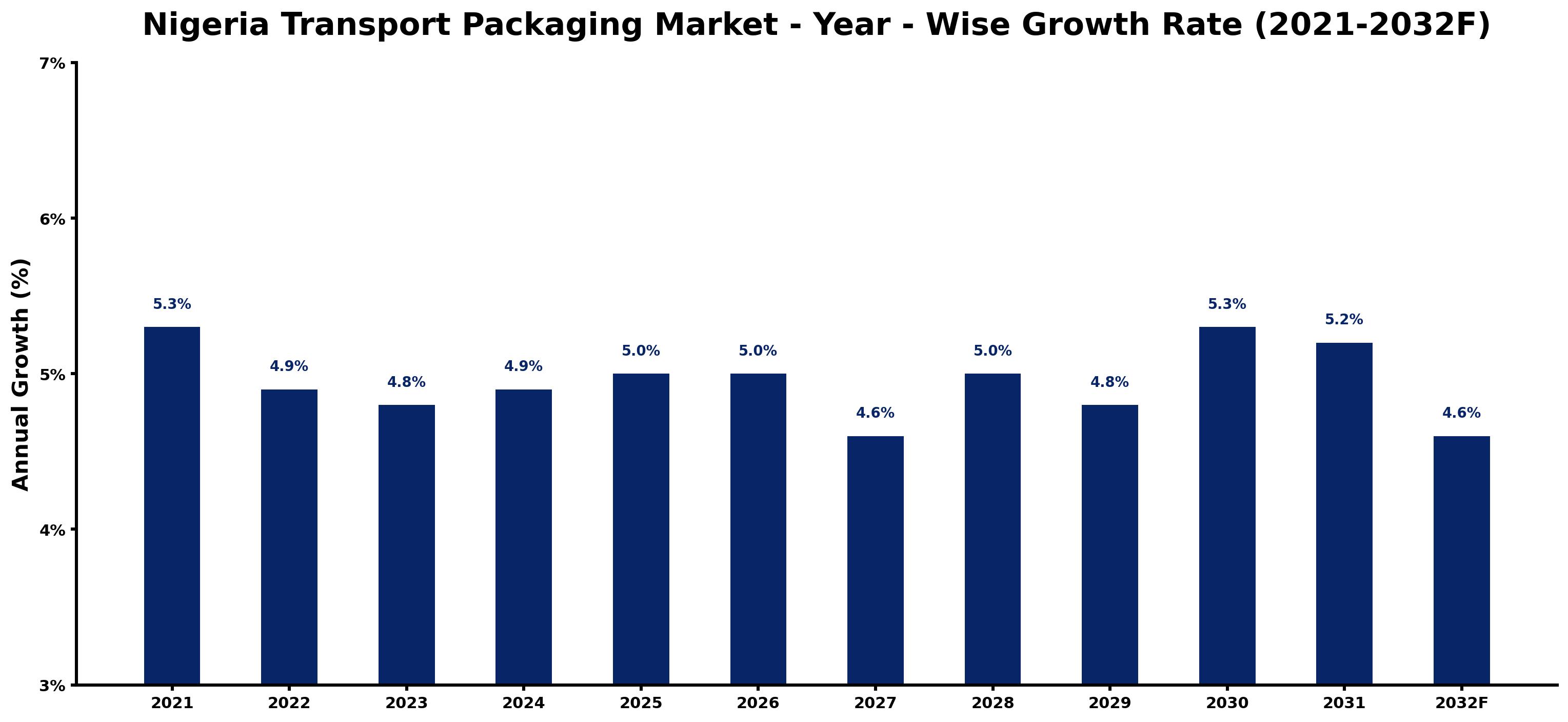
The table below presents the year wise growth rates along with the key drivers influencing the market
| Year | Growth Rate | Major Drivers |
| 2021 | 5.3% | Economic recovery efforts fueled demand for efficient transport packaging solutions. |
| 2022 | 4.9% | Urbanization trends prompted increased logistics needs across Nigeria's expanding cities. |
| 2023 | 4.8% | E-commerce growth required innovative packaging to protect goods during transit. |
| 2024 | 4.9% | Rising consumer awareness spurred interest in sustainable packaging materials and solutions. |
| 2025 | 5.0% | Investment in infrastructure improvements enhanced logistics capabilities for transport companies. |
| 2026 | 5.0% | Technological advancements enabled smarter packaging solutions, boosting operational efficiency. |
| 2027 | 4.6% | Collaborations between manufacturers and retailers aimed to optimize supply chain management. |
| 2028 | 5.0% | Increased foreign investments catalyzed growth in the transport packaging industry. |
| 2029 | 4.8% | Emerging local startups innovated new packaging designs tailored for Nigerian markets. |
| 2030 | 5.3% | Corporate sustainability goals shifted focus towards eco-friendly packaging alternatives. |
| 2031 | 5.2% | Changing consumer preferences necessitated adaptable packaging to suit diverse product categories. |
| 2032 | 4.6% | Competitive pressures encouraged continuous innovation in packaging design and functionality. |
Note - Market size estimations and growth projections presented in this report are based on 6Wresearch's advanced forecasting approach, validated with industry datasets as of June 2026.
Nigeria Transport Packaging Market Synopsis
The Nigeria Transport Packaging Market is projected to reach 5.0% and witness significant growth during the forecast period (2026-2032). This market is increasingly influenced by the burgeoning e-commerce sector, coupled with a pressing need for innovative logistics solutions that enhance the safety and efficiency of goods movement. Transport packaging encompasses various options such as crates, pallets, drums, and protective packaging materials, all critical for safeguarding products during transit. Moreover, the sector is witnessing a notable shift towards sustainable packaging methodologies, aligning with global efforts to minimize environmental impact.
Nigeria Transport Packaging Market Growth Drivers
The growth trajectory of the Nigeria Transport Packaging Market is largely propelled by several key drivers:
- The rapid expansion of the e-commerce industry is fundamentally reshaping consumer purchasing behaviors, leading to a heightened demand for secure and reliable packaging solutions.
- Increasing import and export activities necessitate robust packaging methods that can withstand varied transportation conditions while ensuring product integrity.
- Consumers are progressively prioritizing safe and efficient packaging, prompting businesses to innovate their packaging practices to keep pace with changing preferences.
- Advancements in packaging materials, particularly those that enhance durability and sustainability, are catalyzing market growth as they align with consumer and regulatory demands.
- Stringent regulatory standards concerning packaging safety and environmental impact are pushing companies toward adopting eco-friendly packaging solutions.
Nigeria Transport Packaging Market Challenges and Restraints
Despite its growth potential, the Nigeria Transport Packaging Market is not without its challenges:
- Inadequate infrastructure poses significant hurdles; poorly maintained roads and insufficient port facilities result in delays and increased costs throughout the supply chain.
- A reliance on traditional packaging methods often limits efficiencies and fails to meet the growing demand for sustainable solutions.
- Small and medium-sized enterprises face barriers due to the high costs associated with modern packaging technologies, which may inhibit their competitive edge.
- The lack of standardization in packaging practices can lead to inconsistencies, complicating compliance with international standards.
- Economic fluctuations can impact consumer spending and investment in packaging innovations, potentially stunting market growth.
Nigeria Transport Packaging Market Government Investment and Initiatives
Government initiatives in Nigeria have increasingly targeted the enhancement of the transport packaging sector as part of broader economic development strategies. Significant policies have been introduced focused on:
- Promoting standardized packaging guidelines that align with international best practices to foster competitive advantage in global markets.
- Encouraging investment in environmentally sustainable packaging solutions through grants and subsidies aimed at innovation in this sector.
- Facilitating access to financing options for SMEs within the packaging industry to empower them to invest in modern technologies.
- Investing in infrastructure improvements, particularly in transportation networks, to enhance the efficiency of logistics and reduce overall operational costs.
- Establishing collaborations with industry stakeholders to conduct research and development initiatives focused on improving packaging materials and practices.
Nigeria Transport Packaging Market Latest Developments (May 2025 - June 2026)
The period from May 2025 to June 2026 has seen significant developments within the Nigeria Transport Packaging Market, characterized by ongoing innovations and shifts in consumer preferences. The focus has increasingly turned towards integrating sustainable practices into packaging operations. Major logistics companies have started to adopt biodegradable materials and reduce plastic usage, reflecting both consumer demand and regulatory pressures. Initiatives aimed at upgrading packaging technology have taken shape, with a notable push towards the development of smart packaging solutions that enhance traceability and minimize waste. Trade agreements have also been expanded, facilitating a smoother movement of goods and consequently increasing the necessity for advanced packaging solutions. Additionally, heightened competition among local manufacturers has driven greater investment in research and development, leading to improved packaging designs that cater to the specific needs of various commodities.
Nigeria Transport Packaging Market - Key Attractiveness of the Report
- 10 Years of Market Numbers
- Historical Data Starting from 2022 to 2025
- Base Year: 2025
- Forecast Data until 2032
- Key Performance Indicators Impacting the Market
- Major Upcoming Developments and Projects
Key Highlights of the Report:
- Nigeria Transport Packaging Market Outlook
- Market Size of Nigeria Transport Packaging Market, 2025
- Forecast of Nigeria Transport Packaging Market, 2032
- Historical Data and Forecast of Nigeria Transport Packaging Revenues & Volume for the Period 2022-2032F
- Nigeria Transport Packaging Market Trend Evolution
- Nigeria Transport Packaging Market Drivers and Challenges
- Nigeria Transport Packaging Price Trends
- Nigeria Transport Packaging Porter's Five Forces
- Nigeria Transport Packaging Industry Life Cycle
- Historical Data and Forecast of Nigeria Transport Packaging Market Revenues & Volume By Material Type for the Period 2022-2032F
- Historical Data and Forecast of Nigeria Transport Packaging Market Revenues & Volume By Plastic for the Period 2022-2032F
- Historical Data and Forecast of Nigeria Transport Packaging Market Revenues & Volume By Polyethylene (PE) for the Period 2022-2032F
- Historical Data and Forecast of Nigeria Transport Packaging Market Revenues & Volume By Polypropylene (PP) for the Period 2022-2032F
- Historical Data and Forecast of Nigeria Transport Packaging Market Revenues & Volume By Polyethylene Terephthalate (PET) for the Period 2022-2032F
- Historical Data and Forecast of Nigeria Transport Packaging Market Revenues & Volume By Paper & Paperboard for the Period 2022-2032F
- Historical Data and Forecast of Nigeria Transport Packaging Market Revenues & Volume By Metal for the Period 2022-2032F
- Historical Data and Forecast of Nigeria Transport Packaging Market Revenues & Volume By Wood for the Period 2022-2032F
- Historical Data and Forecast of Nigeria Plastic Transport Packaging Market Revenues & Volume By Others for the Period 2022-2032F
- Historical Data and Forecast of Nigeria Transport Packaging Market Revenues & Volume By Packaging Types for the Period 2022-2032F
- Historical Data and Forecast of Nigeria Transport Packaging Market Revenues & Volume By Cartons for the Period 2022-2032F
- Historical Data and Forecast of Nigeria Transport Packaging Market Revenues & Volume By Wooden crates for the Period 2022-2032F
- Historical Data and Forecast of Nigeria Transport Packaging Market Revenues & Volume By Containers for the Period 2022-2032F
- Historical Data and Forecast of Nigeria Transport Packaging Market Revenues & Volume By Corrugated boxes for the Period 2022-2032F
- Historical Data and Forecast of Nigeria Transport Packaging Market Revenues & Volume By Barrels for the Period 2022-2032F
- Historical Data and Forecast of Nigeria Transport Packaging Market Revenues & Volume By IBCs for the Period 2022-2032F
- Historical Data and Forecast of Nigeria Transport Packaging Market Revenues & Volume By Strapping for the Period 2022-2032F
- Historical Data and Forecast of Nigeria Transport Packaging Market Revenues & Volume By Others for the Period 2022-2032F
- Historical Data and Forecast of Nigeria Transport Packaging Market Revenues & Volume By End-users for the Period 2022-2032F
- Historical Data and Forecast of Nigeria Transport Packaging Market Revenues & Volume By Agriculture for the Period 2022-2032F
- Historical Data and Forecast of Nigeria Transport Packaging Market Revenues & Volume By Automotive for the Period 2022-2032F
- Historical Data and Forecast of Nigeria Transport Packaging Market Revenues & Volume By Building & Construction for the Period 2022-2032F
- Historical Data and Forecast of Nigeria Transport Packaging Market Revenues & Volume By Chemicals & Pharmaceuticals for the Period 2022-2032F
- Historical Data and Forecast of Nigeria Transport Packaging Market Revenues & Volume By Food & Beverages for the Period 2022-2032F
- Historical Data and Forecast of Nigeria Transport Packaging Market Revenues & Volume By Metallurgical for the Period 2022-2032F
- Historical Data and Forecast of Nigeria Transport Packaging Market Revenues & Volume By Electrical & Electronics for the Period 2022-2032F
- Historical Data and Forecast of Nigeria Transport Packaging Market Revenues & Volume By Others for the Period 2022-2032F
- Nigeria Transport Packaging Import Export Trade Statistics
- Market Opportunity Assessment By Material Type
- Market Opportunity Assessment By Packaging Types
- Market Opportunity Assessment By End-users
- Nigeria Transport Packaging Top Companies Market Share
- Nigeria Transport Packaging Competitive Benchmarking By Technical and Operational Parameters
- Nigeria Transport Packaging Company Profiles
- Nigeria Transport Packaging Key Strategic Recommendations






































