Nigeria Vinegar Market Top 5 Importing Countries and Market Competition (HHI) Analysis
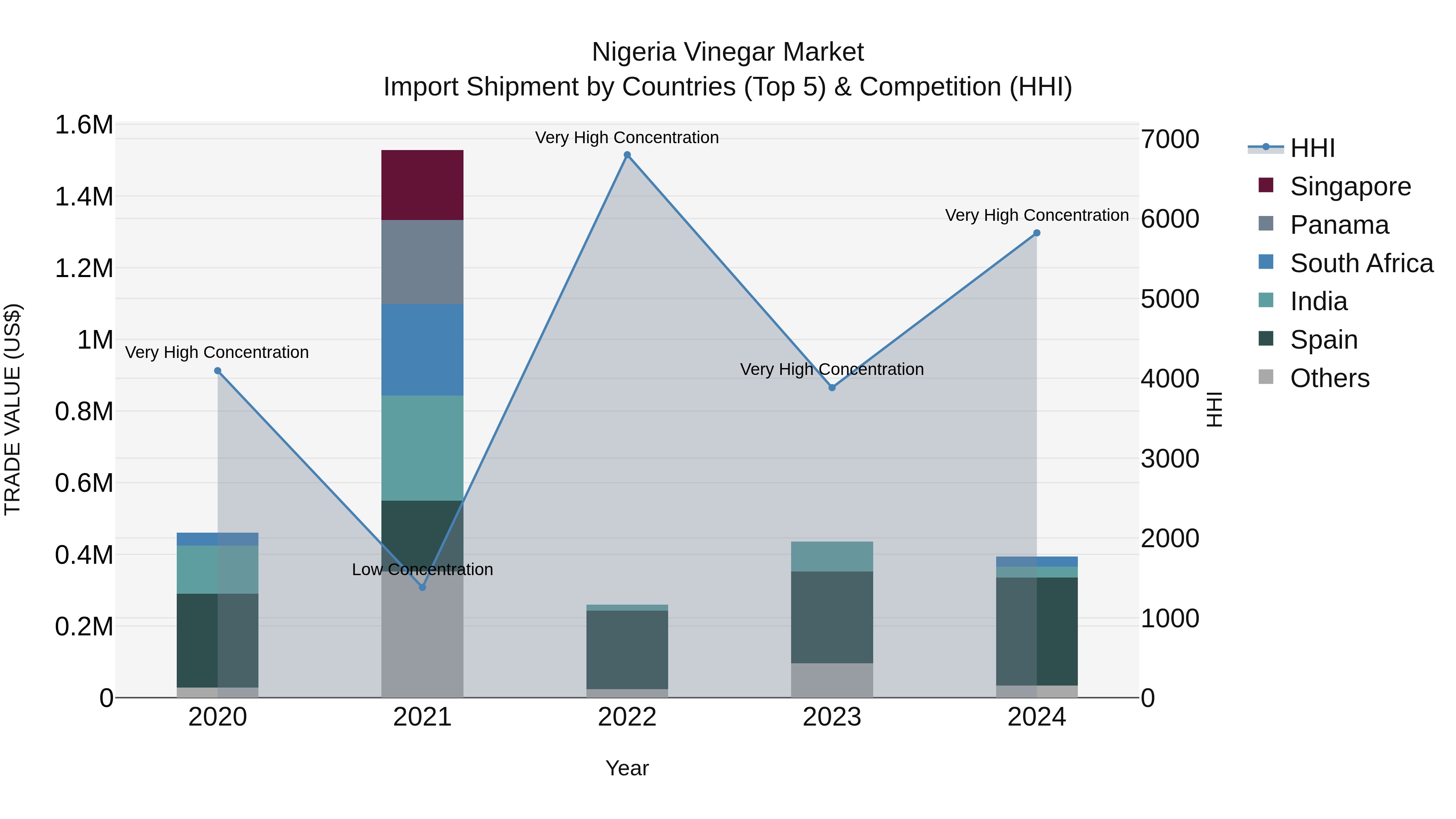
Despite a decline in the Compound Annual Growth Rate (CAGR) and negative growth rate in 2024, Nigeria continues to rely on vinegar imports from top countries like Spain, India, South Africa, Metropolitan France, and China. The high Herfindahl-Hirschman Index (HHI) indicates a concentrated market, potentially leading to market dominance by a few key players. It will be interesting to monitor how these trends impact the vinegar import market in Nigeria in the coming years.
Nigeria Vinegar Market Overview
The vinegar market in Nigeria is characterized by a diverse range of products used for culinary, medicinal, and industrial purposes. Vinegar, traditionally used as a food preservative and flavoring agent, is seeing increased demand due to its applications in various recipes and health benefits. The market features both locally produced and imported varieties, including white vinegar, apple cider vinegar, and balsamic vinegar. Local production is often limited to small-scale operations, while imported brands dominate the higher end of the market. As consumer awareness about the health benefits of vinegar grows, the market is expected to see a steady increase in demand.
Drivers of the market
The vinegar market in Nigeria is growing due to its diverse applications in cooking, preservation, and health remedies. The increasing awareness of the health benefits associated with vinegar, such as weight management and blood sugar control, drives consumer demand. The expansion of the food processing industry and the rising popularity of organic and natural food products further contribute to the market`s growth. Additionally, the proliferation of local manufacturers producing various types of vinegar caters to the diverse preferences of consumers.
Challenges of the market
The vinegar market in Nigeria faces challenges related to the high cost of production and the scarcity of raw materials, such as fruits and grains, which are essential for vinegar manufacturing. The market also struggles with limited consumer awareness and appreciation of the diverse uses and health benefits of vinegar. Competition from imported vinegar products, which often have established brand recognition and perceived higher quality, poses a significant threat to local producers. Additionally, the lack of effective distribution channels and marketing strategies hampers the growth of the domestic vinegar market.
Government Policy of the market
Agricultural policies in Nigeria, focusing on food processing and value addition, have positively influenced the vinegar market. Government initiatives like the Agricultural Promotion Policy (APP) encourage local production and processing of agricultural products, including vinegar. Support for small and medium enterprises (SMEs) in the agro-processing sector, through grants and technical assistance, further stimulates market growth and enhances local production capabilities.
Key Highlights of the Report:
- Nigeria Vinegar Market Outlook
- Market Size of Nigeria Vinegar Market, 2024
- Forecast of Nigeria Vinegar Market, 2031
- Historical Data and Forecast of Nigeria Vinegar Revenues & Volume for the Period 2021-2031
- Nigeria Vinegar Market Trend Evolution
- Nigeria Vinegar Market Drivers and Challenges
- Nigeria Vinegar Price Trends
- Nigeria Vinegar Porter's Five Forces
- Nigeria Vinegar Industry Life Cycle
- Historical Data and Forecast of Nigeria Vinegar Market Revenues & Volume By Product Type for the Period 2021-2031
- Historical Data and Forecast of Nigeria Vinegar Market Revenues & Volume By Balsamic Vinegar for the Period 2021-2031
- Historical Data and Forecast of Nigeria Vinegar Market Revenues & Volume By Red Wine Vinegar for the Period 2021-2031
- Historical Data and Forecast of Nigeria Vinegar Market Revenues & Volume By Cider Vinegar for the Period 2021-2031
- Historical Data and Forecast of Nigeria Vinegar Market Revenues & Volume By White Vinegar for the Period 2021-2031
- Historical Data and Forecast of Nigeria Vinegar Market Revenues & Volume By Rice Vinegar for the Period 2021-2031
- Historical Data and Forecast of Nigeria Vinegar Market Revenues & Volume By Others for the Period 2021-2031
- Historical Data and Forecast of Nigeria Vinegar Market Revenues & Volume By Source for the Period 2021-2031
- Historical Data and Forecast of Nigeria Vinegar Market Revenues & Volume By Natural for the Period 2021-2031
- Historical Data and Forecast of Nigeria Vinegar Market Revenues & Volume By Synthetic for the Period 2021-2031
- Historical Data and Forecast of Nigeria Vinegar Market Revenues & Volume By End-use for the Period 2021-2031
- Historical Data and Forecast of Nigeria Vinegar Market Revenues & Volume By Institutional for the Period 2021-2031
- Historical Data and Forecast of Nigeria Vinegar Market Revenues & Volume By Retail for the Period 2021-2031
- Historical Data and Forecast of Nigeria Vinegar Market Revenues & Volume By Distribution Channel for the Period 2021-2031
- Historical Data and Forecast of Nigeria Vinegar Market Revenues & Volume By Supermarkets and Hypermarkets for the Period 2021-2031
- Historical Data and Forecast of Nigeria Vinegar Market Revenues & Volume By Convenience Stores for the Period 2021-2031
- Historical Data and Forecast of Nigeria Vinegar Market Revenues & Volume By Specialty Stores for the Period 2021-2031
- Historical Data and Forecast of Nigeria Vinegar Market Revenues & Volume By Online for the Period 2021-2031
- Historical Data and Forecast of Nigeria Vinegar Market Revenues & Volume By Others for the Period 2021-2031
- Nigeria Vinegar Import Export Trade Statistics
- Market Opportunity Assessment By Product Type
- Market Opportunity Assessment By Source
- Market Opportunity Assessment By End-use
- Market Opportunity Assessment By Distribution Channel
- Nigeria Vinegar Top Companies Market Share
- Nigeria Vinegar Competitive Benchmarking By Technical and Operational Parameters
- Nigeria Vinegar Company Profiles
- Nigeria Vinegar Key Strategic Recommendations






































