Nigeria Washable Markers Market Top 5 Importing Countries and Market Competition (HHI) Analysis
In 2024, Nigeria continued to rely heavily on imports of washable markers, with key suppliers including China, India, Metropolitan France, Mexico, and Germany. The market exhibited a high level of concentration, as indicated by the high Herfindahl-Hirschman Index (HHI). Despite the overall strong compound annual growth rate (CAGR) of 29.45% from 2020 to 2024, there was a notable decline in the growth rate in 2024, reflecting a challenging year for the industry. Nigeria`s import market for washable markers remains dynamic and influenced by global trade dynamics.
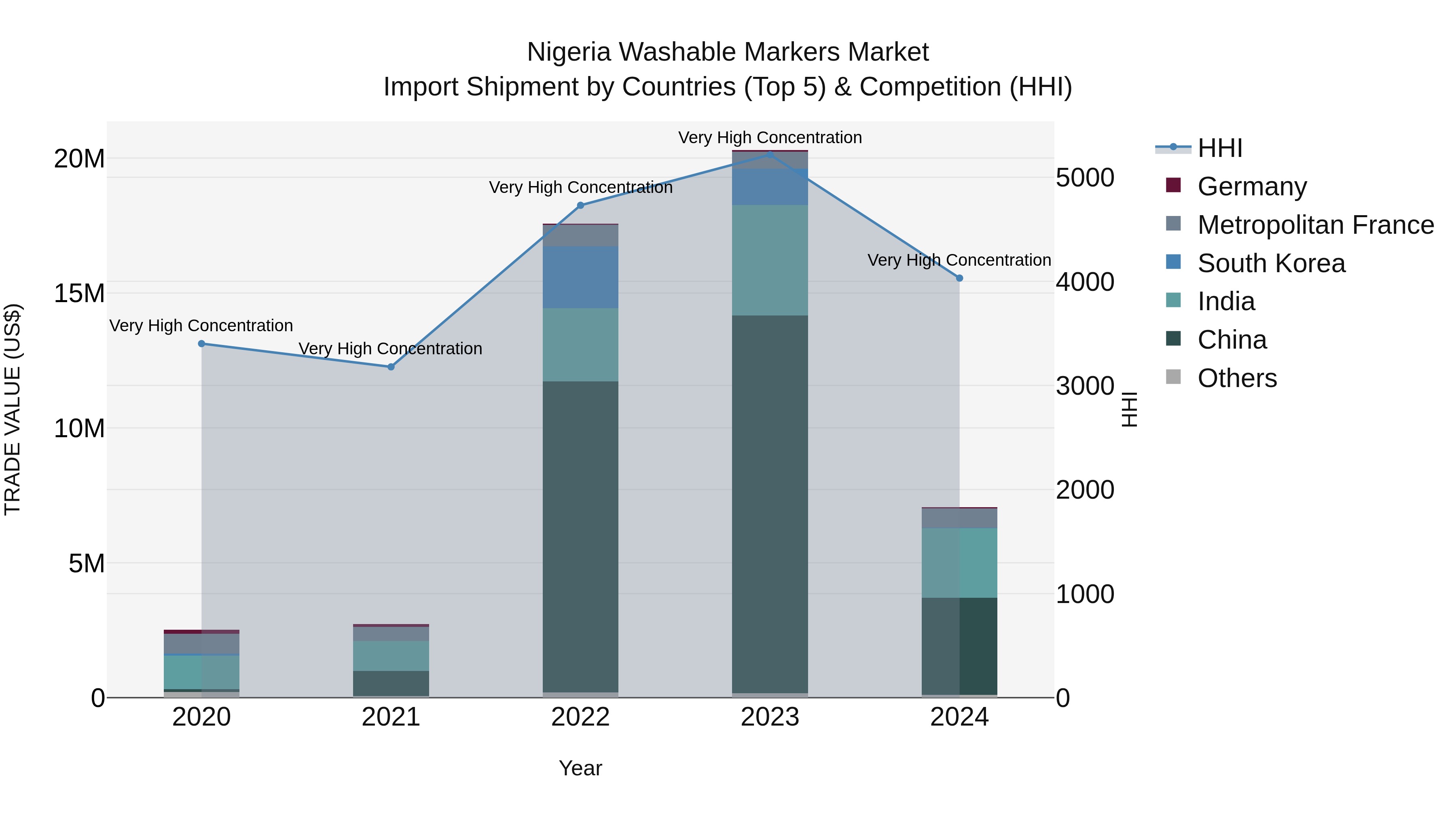
Nigeria Washable Markers Market Overview
The Nigeria washable markers market is experiencing steady growth driven by factors such as increasing disposable income, growing emphasis on children`s education and creativity, and the rise in demand for non-toxic and eco-friendly art supplies. The market is characterized by a wide range of products offered by both domestic and international manufacturers, catering to various age groups and preferences. Key players are focusing on product innovation, such as markers with longer-lasting ink and unique tip designs, to differentiate themselves in this competitive market. Distribution channels include supermarkets, stationery stores, online retailers, and educational institutions. Going forward, the market is expected to continue expanding as consumers become more conscious of product safety and environmental sustainability, driving further innovation and competition among market players.
Nigeria Washable Markers Market Trends
The Nigeria Washable Markers Market is experiencing a growing demand for eco-friendly and non-toxic markers as consumers become more conscious of environmental sustainability and product safety. This trend is driving manufacturers to develop washable markers that are free of harmful chemicals and easy to clean, appealing to parents and educators who prioritize child safety and health. Additionally, there is a rising preference for markers with dual tips, vibrant colors, and long-lasting ink to cater to diverse artistic needs and preferences. The market is also witnessing an increase in online sales and marketing activities, with brands leveraging social media platforms to engage with consumers and promote their products effectively. Overall, the Nigeria Washable Markers Market is evolving to meet the changing demands and preferences of consumers, focusing on sustainability, safety, and innovation.
Nigeria Washable Markers Market Challenges
In the Nigeria Washable Markers Market, challenges are primarily related to competition from low-quality and counterfeit products, which can undermine consumer trust in the overall product category. Additionally, fluctuations in raw material prices and currency exchange rates can impact the cost of production and pricing strategies for manufacturers. Distribution challenges, such as unreliable supply chains and limited access to retail channels, can also hinder market growth and penetration. Furthermore, consumer awareness and education about the benefits of washable markers compared to traditional markers may present a challenge in expanding market demand. Overall, navigating these challenges requires strategic marketing efforts, quality control measures, and partnerships with reliable suppliers and retailers to establish a strong presence in the Nigeria Washable Markers Market.
Nigeria Washable Markers Market Investment Opportunities
In the Nigeria Washable Markers Market, there are several investment opportunities for both local and international companies. With a growing population of young students and increasing focus on education, the demand for washable markers is on the rise. Investing in innovative and eco-friendly washable markers that are non-toxic and easy to clean would appeal to environmentally-conscious consumers. Additionally, partnering with schools, art centers, and office supply stores to distribute these markers can help reach a wider audience. Exploring online sales channels and e-commerce platforms can also be a lucrative investment opportunity, considering the increasing trend of online shopping in Nigeria. Overall, investing in the Nigeria Washable Markers Market presents a promising opportunity for companies to tap into a growing market and meet the evolving needs of consumers.
Nigeria Washable Markers Market Government Policy
In Nigeria, government policies related to the Washable Markers Market primarily revolve around ensuring consumer safety and environmental protection. The National Agency for Food and Drug Administration and Control (NAFDAC) regulates the importation, manufacturing, and sale of washable markers to ensure they meet safety standards and do not contain harmful chemicals. Additionally, the Federal Ministry of Environment enforces waste management regulations to ensure proper disposal of markers to prevent environmental pollution. Importers and manufacturers are required to adhere to these policies to operate in the market, promoting consumer trust and environmental sustainability. Overall, the government plays a crucial role in safeguarding the health of consumers and the environment in the Nigeria Washable Markers Market through stringent regulatory measures.
Nigeria Washable Markers Market Future Outlook
The Nigeria Washable Markers Market is poised for steady growth in the coming years due to increasing demand from the education sector, rising popularity of coloring activities among children, and the growing trend of DIY projects among adults. The market is expected to benefit from the rising disposable income levels, expanding urban population, and the emphasis on creativity and art-based learning in schools. Manufacturers are likely to focus on product innovation, such as introducing eco-friendly and non-toxic markers, to cater to the increasing awareness of sustainable and safe products among consumers. Additionally, the penetration of e-commerce platforms in Nigeria is anticipated to provide a wider reach for market players to target a larger consumer base, further boosting the market growth prospects in the foreseeable future.
Key Highlights of the Report:
- Nigeria Washable Markers Market Outlook
- Market Size of Nigeria Washable Markers Market, 2024
- Forecast of Nigeria Washable Markers Market, 2031
- Historical Data and Forecast of Nigeria Washable Markers Revenues & Volume for the Period 2021 - 2031
- Nigeria Washable Markers Market Trend Evolution
- Nigeria Washable Markers Market Drivers and Challenges
- Nigeria Washable Markers Price Trends
- Nigeria Washable Markers Porter's Five Forces
- Nigeria Washable Markers Industry Life Cycle
- Historical Data and Forecast of Nigeria Washable Markers Market Revenues & Volume By Washability for the Period 2021 - 2031
- Historical Data and Forecast of Nigeria Washable Markers Market Revenues & Volume By Basic- Washable for the Period 2021 - 2031
- Historical Data and Forecast of Nigeria Washable Markers Market Revenues & Volume By Super-washable for the Period 2021 - 2031
- Historical Data and Forecast of Nigeria Washable Markers Market Revenues & Volume By End User for the Period 2021 - 2031
- Historical Data and Forecast of Nigeria Washable Markers Market Revenues & Volume By Children for the Period 2021 - 2031
- Historical Data and Forecast of Nigeria Washable Markers Market Revenues & Volume By Professionals for the Period 2021 - 2031
- Nigeria Washable Markers Import Export Trade Statistics
- Market Opportunity Assessment By Washability
- Market Opportunity Assessment By End User
- Nigeria Washable Markers Top Companies Market Share
- Nigeria Washable Markers Competitive Benchmarking By Technical and Operational Parameters
- Nigeria Washable Markers Company Profiles
- Nigeria Washable Markers Key Strategic Recommendations






































