North America FPGA Market Size & Growth Rate
According to 6Wresearch internal database and industry insights, the North America FPGA Market was valued at USD 2.9 billion in 2025 and is projected to reach nearly USD 5.2 billion by 2032, exhibiting a compound annual growth rate (CAGR) of 9.5% during the forecast period (2026-2032).
North America FPGA Market Year-wise Growth Rate and Key Drivers (2022-2032)
This graph illustrates the annual growth rates of the North America FPGA Market from 2022 to 2032, highlighting stable industrial expansion, infrastructure-driven demand, and increasing adoption of precision finishing solutions.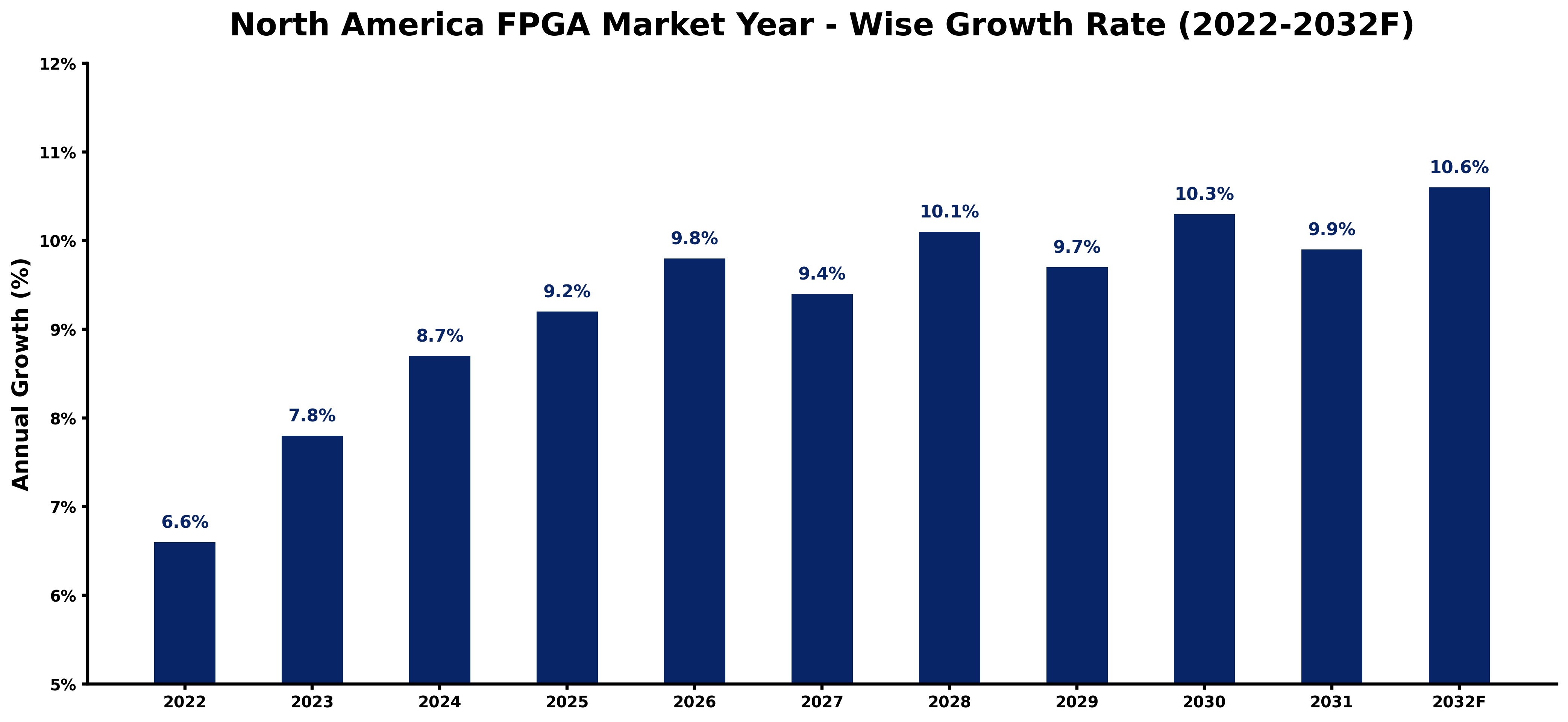
The following table summarizes the historical and forecasted growth rates of the North America FPGA Market, along with the rationale behind each year’s performance.
| Year | Estimated Growth (%) | Market Rationale |
| 2022 | 6.6% | Recovery in industrial automation and communications infrastructure investments. |
| 2023 | 7.8% | Rising adoption of FPGAs in data centers, 5G equipment, and automotive electronics. |
| 2024 | 8.7% | Increased deployment in AI acceleration, edge computing, and defense applications. |
| 2025 | 9.2% | Expansion of cloud infrastructure and high-performance computing supports demand. |
| 2026 | 9.8% | Strong uptake across AI, networking, and aerospace aligns with forecast period. |
| 2027 | 9.4% | Temporary moderation due to semiconductor inventory normalization and pricing adjustments. |
| 2028 | 10.1% | Growth driven by advanced driver-assistance systems (ADAS) and AI workloads. |
| 2029 | 9.7% | Continued expansion in telecom and embedded computing with balanced market demand. |
| 2030 | 10.3% | Higher investments in defense modernization, edge AI, and next-generation networking. |
| 2031 | 9.9% | Stable enterprise and industrial adoption with sustained innovation in programmable logic. |
| 2032 | 10.6% | Mature AI, aerospace, automotive, and cloud applications maintain strong market momentum. |
Topics Covered in the North America FPGA Market Report
The North America FPGA Market report thoroughly covers the market by countries, configurations, technologies, node sizes, components, and applications. The market report provides an unbiased and detailed analysis of ongoing trends, opportunities, and market drivers, helping stakeholders align their strategies with current and future dynamics.
North America FPGA Market Highlights
| Report Name | North America FPGA Market |
| Forecast Period | 2026-2032 |
| Market Size | USD 5.2 billion by 2032 |
| CAGR | 9.5% |
| Growing Sector | Semiconductor & Electronics |
North America FPGA Market Synopsis
The North America FPGA market is expected to grow significantly. The market is mainly driven by advancements in digital electronics, AI, and IoT applications. Moreover, FPGA technologies provide increased flexibility, performance, and energy efficiency, making them suitable for data centers, telecommunications, automotive, and consumer electronics. Also, with continuous demand for high-performance computing solutions, the market is expected to expand steadily during the forecast period, particularly within automotive and telecommunications sectors.
Evaluation of Growth Drivers in the North America FPGA Market
Below mentioned are some key growth drivers and their influence on market dynamics:
| Drivers | Primary Segments Affected | Why It Matters |
| 5G Networks & IoT Adoption | Technology & Telecommunication | Drives the need for low-latency, high-performance FPGA chips in telecom infrastructure. |
| High-Performance Computing (HPC) | Data Centers & Consumer Electronics | High-end FPGAs enable efficient data processing thus reduces time and energy consumption. |
| Automotive Advancements | Automotive Industry | FPGAs are important for real-time processing in autonomous vehicles and ADAS systems. |
| AI and Machine Learning | Technology & Consumer Electronics | Increased need for FPGAs to boost up AI and ML workloads for faster and more efficient processing. |
The North America FPGA market is expected to have significant growth at a CAGR of 9.5% during the forecast period of 2026-2032. One of the main factors that is pushing the North America FPGA Market forward is the soaring demand for high-performance computing among the telecom, automotive, and defense industries. The increasing use of IoT, AI, and machine learning technologies is creating the requirement for versatile and strong processing power. Besides, the 5G networks, self-driving cars, and edge computing are making FPGA integration more attractive. The transition to eco-friendly solutions and real-time data processing is also a major driving factor in the FPGA market. Besides that, the government is backing the semiconductor industry, along with the tech innovations in FPGA design, such that the market is becoming more and more expansive.
Evaluation of Restraints in the North America FPGA Market
Below mentioned are some major restraints and their influence on market dynamics:
| Restraints | Primary Segments Affected | What This Means |
| High Design & Development Costs | All Configurations & Technologies | Increases upfront costs and hampers adoption among small-scale applications. |
| Competition from ASICs | High-End FPGA | In application mass production, ASICs offer lower unit costs and higher performance. |
| Design Complexity | Low-End & Mid-Range FPGA | Increases the need for skilled professionals and advanced design tools. |
North America FPGA Market Challenges
The North America FPGA Market is expected to witness robust growth, despite this a lot of factors hamper its expansion. These factors include high design and development costs, which hamper widespread adoption among smaller enterprises. Additionally, competition from application-specific integrated circuits (ASICs) in mass production applications, like mobile devices, poses a threat to FPGA’s growth in such sectors.
North America FPGA Market Trends
Some of the key trends contributing to the development of the North America FPGA Market Growth are:
- AI-Optimized FPGA: Growing use of AI-driven FPGA designs to increase computing performance, lower energy consumption, and support machine learning tasks.
- Edge Computing Growth: Increasing demand for FPGA-powered edge devices in industrial IoT, automotive, and telecommunications sectors.
- Integration in 5G Infrastructure: increased adoption of FPGAs in 5G base stations and networks for their flexibility and performance.
- Customization & Flexibility: Increasing preference for customizable FPGA designs, particularly in emerging applications like AI and automotive.
Investment Opportunities in the North America FPGA Market
Here are some investment opportunities in the North America FPGA Industry:
- Development of Low-Cost FPGAs: Innovate low-cost FPGAs to capture emerging markets such as IoT and consumer electronics, where budget constraints are a key factor.
- Advanced AI-Powered FPGA Solutions: Focus on R&D for AI-based FPGA designs targeting high-performance computing and smart devices.
- Expansion into Autonomous Vehicles: Invest in FPGAs tailored for automotive applications, particularly ADAS and self-driving cars.
- Managed FPGA Solutions: Provide FPGA-as-a-service models to cater to small- and medium-sized enterprises (SMEs) with lower upfront capital expenditure.
Top 5 Leading Players in the North America FPGA Market
Here are some top companies contributing to North America FPGA Market Share:
1. Xilinx, Inc.
| Company Name | Xilinx, Inc. |
|---|---|
| Established Year | 1984 |
| Headquarters | San Jose, California, USA |
| Official Website | Click Here |
Xilinx is a leader in programmable logic devices, offering innovative FPGA solutions across industries like telecommunications, automotive, and aerospace. The company specializes in high-performance computing and custom hardware acceleration.
2. Intel Corporation
| Company Name | Intel Corporation |
|---|---|
| Established Year | 1968 |
| Headquarters | Santa Clara, California, USA |
| Official Website | Click Here |
Intel provides a wide range of FPGA solutions under the Intel FPGA brand, driving innovations in data centers, telecommunications, automotive, and industrial applications with high-performance, energy-efficient designs.
3. Microsemi Corporation (Acquired by Microchip Technology)
| Company Name | Microsemi Corporation (Acquired by Microchip Technology) |
|---|---|
| Established Year | 1983 |
| Headquarters | Chandler, Arizona, USA |
| Official Website | Click Here |
Microsemi, now part of Microchip Technology, is a key player in FPGA manufacturing, particularly for embedded applications in automotive, aerospace, and communications sectors.
4. Lattice Semiconductor Corporation
| Company Name | Lattice Semiconductor Corporation |
|---|---|
| Established Year | 1983 |
| Headquarters | Hillsboro, Oregon, USA |
| Official Website | Click Here |
Lattice Semiconductor focuses on low-power FPGA solutions, catering to markets like consumer electronics, automotive, and industrial automation, with a focus on efficiency and compact designs.
5. Achronix Semiconductor Corporation
| Company Name | Achronix Semiconductor Corporation |
|---|---|
| Established Year | 2004 |
| Headquarters | Santa Clara, California, USA |
| Official Website | Click Here |
Achronix is a leading provider of high-performance FPGAs for data-intensive applications, including machine learning, networking, and data centers. Their Speedster7t FPGA is designed for high-bandwidth, low-latency applications.
Government Regulations Introduced in the North America FPGA Market
Government regulations in North America are contributing to the growth of the FPGA market through funding programs for semiconductor R&D. The U.S. Department of Energy (DOE) allocates significant investments in supercomputing, which depends on FPGA technology to achieve optimal performance. Furthermore, Canada’s innovation programs support AI and 5G infrastructure development, where FPGA technology plays a key role in accelerating data processing and performance.
Future Insights of the North America FPGA Market
The North America FPGA Market is set for sustained expansion during the forecast period. Propelled by innovations in AI, machine learning, and 5G technology the market is expected to witness strong growth. The growing demand for high-performance computing and low-latency solutions across diverse sectors, such as automotive, telecommunications, and consumer electronics, will drive market growth. The emergence of edge computing and driverless vehicles will further accelerate FPGA use. The future of FPGA technology in North America appears auspicious as an increasing number of enterprises allocate resources to research and development and product creation.
Market Segmentation Analysis
The report offers a comprehensive study of the subsequent market segments and their leading categories.
High-End FPGA to Dominate the Market- By Configuration
According to Guneet Kaur, Senior Research Analyst, 6Wresearch, high-end FPGAs are the fastest-growing segment, driven by their advanced capabilities in handling complex workloads like AI, data centers, and telecommunications, offering high performance and scalability for next-generation applications.
SRAM Technology to Dominate the Market - By Technology
SRAM-based FPGAs are gaining significant traction due to their fast processing speeds and suitability for high-performance applications. These FPGAs are preferred in industries requiring real-time processing, such as telecommunications and defense, offering flexibility and high-speed operations.
<16 NM Node Size to Dominate the Market - By Node Size
FPGAs with <16 NM node size are experiencing rapid adoption due to their power efficiency, speed, and compact form factor, making them ideal for cutting-edge applications like 5G, AI, and edge computing, where performance and low power consumption are crucial.
Key attractiveness of the report
- 10 Years Market Numbers.
- Historical Data Starting from 2022 to 2025.
- Base Year: 2025
- Forecast Data until 2032.
- Key Performance Indicators Impacting the Market.
- Major Upcoming Developments and Projects.
Key Highlights of the Report:
- North America FPGA Market Outlook
- Market Size of North America FPGA Market, 2025
- Forecast of North America FPGA Market, 2032
- Historical Data and Forecast of North America FPGA Revenues & Volume for the Period 2022 - 2032
- North America FPGA Market Trend Evolution
- North America FPGA Market Drivers and Challenges
- North America FPGA Price Trends
- North America FPGA Porter's Five Forces
- North America FPGA Industry Life Cycle
- Historical Data and Forecast of North America FPGA Market Revenues & Volume By Configuration for the Period 2022 - 2032
- Historical Data and Forecast of North America FPGA Market Revenues & Volume By Low-End FPGA for the Period 2022 - 2032
- Historical Data and Forecast of North America FPGA Market Revenues & Volume By Mid-Range FPGA for the Period 2022 - 2032
- Historical Data and Forecast of North America FPGA Market Revenues & Volume By High-End FPGA for the Period 2022 - 2032
- Historical Data and Forecast of United States FPGA Market Revenues & Volume By Configuration for the Period 2022 - 2032
- Historical Data and Forecast of United States FPGA Market Revenues & Volume By Low-End FPGA for the Period 2022 - 2032
- Historical Data and Forecast of United States FPGA Market Revenues & Volume By Mid-Range FPGA for the Period 2022 - 2032
- Historical Data and Forecast of United States FPGA Market Revenues & Volume By High-End FPGA for the Period 2022 - 2032
- Historical Data and Forecast of Canada FPGA Market Revenues & Volume By Configuration for the Period 2022 - 2032
- Historical Data and Forecast of Canada FPGA Market Revenues & Volume By Low-End FPGA for the Period 2022 - 2032
- Historical Data and Forecast of Canada FPGA Market Revenues & Volume By Mid-Range FPGA for the Period 2022 - 2032
- Historical Data and Forecast of Canada FPGA Market Revenues & Volume By High-End FPGA for the Period 2022 - 2032
- Historical Data and Forecast of North America FPGA Market Revenues & Volume By Technology for the Period 2022 - 2032
- Historical Data and Forecast of North America FPGA Market Revenues & Volume By SRAM for the Period 2022 - 2032
- Historical Data and Forecast of North America FPGA Market Revenues & Volume By Flash for the Period 2022 - 2032
- Historical Data and Forecast of North America FPGA Market Revenues & Volume By Antifuse for the Period 2022 - 2032
- Historical Data and Forecast of United States FPGA Market Revenues & Volume By Technology for the Period 2022 - 2032
- Historical Data and Forecast of United States FPGA Market Revenues & Volume By SRAM for the Period 2022 - 2032
- Historical Data and Forecast of United States FPGA Market Revenues & Volume By Flash for the Period 2022 - 2032
- Historical Data and Forecast of United States FPGA Market Revenues & Volume By Antifuse for the Period 2022 - 2032
- Historical Data and Forecast of Canada FPGA Market Revenues & Volume By Technology for the Period 2022 - 2032
- Historical Data and Forecast of Canada FPGA Market Revenues & Volume By SRAM for the Period 2022 - 2032
- Historical Data and Forecast of Canada FPGA Market Revenues & Volume By Flash for the Period 2022 - 2032
- Historical Data and Forecast of Canada FPGA Market Revenues & Volume By Antifuse for the Period 2022 - 2032
- Historical Data and Forecast of North America FPGA Market Revenues & Volume By Node Size for the Period 2022 - 2032
- Historical Data and Forecast of North America FPGA Market Revenues & Volume By ?16 NM for the Period 2022 - 2032
- Historical Data and Forecast of North America FPGA Market Revenues & Volume By 20-90 NM for the Period 2022 - 2032
- Historical Data and Forecast of North America FPGA Market Revenues & Volume By >90 NM for the Period 2022 - 2032
- Historical Data and Forecast of United States FPGA Market Revenues & Volume By Node Size for the Period 2022 - 2032
- Historical Data and Forecast of United States FPGA Market Revenues & Volume By ?16 NM for the Period 2022 - 2032
- Historical Data and Forecast of United States FPGA Market Revenues & Volume By 20-90 NM for the Period 2022 - 2032
- Historical Data and Forecast of United States FPGA Market Revenues & Volume By >90 NM for the Period 2022 - 2032
- Historical Data and Forecast of Canada FPGA Market Revenues & Volume By Node Size for the Period 2022 - 2032
- Historical Data and Forecast of Canada FPGA Market Revenues & Volume By ?16 NM for the Period 2022 - 2032
- Historical Data and Forecast of Canada FPGA Market Revenues & Volume By 20-90 NM for the Period 2022 - 2032
- Historical Data and Forecast of Canada FPGA Market Revenues & Volume By >90 NM for the Period 2022 - 2032
- North America FPGA Market - Key Performance Indicators
- North America FPGA Market - Import Export Trade Statistics
- North America FPGA Market - Opportunity Assessment By Countries
- North America FPGA Market - Opportunity Assessment By Configuration
- North America FPGA Market - Opportunity Assessment By Technology
- North America FPGA Market - Opportunity Assessment By Node Size
- North America FPGA Market - Top Companies Market Share
- North America FPGA Market - Top Companies Profiles
- North America FPGA Market - Comparison of Players in Technical and Operating Parameters
- North America FPGA Market - Strategic Recommendations
Market Covered
The report subsequently cover the market by following segments and subsegments:
By Countries
- United States
- Canada
By Configuration
- Low-End FPGA
- Mid-Range FPGA
- High-End FPGA
By Technology
- SRAM
- Flash
- Antifuse
By Node Size
- <16 NM
- 20-90 NM
- >90 NM






































