Norway Antifreeze Market Growth Rate Analysis (2025 - 2031)
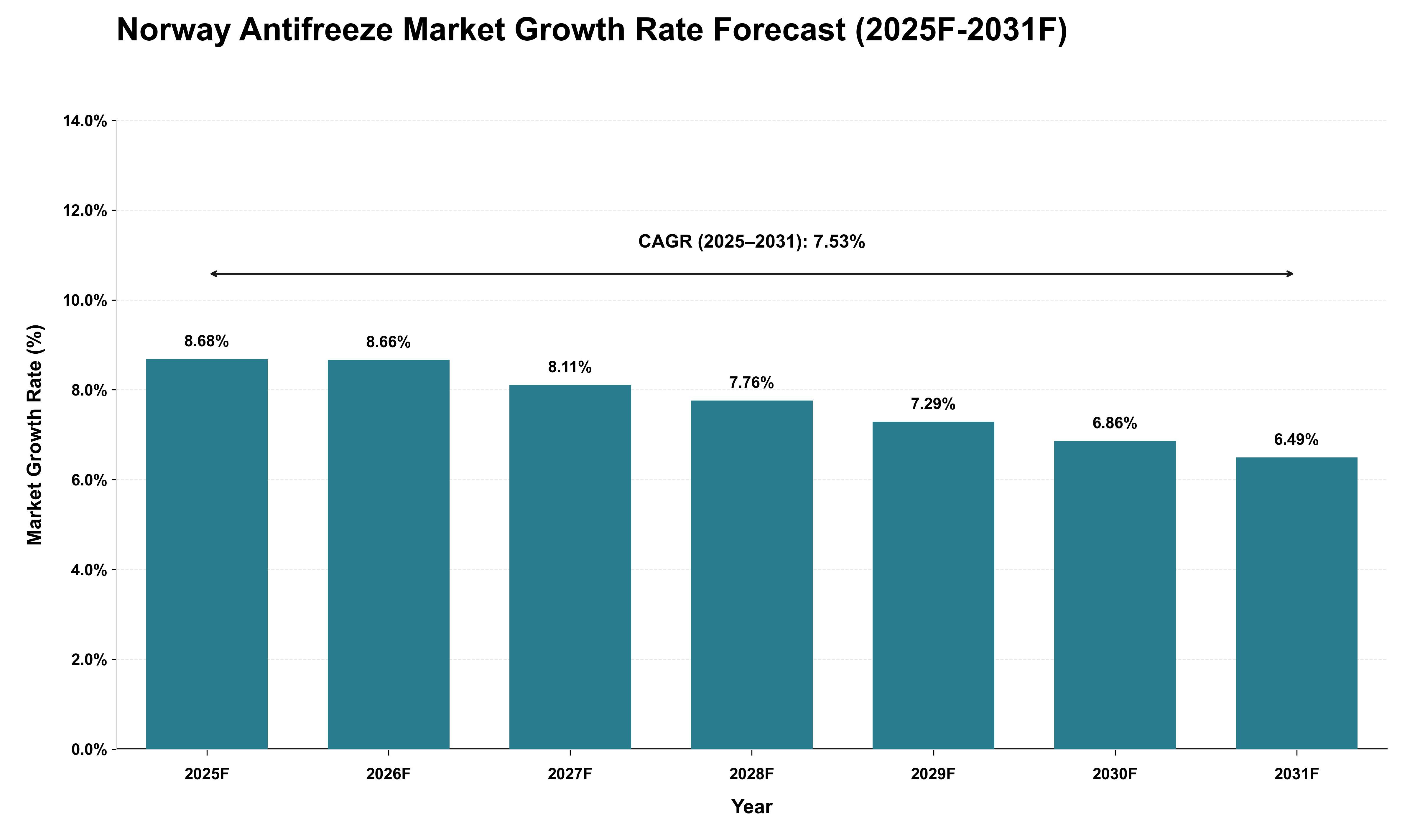
From 2025 onward, the Norwegian antifreeze market is poised to experience robust growth, driven by technological advancements and product substitution dynamics. The projected compound annual growth rate (CAGR) of 7.53% reflects a strong demand for high-performance antifreeze formulations that enhance vehicle efficiency and environmental compliance. As consumers increasingly prioritize sustainability, manufacturers will likely pivot towards bio-based alternatives, fostering innovation in product offerings. The annual growth rates indicate a gradual decline over the forecast period, suggesting that while initial adoption of advanced formulations may surge, the market will stabilize as competition intensifies and consumer preferences evolve. Additionally, Norway's reliance on imported raw materials for antifreeze production could influence pricing structures and availability, further shaping market dynamics. Overall, the interplay between technological evolution and shifting consumer demands will define the trajectory of this sector through 2031.
Key Highlights of the Report:
- Norway Antifreeze Market Outlook
- Market Size of Norway Antifreeze Market, 2024
- Forecast of Norway Antifreeze Market, 2031
- Historical Data and Forecast of Norway Antifreeze Revenues & Volume for the Period 2021-2031
- Norway Antifreeze Market Trend Evolution
- Norway Antifreeze Market Drivers and Challenges
- Norway Antifreeze Price Trends
- Norway Antifreeze Porter`s Five Forces
- Norway Antifreeze Industry Life Cycle
- Historical Data and Forecast of Norway Antifreeze Market Revenues & Volume By Product for the Period 2021-2031
- Historical Data and Forecast of Norway Antifreeze Market Revenues & Volume By Ethylene Glycol for the Period 2021-2031
- Historical Data and Forecast of Norway Antifreeze Market Revenues & Volume By Propylene Glycol for the Period 2021-2031
- Historical Data and Forecast of Norway Antifreeze Market Revenues & Volume By Glycerine for the Period 2021-2031
- Historical Data and Forecast of Norway Antifreeze Market Revenues & Volume By Application for the Period 2021-2031
- Historical Data and Forecast of Norway Antifreeze Market Revenues & Volume By Automotive for the Period 2021-2031
- Historical Data and Forecast of Norway Antifreeze Market Revenues & Volume By Aerospace for the Period 2021-2031
- Historical Data and Forecast of Norway Antifreeze Market Revenues & Volume By Industrial heat transfer and cooling applications for the Period 2021-2031
- Historical Data and Forecast of Norway Antifreeze Market Revenues & Volume By Technology for the Period 2021-2031
- Historical Data and Forecast of Norway Antifreeze Market Revenues & Volume By OAT for the Period 2021-2031
- Historical Data and Forecast of Norway Antifreeze Market Revenues & Volume By HOAT for the Period 2021-2031
- Historical Data and Forecast of Norway Antifreeze Market Revenues & Volume By IAT for the Period 2021-2031
- Norway Antifreeze Import Export Trade Statistics
- Market Opportunity Assessment By Product
- Market Opportunity Assessment By Application
- Market Opportunity Assessment By Technology
- Norway Antifreeze Top Companies Market Share
- Norway Antifreeze Competitive Benchmarking By Technical and Operational Parameters
- Norway Antifreeze Company Profiles
- Norway Antifreeze Key Strategic Recommendations






































