Norway Artificial Flowers Market Growth Rate Analysis (2025 - 2031)
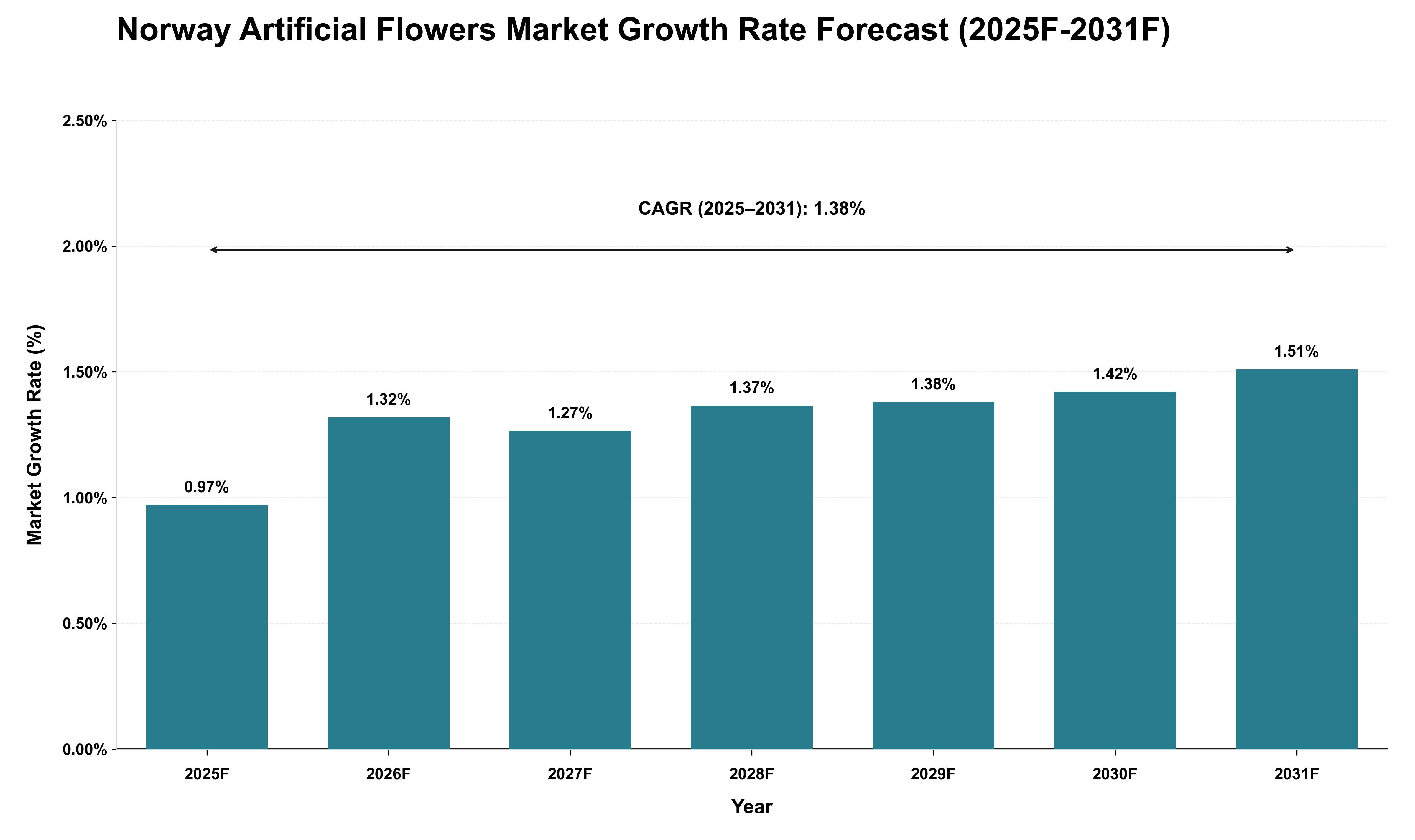
The Norway artificial flowers market is projected to experience a compound annual growth rate of 1.38% from 2025 to 2031, reflecting a gradual increase in demand driven by evolving consumer preferences and aesthetic trends. The anticipated annual growth rates suggest that input costs, particularly for synthetic materials and labor, will play a crucial role in shaping market dynamics. As global supply chains stabilize post-pandemic, fluctuations in raw material prices may influence production costs, impacting pricing strategies. Additionally, Norway's reliance on imports for certain components could lead to vulnerabilities in supply chain disruptions or tariff changes, affecting availability and cost structures. The incremental growth observed each year indicates that while demand will rise steadily, it will be essential for manufacturers to optimize their operations and manage input costs effectively to maintain profitability amidst these external pressures.
Key Highlights of the Report:
- Norway Artificial Flowers Market Outlook
- Market Size of Norway Artificial Flowers Market, 2024
- Forecast of Norway Artificial Flowers Market, 2031
- Historical Data and Forecast of Norway Artificial Flowers Revenues & Volume for the Period 2021-2031
- Norway Artificial Flowers Market Trend Evolution
- Norway Artificial Flowers Market Drivers and Challenges
- Norway Artificial Flowers Price Trends
- Norway Artificial Flowers Porter`s Five Forces
- Norway Artificial Flowers Industry Life Cycle
- Historical Data and Forecast of Norway Artificial Flowers Market Revenues & Volume By Material Type for the Period 2021-2031
- Historical Data and Forecast of Norway Artificial Flowers Market Revenues & Volume By Clay & Porcelain for the Period 2021-2031
- Historical Data and Forecast of Norway Artificial Flowers Market Revenues & Volume By Cotton & Silk for the Period 2021-2031
- Historical Data and Forecast of Norway Artificial Flowers Market Revenues & Volume By Leather & Nylon for the Period 2021-2031
- Historical Data and Forecast of Norway Artificial Flowers Market Revenues & Volume By Paper & Wax for the Period 2021-2031
- Historical Data and Forecast of Norway Artificial Flowers Market Revenues & Volume By Plastic & Polyester for the Period 2021-2031
- Historical Data and Forecast of Norway Artificial Flowers Market Revenues & Volume By Application for the Period 2021-2031
- Historical Data and Forecast of Norway Artificial Flowers Market Revenues & Volume By Commercial for the Period 2021-2031
- Historical Data and Forecast of Norway Artificial Flowers Market Revenues & Volume By Residential for the Period 2021-2031
- Norway Artificial Flowers Import Export Trade Statistics
- Market Opportunity Assessment By Material Type
- Market Opportunity Assessment By Application
- Norway Artificial Flowers Top Companies Market Share
- Norway Artificial Flowers Competitive Benchmarking By Technical and Operational Parameters
- Norway Artificial Flowers Company Profiles
- Norway Artificial Flowers Key Strategic Recommendations






































