Norway Asphalt Mixing Plants Market Growth Rate Analysis (2025 - 2031)
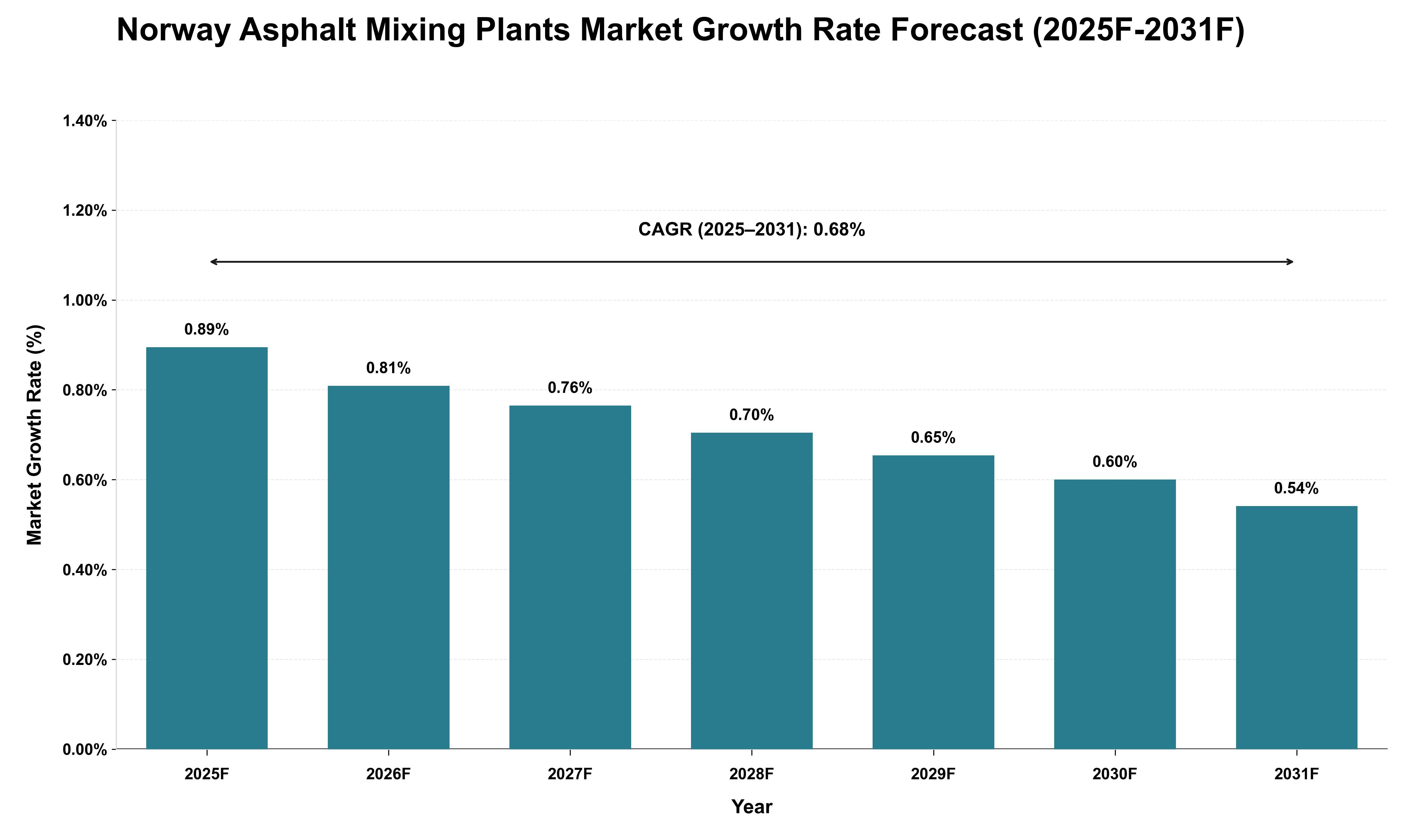
The Norway asphalt mixing plants market is poised to experience a gradual deceleration in growth, with an anticipated CAGR of 0.68% from 2025 to 2031. This trend will reflect a competitive landscape characterized by stable demand driven by ongoing infrastructure projects and maintenance needs, albeit at diminishing annual growth rates, starting at 0.89% in 2025 and tapering to 0.54% by 2031. The market dynamics will be influenced by import dependencies on specialized equipment and technology, which may face fluctuations due to global supply chain constraints and geopolitical factors. Additionally, cyclical trends in construction activity will play a crucial role; as public spending on infrastructure may fluctuate based on economic conditions, the asphalt mixing plants sector will likely adapt to these shifts while maintaining operational efficiency. Overall, the market's resilience will hinge on its ability to navigate these macroeconomic variables effectively.
Key Highlights of the Report:
- Norway Asphalt Mixing Plants Market Outlook
- Market Size of Norway Asphalt Mixing Plants Market, 2024
- Forecast of Norway Asphalt Mixing Plants Market, 2031
- Historical Data and Forecast of Norway Asphalt Mixing Plants Revenues & Volume for the Period 2021-2031
- Norway Asphalt Mixing Plants Market Trend Evolution
- Norway Asphalt Mixing Plants Market Drivers and Challenges
- Norway Asphalt Mixing Plants Price Trends
- Norway Asphalt Mixing Plants Porter`s Five Forces
- Norway Asphalt Mixing Plants Industry Life Cycle
- Historical Data and Forecast of Norway Asphalt Mixing Plants Market Revenues & Volume By Process for the Period 2021-2031
- Historical Data and Forecast of Norway Asphalt Mixing Plants Market Revenues & Volume By Batch for the Period 2021-2031
- Historical Data and Forecast of Norway Asphalt Mixing Plants Market Revenues & Volume By Continuous for the Period 2021-2031
- Historical Data and Forecast of Norway Asphalt Mixing Plants Market Revenues & Volume By Product for the Period 2021-2031
- Historical Data and Forecast of Norway Asphalt Mixing Plants Market Revenues & Volume By Portable for the Period 2021-2031
- Historical Data and Forecast of Norway Asphalt Mixing Plants Market Revenues & Volume By Stationary for the Period 2021-2031
- Historical Data and Forecast of Norway Asphalt Mixing Plants Market Revenues & Volume By Application for the Period 2021-2031
- Historical Data and Forecast of Norway Asphalt Mixing Plants Market Revenues & Volume By Road construction for the Period 2021-2031
- Historical Data and Forecast of Norway Asphalt Mixing Plants Market Revenues & Volume By Others for the Period 2021-2031
- Historical Data and Forecast of Norway Asphalt Mixing Plants Market Revenues & Volume By Capacity for the Period 2021-2031
- Historical Data and Forecast of Norway Asphalt Mixing Plants Market Revenues & Volume By Below 50T/H for the Period 2021-2031
- Historical Data and Forecast of Norway Asphalt Mixing Plants Market Revenues & Volume By 50-150T/H for the Period 2021-2031
- Historical Data and Forecast of Norway Asphalt Mixing Plants Market Revenues & Volume By 151-300T/H for the Period 2021-2031
- Historical Data and Forecast of Norway Asphalt Mixing Plants Market Revenues & Volume By Above 300T/H for the Period 2021-2031
- Norway Asphalt Mixing Plants Import Export Trade Statistics
- Market Opportunity Assessment By Process
- Market Opportunity Assessment By Product
- Market Opportunity Assessment By Application
- Market Opportunity Assessment By Capacity
- Norway Asphalt Mixing Plants Top Companies Market Share
- Norway Asphalt Mixing Plants Competitive Benchmarking By Technical and Operational Parameters
- Norway Asphalt Mixing Plants Company Profiles
- Norway Asphalt Mixing Plants Key Strategic Recommendations






































