Norway Boron Market Growth Rate Analysis (2025 - 2031)
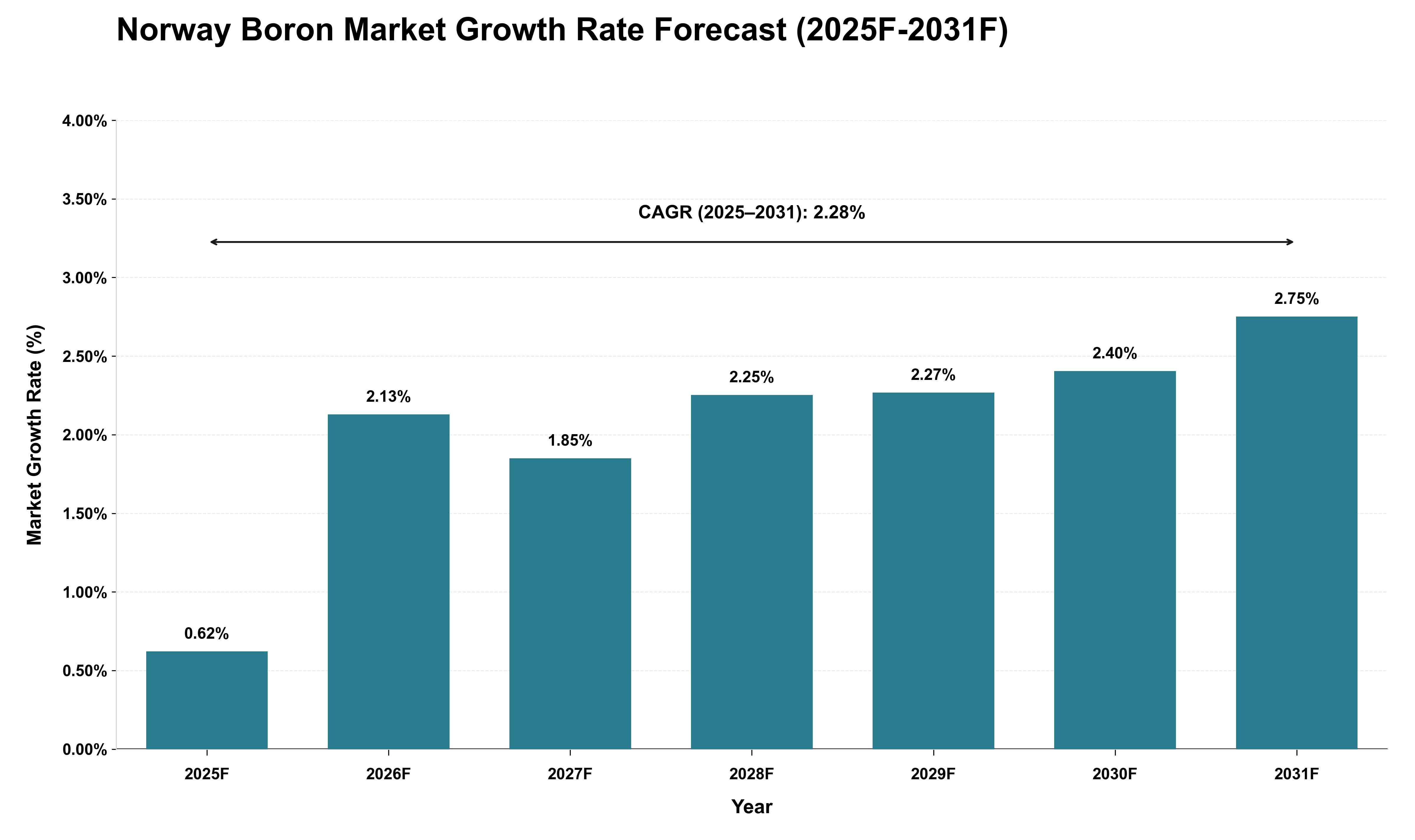
The outlook for the Norwegian boron market will be shaped by several macroeconomic factors, including increasing end-use demand in sectors such as glass manufacturing, agriculture, and ceramics. As global trends lean towards sustainable practices, the demand for boron in advanced materials and fertilizers is expected to rise, driving a compound annual growth rate (CAGR) of 2.28% from 2025 to 2031. The annual growth rates will reflect fluctuations in industrial activity; for instance, a projected increase to 2.75% by 2031 indicates a strengthening reliance on boron as industries adapt to evolving technological needs. Additionally, Norway's import dependencies may influence pricing dynamics and availability, particularly as global supply chains adjust post-pandemic. Overall, these factors will contribute to a steady upward trajectory in boron consumption across various applications throughout the forecast period.
Key Highlights of the Report:
- Norway Boron Market Outlook
- Market Size of Norway Boron Market, 2024
- Forecast of Norway Boron Market, 2031
- Historical Data and Forecast of Norway Boron Revenues & Volume for the Period 2021-2031
- Norway Boron Market Trend Evolution
- Norway Boron Market Drivers and Challenges
- Norway Boron Price Trends
- Norway Boron Porter`s Five Forces
- Norway Boron Industry Life Cycle
- Historical Data and Forecast of Norway Boron Market Revenues & Volume By Source for the Period 2021-2031
- Historical Data and Forecast of Norway Boron Market Revenues & Volume By Salt Lake Source for the Period 2021-2031
- Historical Data and Forecast of Norway Boron Market Revenues & Volume By Mine Source for the Period 2021-2031
- Historical Data and Forecast of Norway Boron Market Revenues & Volume By Others for the Period 2021-2031
- Historical Data and Forecast of Norway Boron Market Revenues & Volume By Application for the Period 2021-2031
- Historical Data and Forecast of Norway Boron Market Revenues & Volume By Glass for the Period 2021-2031
- Historical Data and Forecast of Norway Boron Market Revenues & Volume By Ceramics for the Period 2021-2031
- Historical Data and Forecast of Norway Boron Market Revenues & Volume By Agriculture for the Period 2021-2031
- Historical Data and Forecast of Norway Boron Market Revenues & Volume By Detergents for the Period 2021-2031
- Historical Data and Forecast of Norway Boron Market Revenues & Volume By Others for the Period 2021-2031
- Norway Boron Import Export Trade Statistics
- Market Opportunity Assessment By Source
- Market Opportunity Assessment By Application
- Norway Boron Top Companies Market Share
- Norway Boron Competitive Benchmarking By Technical and Operational Parameters
- Norway Boron Company Profiles
- Norway Boron Key Strategic Recommendations






































