Norway Canned Food Market Top 5 Importing Countries and Market Competition (HHI) Analysis
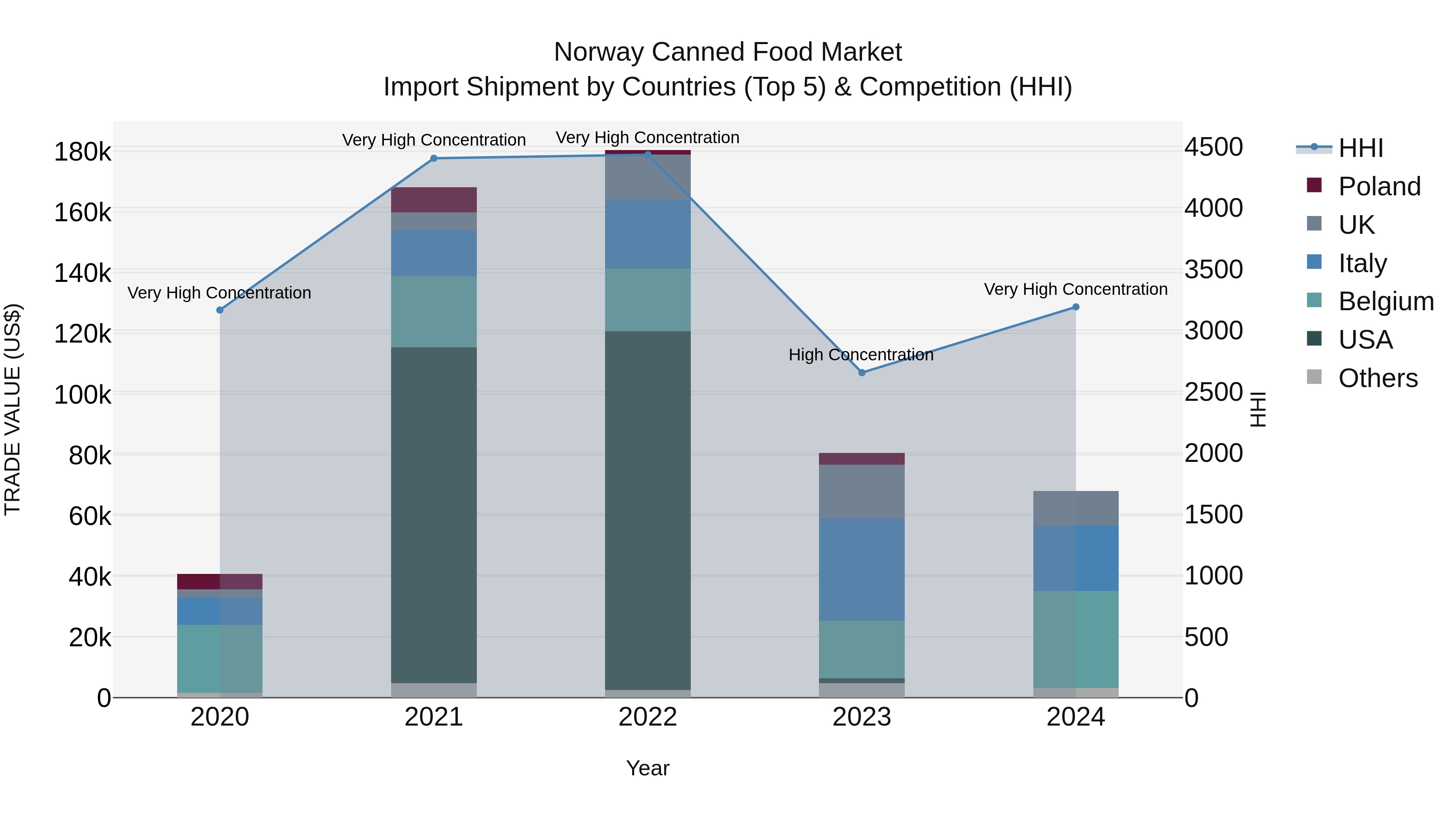
Norway`s canned food import market saw a significant increase in concentration in 2024, with top exporters being Belgium, Italy, UK, Spain, and Greece. Despite a decline in growth rate from 2023 to 2024, the compound annual growth rate (CAGR) from 2020 to 2024 remained strong at 13.65%. The high concentration of import shipments in 2024 suggests a competitive market landscape, potentially driving strategic partnerships and market positioning among suppliers. Monitoring these trends can help stakeholders navigate challenges and capitalize on opportunities in Norway`s canned food import industry.
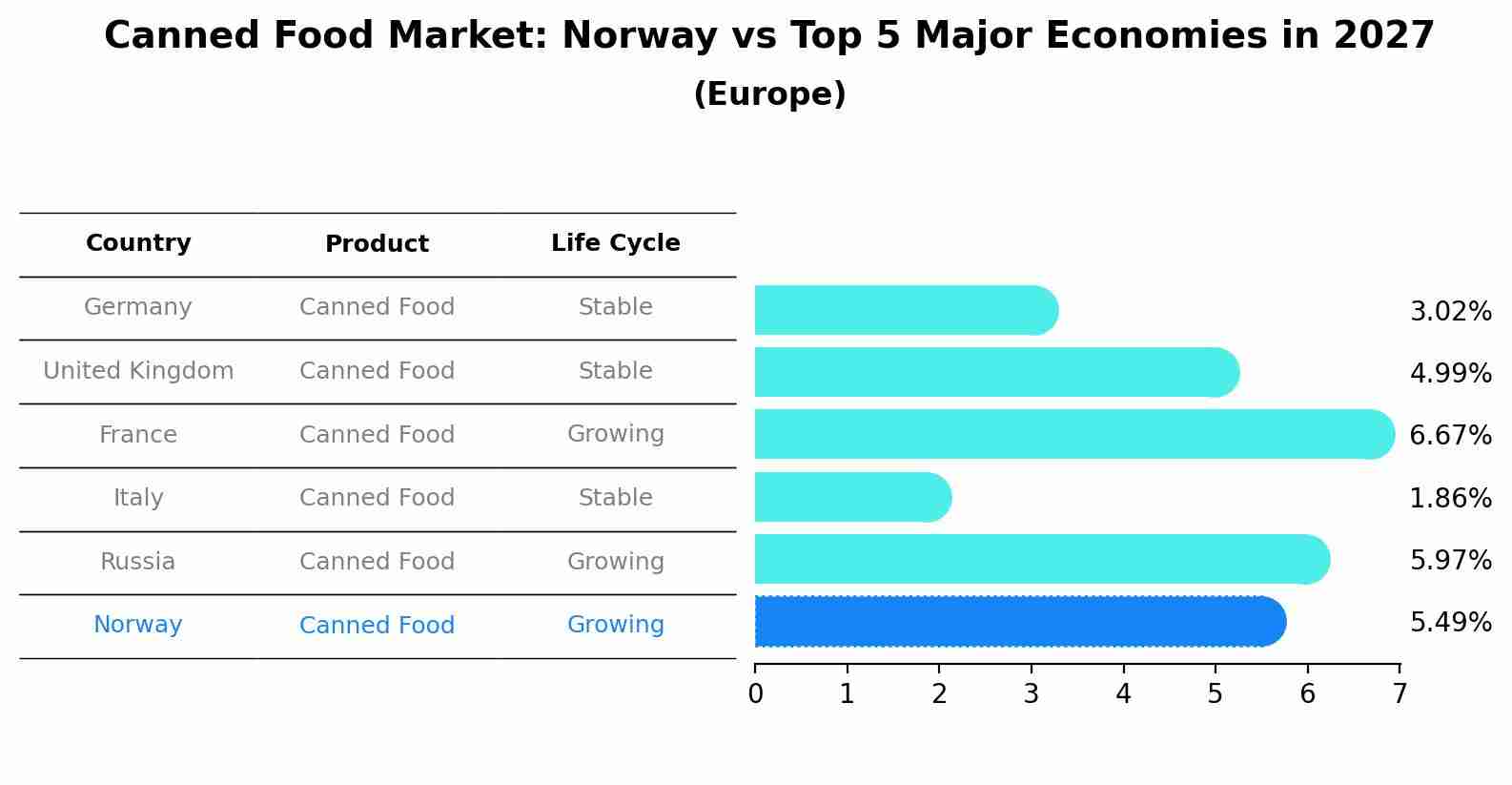
Canned Food Market: Norway vs Top 5 Major Economies in 2027 (Europe)
By 2027, Norway's Canned Food market is forecasted to achieve a growing growth rate of 5.49%, with Germany leading the Europe region, followed by United Kingdom, France, Italy and Russia.
Norway Canned Food Market Overview
The canned food market in Norway is growing as consumers seek convenient and long-lasting food options. Canned foods include a range of products such as fruits, vegetables, and meats, offering convenience and extended shelf life. The market is driven by consumer demand for ready-to-eat meals, advancements in canning technology, and the growing availability of diverse canned food products.
Drivers of the market
The growing demand for convenient and ready-to-eat meals is a primary driver of the canned food market in Norway. Busy lifestyles, increasing urbanization, and rising disposable incomes are propelling the consumption of canned products. Moreover, the push for longer shelf-life, coupled with advancements in food preservation technology, is fueling market demand across various food categories.
Challenges of the market
Challenges in the Norway Canned Food Market include fluctuating raw material prices and the need for compliance with food safety standards. The market is influenced by consumer demand for convenient and long-lasting food products, but competition from alternative food preservation methods and the need for continuous innovation add complexity.
Government Policy of the market
Food safety and sustainability are key factors in Norwegian policies affecting the canned food market. Government initiatives promoting long-shelf-life foods that reduce food waste and provide nutritional value play a significant role in shaping this market.
Key Highlights of the Report:
- Norway Canned Food Market Outlook
- Market Size of Norway Canned Food Market, 2024
- Forecast of Norway Canned Food Market, 2031
- Historical Data and Forecast of Norway Canned Food Revenues & Volume for the Period 2021-2031
- Norway Canned Food Market Trend Evolution
- Norway Canned Food Market Drivers and Challenges
- Norway Canned Food Price Trends
- Norway Canned Food Porter`s Five Forces
- Norway Canned Food Industry Life Cycle
- Historical Data and Forecast of Norway Canned Food Market Revenues & Volume By Product Type for the Period 2021-2031
- Historical Data and Forecast of Norway Canned Food Market Revenues & Volume By Canned meat & seafood for the Period 2021-2031
- Historical Data and Forecast of Norway Canned Food Market Revenues & Volume By Canned fruit & vegetables for the Period 2021-2031
- Historical Data and Forecast of Norway Canned Food Market Revenues & Volume By Canned ready meals for the Period 2021-2031
- Historical Data and Forecast of Norway Canned Food Market Revenues & Volume By Others for the Period 2021-2031
- Historical Data and Forecast of Norway Canned Food Market Revenues & Volume By Type for the Period 2021-2031
- Historical Data and Forecast of Norway Canned Food Market Revenues & Volume By Organic for the Period 2021-2031
- Historical Data and Forecast of Norway Canned Food Market Revenues & Volume By Conventional for the Period 2021-2031
- Historical Data and Forecast of Norway Canned Food Market Revenues & Volume By Distribution Channel for the Period 2021-2031
- Historical Data and Forecast of Norway Canned Food Market Revenues & Volume By Supermarket/Hypermarket for the Period 2021-2031
- Historical Data and Forecast of Norway Canned Food Market Revenues & Volume By Convenience stores for the Period 2021-2031
- Historical Data and Forecast of Norway Canned Food Market Revenues & Volume By E-commerce for the Period 2021-2031
- Historical Data and Forecast of Norway Canned Food Market Revenues & Volume By Others for the Period 2021-2031
- Norway Canned Food Import Export Trade Statistics
- Market Opportunity Assessment By Product Type
- Market Opportunity Assessment By Type
- Market Opportunity Assessment By Distribution Channel
- Norway Canned Food Top Companies Market Share
- Norway Canned Food Competitive Benchmarking By Technical and Operational Parameters
- Norway Canned Food Company Profiles
- Norway Canned Food Key Strategic Recommendations






































