Norway Cheese Ingredients Market Top 5 Importing Countries and Market Competition (HHI) Analysis
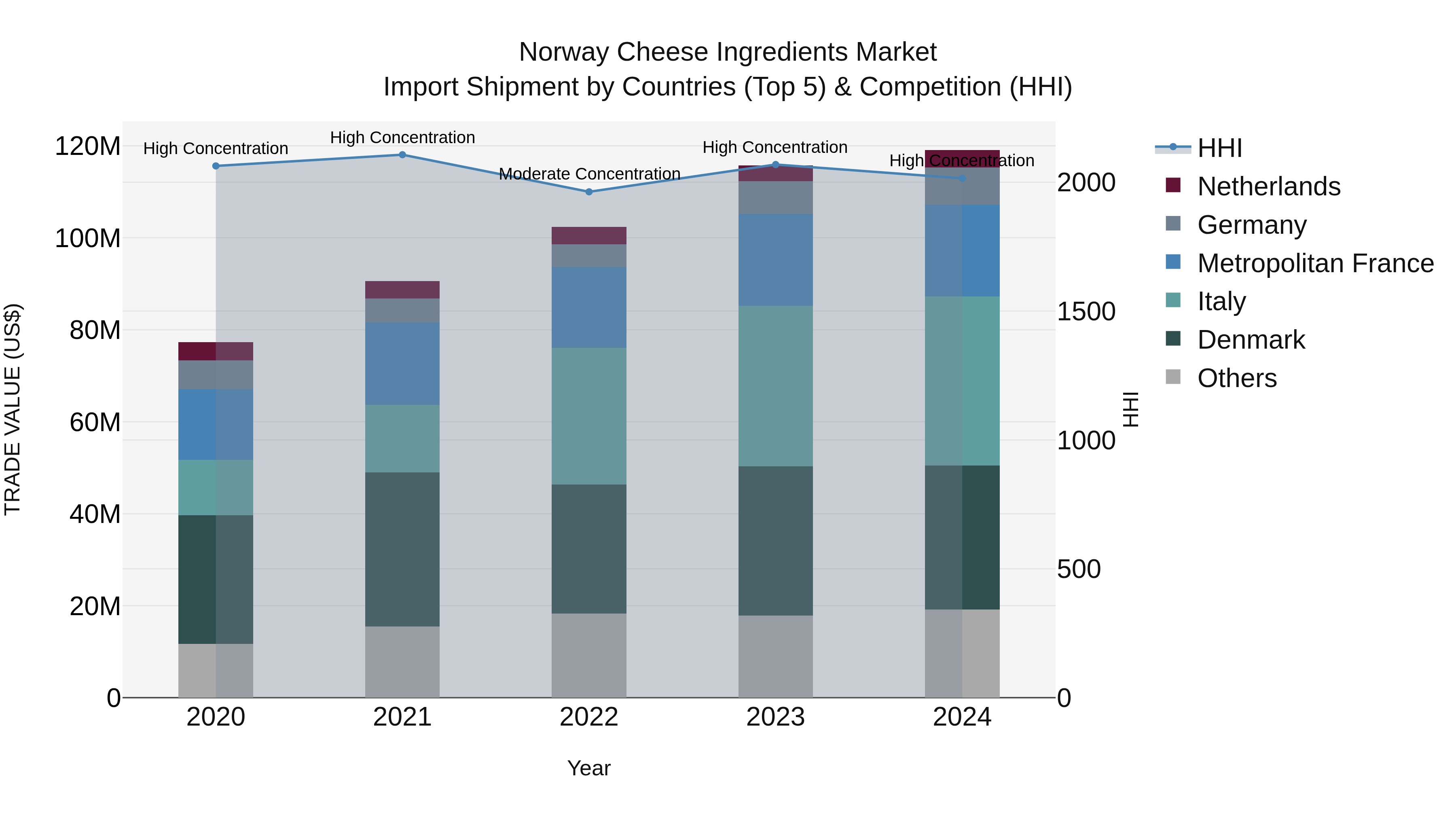
In 2024, Norway continued to witness significant imports of cheese ingredients, with top exporting countries being Italy, Denmark, Metropolitan France, Germany, and Spain. The market displayed high concentration levels, as indicated by the Herfindahl-Hirschman Index (HHI). The compound annual growth rate (CAGR) from 2020 to 2024 stood at a notable 11.4%, showcasing a robust expansion in the sector. Additionally, the growth rate from 2023 to 2024 was 2.84%, indicating steady momentum in the importation of cheese ingredients into Norway.
Norway Cheese Ingredients Market Overview
The Cheese Ingredients market in Norway is growing as cheese production requires various ingredients such as milk, cultures, enzymes, and additives. The market is driven by increasing demand for cheese products, advancements in ingredient technologies, and the expansion of the dairy industry. Innovations in cheese ingredient formulations and processing technologies are also contributing to market growth.
Drivers of the market
The Norway Cheese Ingredients Market benefits from the growing consumption of cheese in households and the foodservice industry. The demand for high-quality, natural ingredients in cheese production fuels the market.
Challenges of the market
The cheese ingredients market in Norway faces challenges due to fluctuating milk prices, which significantly affect production costs. Additionally, consumer demand for plant-based alternatives and increasing scrutiny of dairy`s environmental impact have slowed the market`s growth. Compliance with strict food safety regulations further complicates ingredient sourcing and product development.
Government Policy of the market
The cheese ingredients market in Norway is heavily influenced by government policies focused on food safety, quality standards, and agricultural sustainability. The Norwegian government provides subsidies and support for local dairy farmers, promoting the use of high-quality, natural ingredients in cheese production. Regulations ensure that cheese ingredients comply with health and safety standards, with strict guidelines on additives, preservatives, and allergens.
Key Highlights of the Report:
- Norway Cheese Ingredients Market Outlook
- Market Size of Norway Cheese Ingredients Market, 2024
- Forecast of Norway Cheese Ingredients Market, 2031
- Historical Data and Forecast of Norway Cheese Ingredients Revenues & Volume for the Period 2021-2031
- Norway Cheese Ingredients Market Trend Evolution
- Norway Cheese Ingredients Market Drivers and Challenges
- Norway Cheese Ingredients Price Trends
- Norway Cheese Ingredients Porter`s Five Forces
- Norway Cheese Ingredients Industry Life Cycle
- Historical Data and Forecast of Norway Cheese Ingredients Market Revenues & Volume By Cheese Type for the Period 2021-2031
- Historical Data and Forecast of Norway Cheese Ingredients Market Revenues & Volume By Natural for the Period 2021-2031
- Historical Data and Forecast of Norway Cheese Ingredients Market Revenues & Volume By Processed for the Period 2021-2031
- Historical Data and Forecast of Norway Cheese Ingredients Market Revenues & Volume By Ingredient for the Period 2021-2031
- Historical Data and Forecast of Norway Cheese Ingredients Market Revenues & Volume By Milk Fresh Milk for the Period 2021-2031
- Historical Data and Forecast of Norway Cheese Ingredients Market Revenues & Volume By Powdered Milk for the Period 2021-2031
- Historical Data and Forecast of Norway Cheese Ingredients Market Revenues & Volume By Milk Cream for the Period 2021-2031
- Norway Cheese Ingredients Import Export Trade Statistics
- Market Opportunity Assessment By Cheese Type
- Market Opportunity Assessment By Ingredient
- Norway Cheese Ingredients Top Companies Market Share
- Norway Cheese Ingredients Competitive Benchmarking By Technical and Operational Parameters
- Norway Cheese Ingredients Company Profiles
- Norway Cheese Ingredients Key Strategic Recommendations






































