Norway Cyclohexanone Market Top 5 Importing Countries and Market Competition (HHI) Analysis
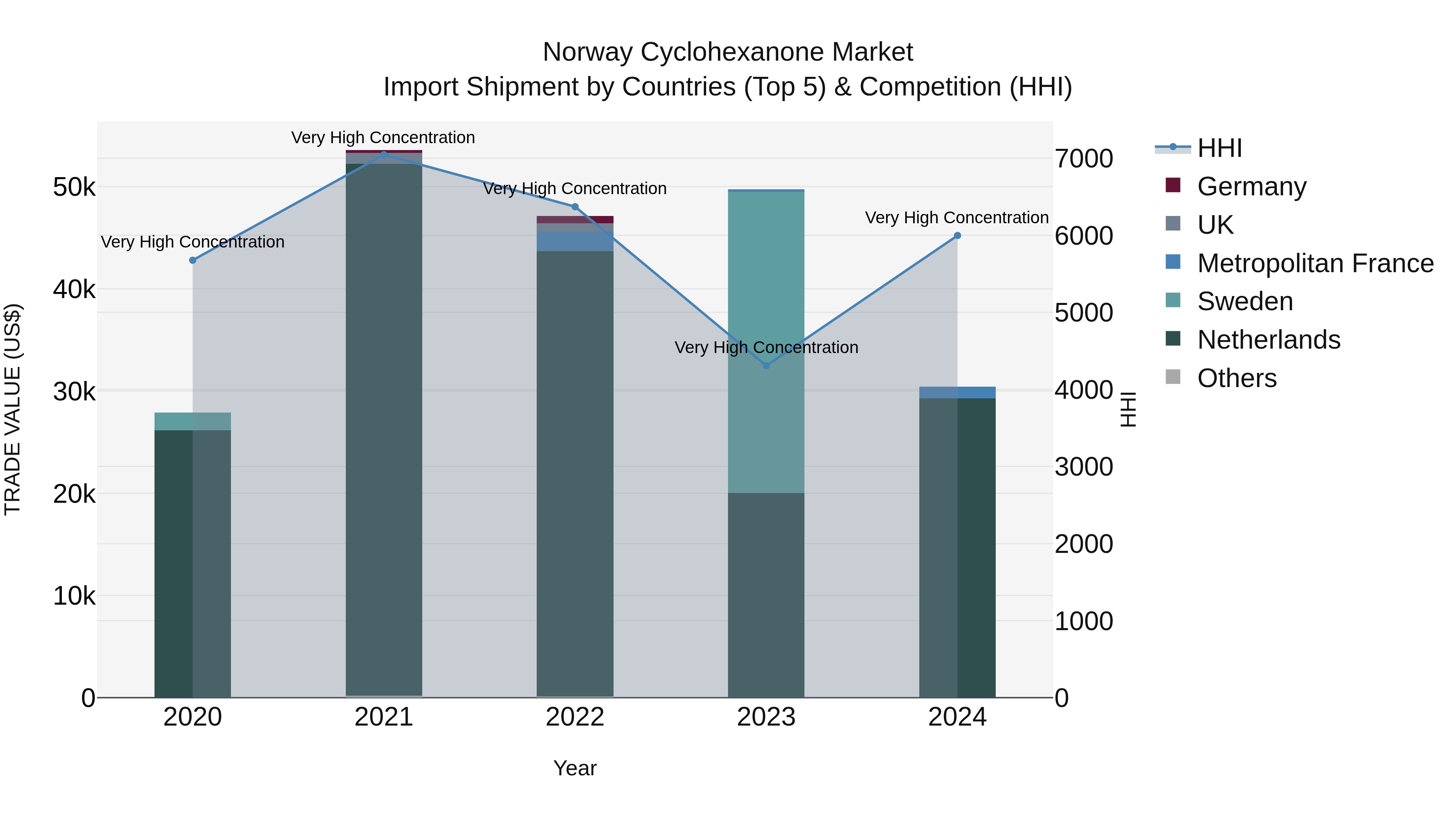
In 2024, Norway continued to rely heavily on imports of cyclohexanone, with the top exporting countries being Netherlands, Metropolitan France, Belgium, Italy, and Germany. Despite the high concentration of suppliers, the market saw a modest compound annual growth rate (CAGR) of 2.2% from 2020 to 2024. However, there was a notable decline in growth rate from 2023 to 2024, with a decrease of -38.84%. These trends suggest a complex landscape for cyclohexanone imports in Norway, with potential implications for market dynamics and competitive strategies in the industry.
Norway Cyclohexanone Market Overview
The cyclohexanone market in Norway focuses on the chemical used as an intermediate in the production of nylon and other synthetic materials. Cyclohexanone is also used in solvents and coatings. The market is driven by the growth of the automotive and textile industries, which rely on cyclohexanone for various applications.
Drivers of the market
The Norway Cyclohexanone Market benefits from its use as a solvent and intermediate in the production of chemicals, including nylon and synthetic resins. The demand for cyclohexanone in industrial applications and its role in chemical manufacturing support market growth. Advancements in production technologies and increasing industrial demand contribute to market expansion.
Challenges of the market
The cyclohexanone market in Norway faces challenges including the high cost of raw materials and the need for specialized production processes. Demand is influenced by fluctuations in industries such as chemicals and pharmaceuticals. Additionally, competition from alternative chemicals and the need to meet regulatory standards for safety and environmental impact impact market dynamics.
Government Policy of the market
Norwegian policies on the Cyclohexanone market focus on safety and environmental impact. Regulations ensure that cyclohexanone products meet high standards for quality and safety. The government supports research into safer production methods and provides incentives for innovations that enhance performance while minimizing environmental and health risks.
Key Highlights of the Report:
- Norway Cyclohexanone Market Outlook
- Market Size of Norway Cyclohexanone Market, 2024
- Forecast of Norway Cyclohexanone Market, 2031
- Historical Data and Forecast of Norway Cyclohexanone Revenues & Volume for the Period 2021-2031
- Norway Cyclohexanone Market Trend Evolution
- Norway Cyclohexanone Market Drivers and Challenges
- Norway Cyclohexanone Price Trends
- Norway Cyclohexanone Porter`s Five Forces
- Norway Cyclohexanone Industry Life Cycle
- Historical Data and Forecast of Norway Cyclohexanone Market Revenues & Volume By Type for the Period 2021-2031
- Historical Data and Forecast of Norway Cyclohexanone Market Revenues & Volume By Nylon 6 for the Period 2021-2031
- Historical Data and Forecast of Norway Cyclohexanone Market Revenues & Volume By Nylon 66 for the Period 2021-2031
- Historical Data and Forecast of Norway Cyclohexanone Market Revenues & Volume By Polyester Polyol for the Period 2021-2031
- Historical Data and Forecast of Norway Cyclohexanone Market Revenues & Volume By Others for the Period 2021-2031
- Historical Data and Forecast of Norway Cyclohexanone Market Revenues & Volume By End-use for the Period 2021-2031
- Historical Data and Forecast of Norway Cyclohexanone Market Revenues & Volume By Construction for the Period 2021-2031
- Historical Data and Forecast of Norway Cyclohexanone Market Revenues & Volume By Aerospace and Defence for the Period 2021-2031
- Historical Data and Forecast of Norway Cyclohexanone Market Revenues & Volume By Textiles for the Period 2021-2031
- Historical Data and Forecast of Norway Cyclohexanone Market Revenues & Volume By Automotive for the Period 2021-2031
- Historical Data and Forecast of Norway Cyclohexanone Market Revenues & Volume By Electrical and Electronics for the Period 2021-2031
- Historical Data and Forecast of Norway Cyclohexanone Market Revenues & Volume By Others for the Period 2021-2031
- Historical Data and Forecast of Norway Cyclohexanone Market Revenues & Volume By Application for the Period 2021-2031
- Historical Data and Forecast of Norway Cyclohexanone Market Revenues & Volume By Paint and Dyes for the Period 2021-2031
- Historical Data and Forecast of Norway Cyclohexanone Market Revenues & Volume By Soaps for the Period 2021-2031
- Historical Data and Forecast of Norway Cyclohexanone Market Revenues & Volume By Fertilizers for the Period 2021-2031
- Historical Data and Forecast of Norway Cyclohexanone Market Revenues & Volume By Films for the Period 2021-2031
- Historical Data and Forecast of Norway Cyclohexanone Market Revenues & Volume By Pharmaceutical for the Period 2021-2031
- Historical Data and Forecast of Norway Cyclohexanone Market Revenues & Volume By Caprolactam for the Period 2021-2031
- Historical Data and Forecast of Norway Cyclohexanone Market Revenues & Volume By Adipic Acid for the Period 2021-2031
- Historical Data and Forecast of Norway Cyclohexanone Market Revenues & Volume By Others for the Period 2021-2031
- Norway Cyclohexanone Import Export Trade Statistics
- Market Opportunity Assessment By Type
- Market Opportunity Assessment By End-use
- Market Opportunity Assessment By Application
- Norway Cyclohexanone Top Companies Market Share
- Norway Cyclohexanone Competitive Benchmarking By Technical and Operational Parameters
- Norway Cyclohexanone Company Profiles
- Norway Cyclohexanone Key Strategic Recommendations






































