Norway Emollient Market Top 5 Importing Countries and Market Competition (HHI) Analysis
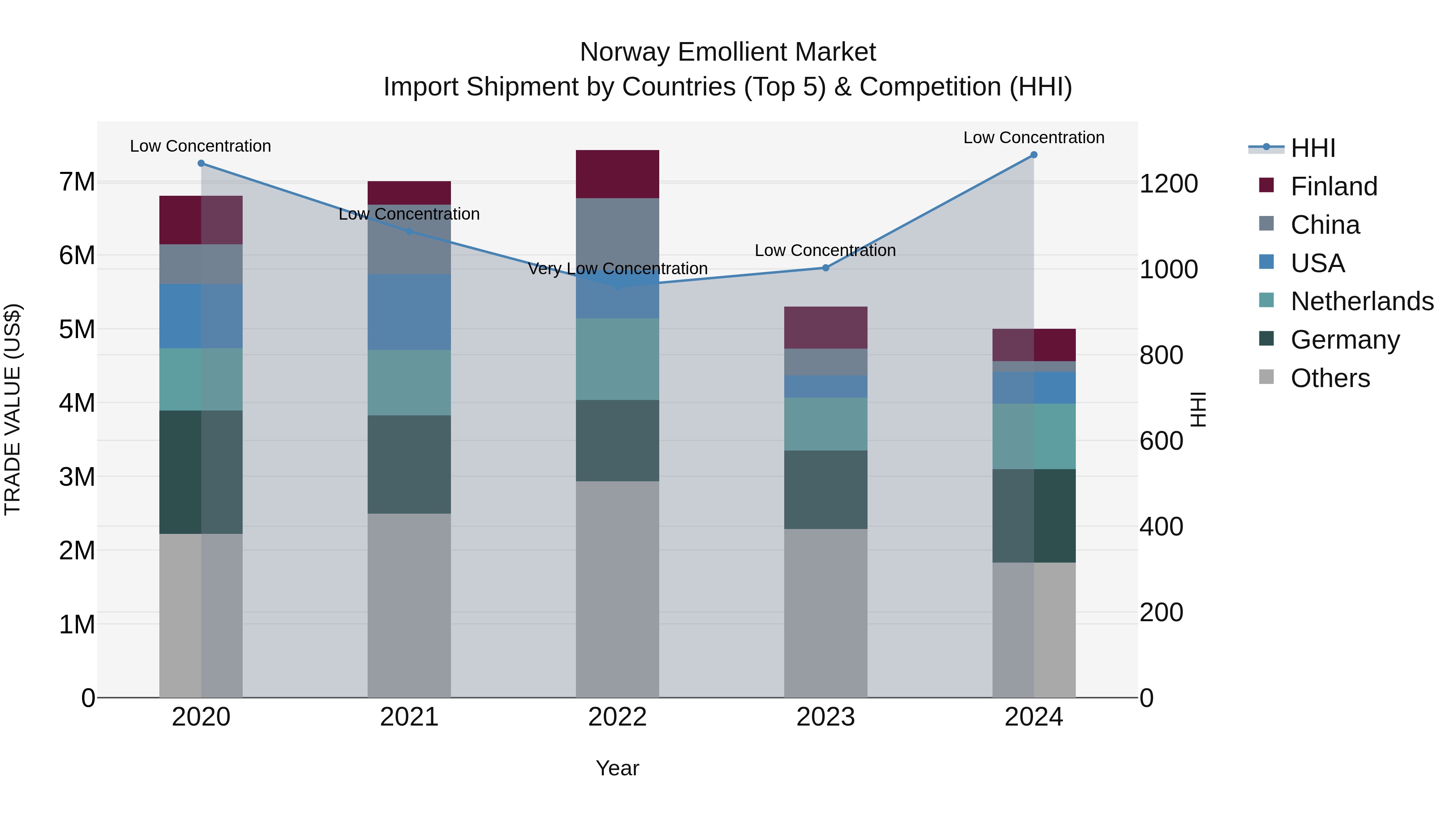
In 2024, Norway continued to rely on key emollient imports from Germany, Netherlands, Finland, USA, and Malaysia. The market saw low concentration levels with a low Herfindahl-Hirschman Index (HHI). The compound annual growth rate (CAGR) from 2020 to 2024 was negative at -7.42%, indicating a decline in demand. The growth rate from 2023 to 2024 remained negative at -5.72%, suggesting a challenging year for emollient imports into Norway. Monitoring market trends and exploring potential strategies for revitalizing the market will be crucial for stakeholders in the industry.
Norway Emollient Market Overview
The Norway Emollient Market is experiencing steady growth driven by the increasing awareness and preference for natural and organic skincare products. Emollients play a crucial role in moisturizing and protecting the skin, leading to their high demand in the personal care industry. Key trends in the market include the rising popularity of emollients with added benefits such as sun protection and anti-aging properties. The market is also witnessing a shift towards sustainable and eco-friendly emollient products, aligning with the growing consumer focus on environmental consciousness. Major players in the Norway Emollient Market are focusing on product innovation and marketing strategies to cater to the evolving consumer preferences and maintain a competitive edge in the market. Overall, the market is projected to continue its growth trajectory driven by the increasing demand for premium skincare products in Norway.
Norway Emollient Market Trends and Opportunities
The Norway Emollient Market is experiencing growth due to the increasing awareness about skincare and the demand for natural and organic products. Consumers are seeking products with moisturizing and nourishing properties, driving the demand for emollients in various personal care products. Key trends in the market include the rising popularity of clean beauty products, sustainable sourcing practices, and the incorporation of innovative ingredients like plant-based oils and butters. Opportunities in the market lie in the development of multifunctional emollients that offer additional benefits such as anti-aging or UV protection, as well as the expansion of product lines targeted towards specific skin concerns like sensitive skin or eczema. Companies can also capitalize on the growing online retail sector to reach a wider audience and offer personalized skincare solutions.
Norway Emollient Market Challenges
In the Norway Emollient Market, some challenges include increasing competition from both domestic and international brands, strict regulatory requirements for product safety and labeling, and a growing demand for natural and organic emollients. Additionally, consumer preferences are shifting towards sustainable and eco-friendly products, putting pressure on emollient manufacturers to innovate and adapt their formulations. Rising raw material costs and the need for continuous research and development to create effective and safe emollients further add to the challenges faced by companies operating in this market. Overall, staying competitive, compliant with regulations, and meeting evolving consumer demands are key challenges for players in the Norway Emollient Market.
Norway Emollient Market Drivers
The Norway Emollient Market is primarily driven by the increasing awareness among consumers regarding the benefits of emollients in skincare products, especially in a country with a cold climate like Norway. The growing demand for natural and organic emollients due to their gentle and non-irritating properties is also a significant driver. Additionally, the rising prevalence of skin conditions such as eczema and psoriasis has led to a higher demand for emollient products for their moisturizing and soothing effects. Furthermore, the expanding beauty and personal care industry in Norway, coupled with the availability of a wide range of emollient products across various distribution channels, is contributing to the market growth. Overall, the emphasis on skin health, preference for natural ingredients, and the diverse product offerings in the market are key drivers fuelling the growth of the Norway Emollient Market.
Norway Emollient Market Government Policy
The Norwegian government has implemented various policies to regulate the emollient market in the country. These policies focus on ensuring the safety and efficacy of emollient products, including stringent regulations on ingredients, labeling requirements, and product testing. Additionally, there are guidelines in place to monitor advertising practices and claims made by emollient manufacturers to protect consumers from false or misleading information. The government also emphasizes the importance of environmental sustainability in the production and disposal of emollient products, encouraging companies to adopt eco-friendly practices. Overall, these policies aim to promote transparency, consumer safety, and environmental responsibility within the Norway emollient market.
Norway Emollient Market Future Outlook
The future outlook for the Norway Emollient Market appears promising, driven by increasing awareness about skin health and a growing demand for natural and organic skincare products. With consumers becoming more conscious about the ingredients in their personal care products, there is a rising preference for emollients that are derived from natural sources and have moisturizing and soothing properties. Additionally, the trend towards clean beauty and sustainable practices is expected to further fuel the demand for emollients in Norway. Market players are likely to focus on product innovation, incorporating advanced technologies to develop emollients that offer enhanced benefits and meet the evolving consumer preferences. Overall, the Norway Emollient Market is poised for steady growth in the coming years, supported by the evolving skincare trends and increasing emphasis on skin hydration and protection.
Key Highlights of the Report:
- Norway Emollient Market Outlook
- Market Size of Norway Emollient Market, 2024
- Forecast of Norway Emollient Market, 2031
- Historical Data and Forecast of Norway Emollient Revenues & Volume for the Period 2021- 2031
- Norway Emollient Market Trend Evolution
- Norway Emollient Market Drivers and Challenges
- Norway Emollient Price Trends
- Norway Emollient Porter's Five Forces
- Norway Emollient Industry Life Cycle
- Historical Data and Forecast of Norway Emollient Market Revenues & Volume By Type for the Period 2021- 2031
- Historical Data and Forecast of Norway Emollient Market Revenues & Volume By Esters for the Period 2021- 2031
- Historical Data and Forecast of Norway Emollient Market Revenues & Volume By Fatty Alcohols for the Period 2021- 2031
- Historical Data and Forecast of Norway Emollient Market Revenues & Volume By Fatty Acids for the Period 2021- 2031
- Historical Data and Forecast of Norway Emollient Market Revenues & Volume By Ethers for the Period 2021- 2031
- Historical Data and Forecast of Norway Emollient Market Revenues & Volume By Silicones for the Period 2021- 2031
- Historical Data and Forecast of Norway Emollient Market Revenues & Volume By Others for the Period 2021- 2031
- Historical Data and Forecast of Norway Emollient Market Revenues & Volume By Form for the Period 2021- 2031
- Historical Data and Forecast of Norway Emollient Market Revenues & Volume By Solid for the Period 2021- 2031
- Historical Data and Forecast of Norway Emollient Market Revenues & Volume By Liquid for the Period 2021- 2031
- Historical Data and Forecast of Norway Emollient Market Revenues & Volume By Application for the Period 2021- 2031
- Historical Data and Forecast of Norway Emollient Market Revenues & Volume By Skin Care for the Period 2021- 2031
- Historical Data and Forecast of Norway Emollient Market Revenues & Volume By Hair Care for the Period 2021- 2031
- Historical Data and Forecast of Norway Emollient Market Revenues & Volume By Deodorants for the Period 2021- 2031
- Historical Data and Forecast of Norway Emollient Market Revenues & Volume By Oral Care for the Period 2021- 2031
- Historical Data and Forecast of Norway Emollient Market Revenues & Volume By Others for the Period 2021- 2031
- Norway Emollient Import Export Trade Statistics
- Market Opportunity Assessment By Type
- Market Opportunity Assessment By Form
- Market Opportunity Assessment By Application
- Norway Emollient Top Companies Market Share
- Norway Emollient Competitive Benchmarking By Technical and Operational Parameters
- Norway Emollient Company Profiles
- Norway Emollient Key Strategic Recommendations






































