Norway Epoxy Market Growth Rate Analysis (2025 - 2031)
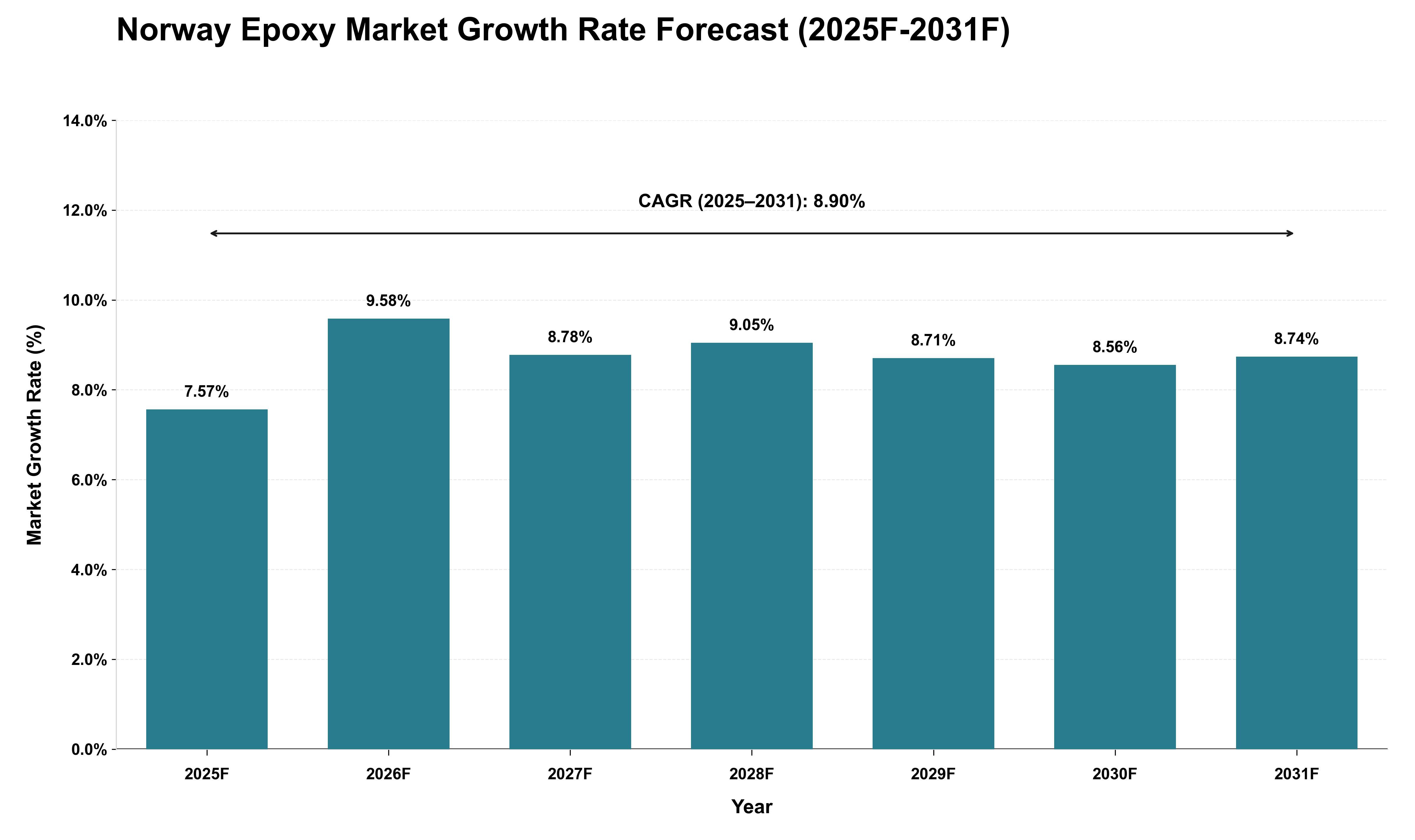
The forecast for the Norway epoxy market indicates a notable acceleration in growth rates, particularly in 2026, where a peak of 9.58% is anticipated. This spike suggests an increasing end-use demand driven by sectors such as construction and automotive, which are expected to leverage epoxy's superior adhesive properties and durability. The subsequent years will likely reflect a slight deceleration, yet the overall CAGR of 8.90% signals sustained interest and investment in epoxy applications. Factors such as import dependencies on raw materials may influence pricing dynamics and availability, potentially impacting production timelines. Additionally, cyclical trends in infrastructure development and technological advancements in epoxy formulations will further shape market trajectories. As these macroeconomic factors converge, the Norwegian epoxy market is poised for robust growth through 2031, reflecting broader shifts towards high-performance materials across various industries.
Key Highlights of the Report:
- Norway Epoxy Market Outlook
- Market Size of Norway Epoxy Market, 2025
- Forecast of Norway Epoxy Market, 2032
- Historical Data and Forecast of Norway Epoxy Revenues & Volume for the Period 2022 - 2032F
- Norway Epoxy Market Trend Evolution
- Norway Epoxy Market Drivers and Challenges
- Norway Epoxy Price Trends
- Norway Epoxy Porter`s Five Forces
- Norway Epoxy Industry Life Cycle
- Historical Data and Forecast of Norway Epoxy Market Revenues & Volume By Type for the Period 2022 - 2032F
- Historical Data and Forecast of Norway Epoxy Market Revenues & Volume By Liquid for the Period 2022 - 2032F
- Historical Data and Forecast of Norway Epoxy Market Revenues & Volume By Solid & Solution for the Period 2022 - 2032F
- Historical Data and Forecast of Norway Epoxy Market Revenues & Volume By Application for the Period 2022 - 2032F
- Historical Data and Forecast of Norway Epoxy Market Revenues & Volume By Construction for the Period 2022 - 2032F
- Historical Data and Forecast of Norway Epoxy Market Revenues & Volume By Automotive & transportation for the Period 2022 - 2032F
- Historical Data and Forecast of Norway Epoxy Market Revenues & Volume By Electrical & electronics for the Period 2022 - 2032F
- Historical Data and Forecast of Norway Epoxy Market Revenues & Volume By General industrial for the Period 2022 - 2032F
- Historical Data and Forecast of Norway Epoxy Market Revenues & Volume By Wind for the Period 2022 - 2032F
- Historical Data and Forecast of Norway Epoxy Market Revenues & Volume By Marine for the Period 2022 - 2032F
- Historical Data and Forecast of Norway Epoxy Market Revenues & Volume By Aerospace for the Period 2022 - 2032F
- Historical Data and Forecast of Norway Epoxy Market Revenues & Volume By Consumer goods for the Period 2022 - 2032F
- Norway Epoxy Import Export Trade Statistics
- Market Opportunity Assessment By Type
- Market Opportunity Assessment By Application
- Norway Epoxy Top Companies Market Share
- Norway Epoxy Competitive Benchmarking By Technical and Operational Parameters
- Norway Epoxy Company Profiles
- Norway Epoxy Key Strategic Recommendations






































