Norway Garden Equipment Market Top 5 Importing Countries and Market Competition (HHI) Analysis
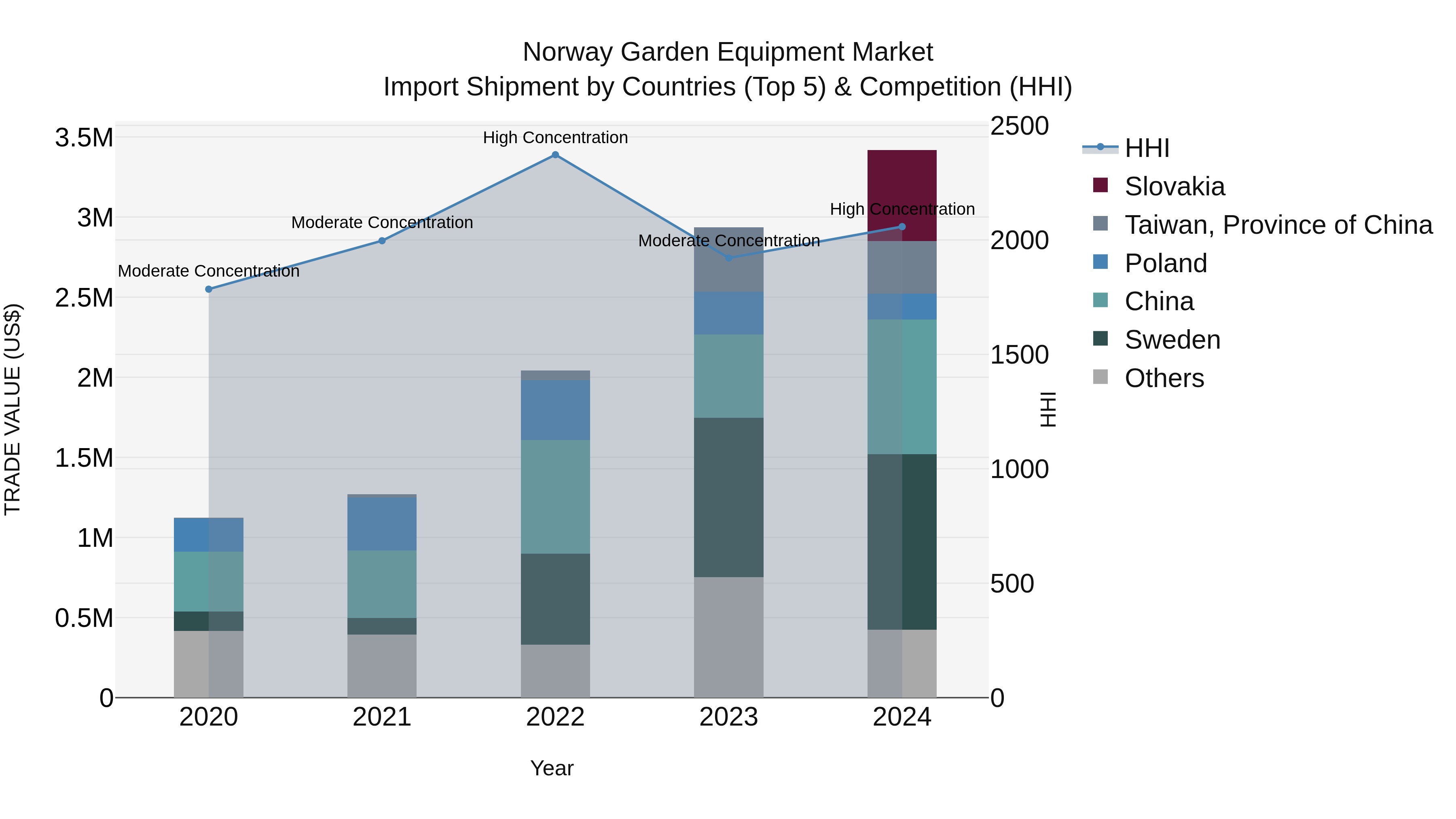
The Norway garden equipment import market saw significant growth in 2024, with top exporting countries including Sweden, China, Slovakia, Taiwan, and Poland. The market concentration, as measured by the HHI, increased from moderate to high in 2024, indicating a more consolidated market landscape. The impressive Compound Annual Growth Rate (CAGR) of 32.03% from 2020 to 2024 demonstrates the robust expansion of the market, with a notable growth rate of 16.36% in 2024 alone. This data suggests a thriving demand for garden equipment in Norway, driven by imports from a diverse range of countries.
Norway Garden Equipment Market Synopsis
The Norway Garden Equipment Market is experiencing steady growth driven by increasing urbanization, a rising trend of home gardening, and a growing emphasis on outdoor living spaces. Key product segments in the market include lawn mowers, trimmers, chainsaws, and garden hand tools. Consumers in Norway are increasingly investing in high-quality, durable, and environmentally friendly garden equipment, leading to a growing demand for electric and battery-powered tools over traditional gas-powered ones. The market is characterized by a strong emphasis on sustainability and eco-friendly practices, with a growing preference for products that reduce carbon footprint. Major players in the Norway Garden Equipment Market include Husqvarna Group, STIGA Group, and Gardena. As the market continues to expand, there is a rising focus on innovation, product customization, and digitalization to meet the evolving needs of Norwegian consumers.
Norway Garden Equipment Market Trends
The Norway Garden Equipment Market is witnessing a growing trend towards environmentally friendly and sustainable products, driven by increasing awareness of the importance of eco-friendly practices among consumers. Electric and battery-powered garden tools are gaining popularity due to their lower carbon footprint and reduced noise levels compared to traditional gasoline-powered equipment. There is also a rising demand for smart gardening products that utilize technology to enhance efficiency and convenience for users. Opportunities exist for market players to innovate and develop products that cater to these trends, as well as to capitalize on the increasing popularity of urban gardening and outdoor living spaces in Norway. Additionally, partnerships with retailers and online platforms can help reach a wider customer base and capitalize on the growing e-commerce trend in the country.
Norway Garden Equipment Market Challenges
In the Norway Garden Equipment Market, one of the main challenges faced is the short gardening season due to the country`s cold climate. This limits the time window for consumers to engage in gardening activities, impacting the demand for garden equipment. Additionally, the high cost of garden equipment, especially for advanced and specialized tools, can deter price-sensitive consumers. Another challenge is the growing trend towards sustainable and environmentally friendly practices, which has led to increased demand for eco-friendly garden equipment, putting pressure on manufacturers to innovate and offer more environmentally conscious products. Competition from international brands and online retailers also poses a challenge to local garden equipment companies in Norway. Overall, navigating these challenges requires companies to adapt their product offerings, pricing strategies, and marketing efforts to meet the evolving needs of Norwegian consumers in the garden equipment market.
Norway Garden Equipment Market Investment Opportunities
The Norway Garden Equipment Market is primarily driven by factors such as increasing urbanization leading to smaller living spaces and a growing trend towards gardening as a hobby among urban dwellers. The focus on sustainability and environmental consciousness is also propelling the market growth, with consumers opting for electric or battery-powered garden equipment over traditional gas-powered tools. Additionally, the rise in disposable income levels in Norway is enabling consumers to invest in high-quality garden equipment to maintain their outdoor spaces efficiently. Furthermore, government initiatives promoting green spaces and gardening activities are stimulating market demand for various garden tools and equipment. Overall, the combination of lifestyle trends, environmental awareness, and economic factors is driving the growth of the Garden Equipment Market in Norway.
Norway Garden Equipment Market Government Polices
In Norway, the government has implemented various policies to promote environmentally friendly practices in the garden equipment market. These include regulations on emissions standards for gas-powered equipment, incentives for the purchase of electric and battery-powered tools, and awareness campaigns to encourage sustainable gardening practices. Additionally, there are programs in place to support the recycling and proper disposal of old equipment to reduce waste and minimize environmental impact. The government`s focus on sustainability and environmental protection is driving the market towards more eco-friendly and energy-efficient products, reflecting the country`s commitment to reducing carbon emissions and promoting a greener future in the garden equipment industry.
Norway Garden Equipment Market Future Outlook
The Norway Garden Equipment Market is poised for steady growth in the coming years, driven by increasing demand for garden maintenance products and tools among both residential and commercial users. Factors such as a growing trend towards home gardening, emphasis on outdoor living spaces, and rising awareness about environmental sustainability are expected to fuel the market`s expansion. Innovations in garden equipment technology, such as the development of electric and battery-powered tools for eco-conscious consumers, are likely to further drive market growth. Additionally, the influence of urban gardening and landscaping trends is anticipated to create new opportunities for market players. Overall, the Norway Garden Equipment Market is expected to experience a positive trajectory in the foreseeable future, with a focus on convenience, efficiency, and sustainability driving consumer preferences and shaping industry dynamics.
Key Highlights of the Report:
- Norway Garden Equipment Market Outlook
- Market Size of Norway Garden Equipment Market, 2024
- Forecast of Norway Garden Equipment Market, 2031
- Historical Data and Forecast of Norway Garden Equipment Revenues & Volume for the Period 2021- 2031
- Norway Garden Equipment Market Trend Evolution
- Norway Garden Equipment Market Drivers and Challenges
- Norway Garden Equipment Price Trends
- Norway Garden Equipment Porter's Five Forces
- Norway Garden Equipment Industry Life Cycle
- Historical Data and Forecast of Norway Garden Equipment Market Revenues & Volume By GardeProduct for the Period 2021- 2031
- Historical Data and Forecast of Norway Garden Equipment Market Revenues & Volume By Lawn Mowing Machines for the Period 2021- 2031
- Historical Data and Forecast of Norway Garden Equipment Market Revenues & Volume By Handheld Tools for the Period 2021- 2031
- Historical Data and Forecast of Norway Garden Equipment Market Revenues & Volume By Tillers for the Period 2021- 2031
- Historical Data and Forecast of Norway Garden Equipment Market Revenues & Volume By Cleaning for the Period 2021- 2031
- Historical Data and Forecast of Norway Garden Equipment Market Revenues & Volume By Others for the Period 2021- 2031
- Historical Data and Forecast of Norway Garden Equipment Market Revenues & Volume By Power Source for the Period 2021- 2031
- Historical Data and Forecast of Norway Garden Equipment Market Revenues & Volume By Petro for the Period 2021- 2031
- Historical Data and Forecast of Norway Garden Equipment Market Revenues & Volume By Electric Corded for the Period 2021- 2031
- Historical Data and Forecast of Norway Garden Equipment Market Revenues & Volume By Battery for the Period 2021- 2031
- Historical Data and Forecast of Norway Garden Equipment Market Revenues & Volume By Cordless for the Period 2021- 2031
- Historical Data and Forecast of Norway Garden Equipment Market Revenues & Volume By Others for the Period 2021- 2031
- Historical Data and Forecast of Norway Garden Equipment Market Revenues & Volume By Material for the Period 2021- 2031
- Historical Data and Forecast of Norway Garden Equipment Market Revenues & Volume By Wood for the Period 2021- 2031
- Historical Data and Forecast of Norway Garden Equipment Market Revenues & Volume By Metal for the Period 2021- 2031
- Historical Data and Forecast of Norway Garden Equipment Market Revenues & Volume By Plastic for the Period 2021- 2031
- Historical Data and Forecast of Norway Garden Equipment Market Revenues & Volume By Recycled Plastics for the Period 2021- 2031
- Historical Data and Forecast of Norway Garden Equipment Market Revenues & Volume By Synthetic Resin for the Period 2021- 2031
- Historical Data and Forecast of Norway Garden Equipment Market Revenues & Volume By Others for the Period 2021- 2031
- Historical Data and Forecast of Norway Garden Equipment Market Revenues & Volume By Distribution Channel for the Period 2021- 2031
- Historical Data and Forecast of Norway Garden Equipment Market Revenues & Volume By B2B/Direct Sales for the Period 2021- 2031
- Historical Data and Forecast of Norway Garden Equipment Market Revenues & Volume By Supermarkets/Hypermarkets for the Period 2021- 2031
- Historical Data and Forecast of Norway Garden Equipment Market Revenues & Volume By E-Commerce for the Period 2021- 2031
- Historical Data and Forecast of Norway Garden Equipment Market Revenues & Volume By Specialty Stores for the Period 2021- 2031
- Historical Data and Forecast of Norway Garden Equipment Market Revenues & Volume By Convenience Stores for the Period 2021- 2031
- Historical Data and Forecast of Norway Garden Equipment Market Revenues & Volume By Others for the Period 2021- 2031
- Historical Data and Forecast of Norway Garden Equipment Market Revenues & Volume By End-user for the Period 2021- 2031
- Historical Data and Forecast of Norway Garden Equipment Market Revenues & Volume By Residential for the Period 2021- 2031
- Historical Data and Forecast of Norway Garden Equipment Market Revenues & Volume By Commercial Offices for the Period 2021- 2031
- Historical Data and Forecast of Norway Garden Equipment Market Revenues & Volume By Malls/Supermarkets for the Period 2021- 2031
- Historical Data and Forecast of Norway Garden Equipment Market Revenues & Volume By Parks for the Period 2021- 2031
- Historical Data and Forecast of Norway Garden Equipment Market Revenues & Volume By Airports for the Period 2021- 2031
- Historical Data and Forecast of Norway Garden Equipment Market Revenues & Volume By Sports Stadium for the Period 2021- 2031
- Historical Data and Forecast of Norway Garden Equipment Market Revenues & Volume By Others for the Period 2021- 2031
- Norway Garden Equipment Import Export Trade Statistics
- Market Opportunity Assessment By GardeProduct
- Market Opportunity Assessment By Power Source
- Market Opportunity Assessment By Material
- Market Opportunity Assessment By Distribution Channel
- Market Opportunity Assessment By End-user
- Norway Garden Equipment Top Companies Market Share
- Norway Garden Equipment Competitive Benchmarking By Technical and Operational Parameters
- Norway Garden Equipment Company Profiles
- Norway Garden Equipment Key Strategic Recommendations






































