Norway Glass Market Growth Rate Analysis (2025 - 2031)
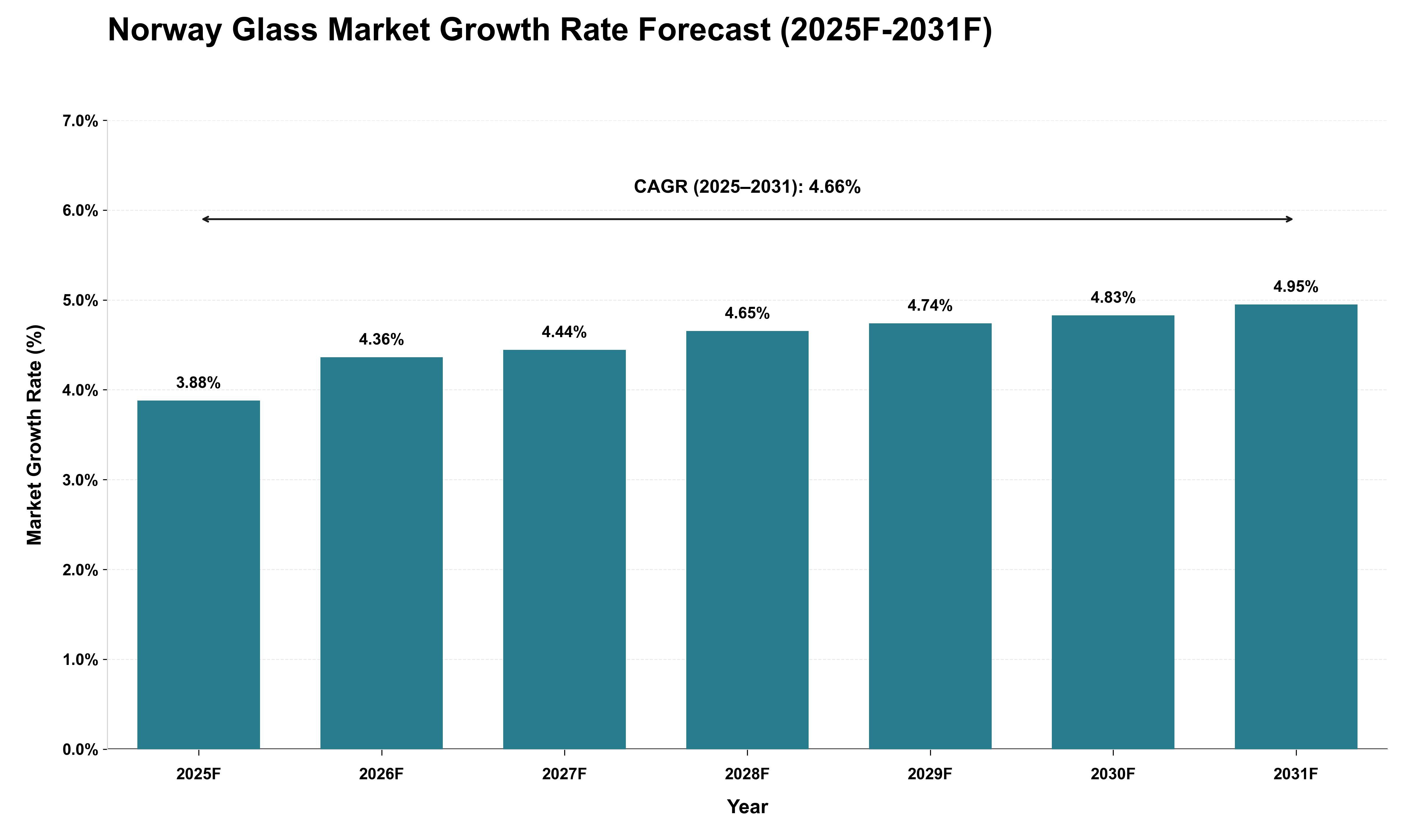
The Norway glass market will experience a notable transformation driven by evolving supply chain dynamics and fluctuating input costs over the forecast period. As demand for glass products increases, particularly in construction and packaging sectors, manufacturers will likely face rising raw material prices, influenced by global commodity trends and potential trade disruptions. The projected CAGR of 4.66% reflects an anticipated acceleration in growth rates, with annual increases peaking at 4.95% by 2031. This growth trajectory suggests that companies will need to adapt their sourcing strategies to mitigate cost pressures while ensuring quality and sustainability standards are met. Additionally, import dependencies may shift as local production capabilities expand or contract based on economic policies and environmental regulations, further impacting pricing structures and competitive positioning within the market. Overall, these factors will shape the operational landscape for glass producers in Norway during this period.
Key Highlights of the Report:
- Norway Glass Market Outlook
- Market Size of Norway Glass Market, 2025
- Forecast of Norway Glass Market, 2032
- Historical Data and Forecast of Norway Glass Revenues & Volume for the Period 2022 - 2032F
- Norway Glass Market Trend Evolution
- Norway Glass Market Drivers and Challenges
- Norway Glass Price Trends
- Norway Glass Porter`s Five Forces
- Norway Glass Industry Life Cycle
- Historical Data and Forecast of Norway Glass Market Revenues & Volume By Product Types for the Period 2022 - 2032F
- Historical Data and Forecast of Norway Glass Market Revenues & Volume By Basic for the Period 2022 - 2032F
- Historical Data and Forecast of Norway Glass Market Revenues & Volume By Tempered for the Period 2022 - 2032F
- Historical Data and Forecast of Norway Glass Market Revenues & Volume By Laminated for the Period 2022 - 2032F
- Historical Data and Forecast of Norway Glass Market Revenues & Volume By Insulated for the Period 2022 - 2032F
- Historical Data and Forecast of Norway Glass Market Revenues & Volume By Others for the Period 2022 - 2032F
- Historical Data and Forecast of Norway Glass Market Revenues & Volume By Applications for the Period 2022 - 2032F
- Historical Data and Forecast of Norway Glass Market Revenues & Volume By Architectural for the Period 2022 - 2032F
- Historical Data and Forecast of Norway Glass Market Revenues & Volume By Automotive & transportation for the Period 2022 - 2032F
- Historical Data and Forecast of Norway Glass Market Revenues & Volume By Others for the Period 2022 - 2032F
- Historical Data and Forecast of Norway Glass Market Revenues & Volume By Technology Types for the Period 2022 - 2032F
- Historical Data and Forecast of Norway Glass Market Revenues & Volume By Float for the Period 2022 - 2032F
- Historical Data and Forecast of Norway Glass Market Revenues & Volume By Rolled for the Period 2022 - 2032F
- Historical Data and Forecast of Norway Glass Market Revenues & Volume By Sheet for the Period 2022 - 2032F
- Norway Glass Import Export Trade Statistics
- Market Opportunity Assessment By Product Types
- Market Opportunity Assessment By Applications
- Market Opportunity Assessment By Technology Types
- Norway Glass Top Companies Market Share
- Norway Glass Competitive Benchmarking By Technical and Operational Parameters
- Norway Glass Company Profiles
- Norway Glass Key Strategic Recommendations






































