Norway Glycerol Market Top 5 Importing Countries and Market Competition (HHI) Analysis
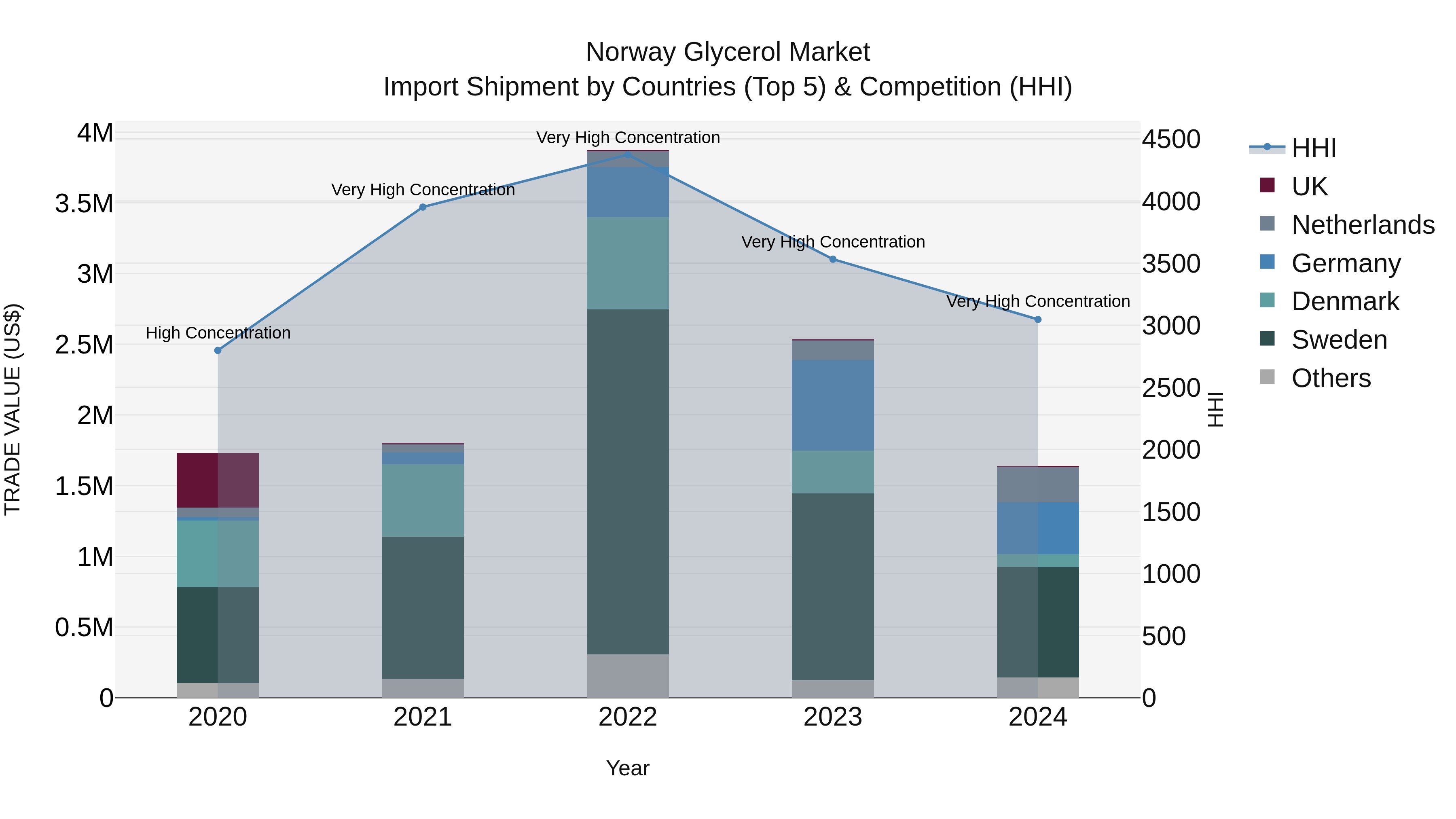
Norway`s glycerol import market in 2024 continued to see a high concentration of shipments from top exporting countries such as Sweden, Germany, Netherlands, Denmark, and China. Despite a negative CAGR of -1.36% from 2020 to 2024 and a significant decline in growth rate of -35.41% from 2023 to 2024, the market dynamics suggest a stable demand for glycerol imports in Norway. The consistent presence of key exporting countries indicates a reliable supply chain for glycerol in the Norwegian market.
Glycerol Market: Norway vs Top 5 Major Economies in 2027 (Europe)
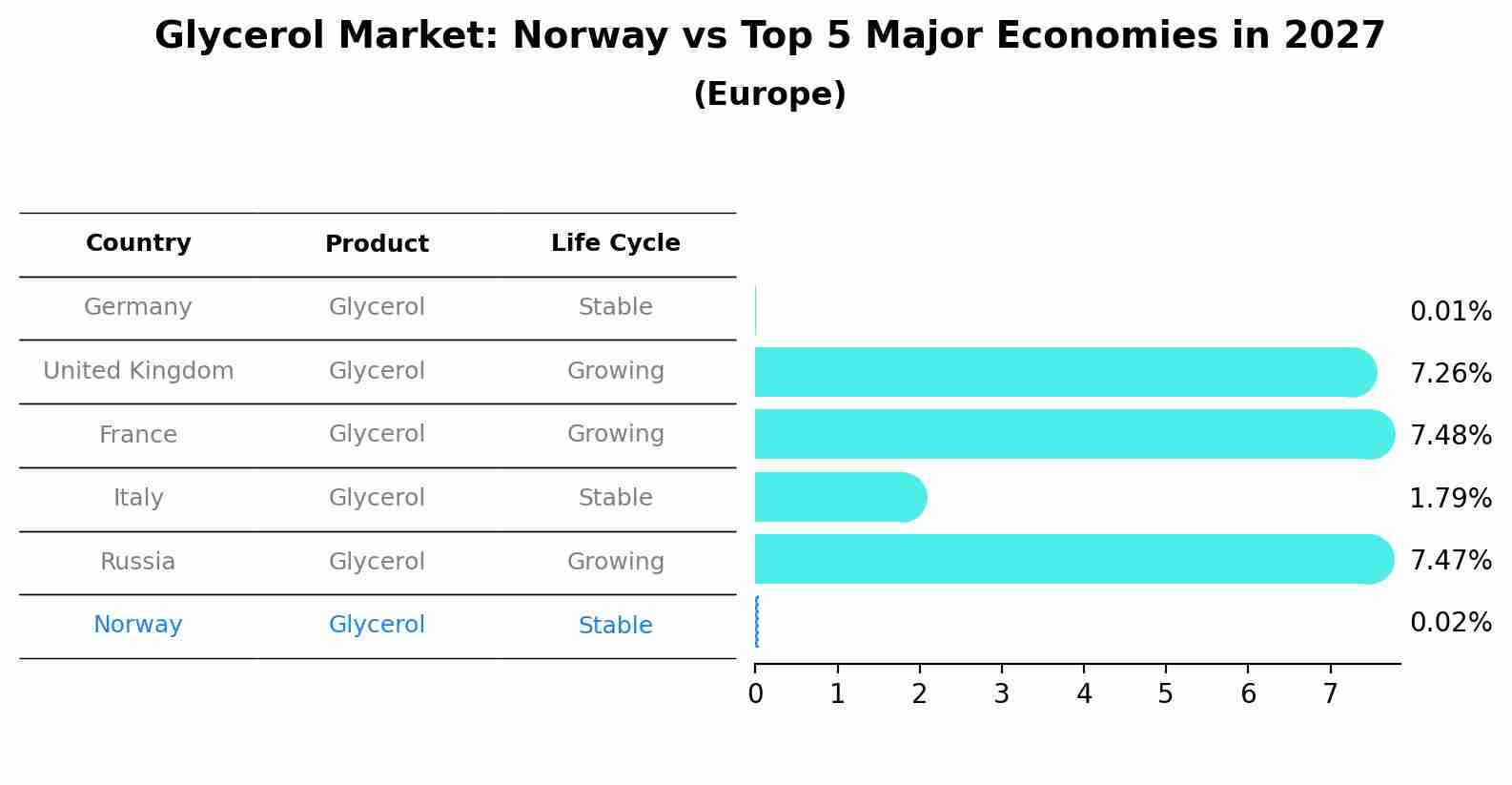
The Glycerol market in Norway is projected to grow at a stable growth rate of 0.02% by 2027, highlighting the country's increasing focus on advanced technologies within the Europe region, where Germany holds the dominant position, followed closely by United Kingdom, France, Italy and Russia, shaping overall regional demand.
Norway Glycerol Market Overview
The glycerol market in Norway is closely related to the glycerin market, with glycerol being used in similar applications across pharmaceuticals, cosmetics, and food industries. Glycerol`s role as a solvent, humectant, and sweetener contributes to its demand. The market benefits from trends towards natural and multifunctional ingredients, as well as innovations in glycerol production and applications.
Drivers of the market
The glycerol market in Norway is driven by the demand for this versatile compound used in various applications, including pharmaceuticals, cosmetics, and food products. Glycerol offers benefits such as solubility and moisturizing properties. The market benefits from advancements in glycerol production and purification technologies, increasing consumer demand for high-quality and sustainable products, and the growing focus on enhancing product performance and safety.
Challenges of the market
The glycerol market in Norway faces challenges due to volatility in the supply of raw materials, especially as it is a byproduct of biodiesel production. Additionally, ensuring consistent purity for applications in pharmaceuticals and cosmetics adds complexity to the manufacturing process.
Government Policy of the market
Government policies in Norways glycerol market focus on ensuring product safety and quality. Regulations require that glycerol products meet standards for purity and labeling. The government supports the development of glycerol technologies that enhance product safety and environmental sustainability.
Key Highlights of the Report:
- Norway Glycerol Market Outlook
- Market Size of Norway Glycerol Market, 2024
- Forecast of Norway Glycerol Market, 2031
- Historical Data and Forecast of Norway Glycerol Revenues & Volume for the Period 2021-2031
- Norway Glycerol Market Trend Evolution
- Norway Glycerol Market Drivers and Challenges
- Norway Glycerol Price Trends
- Norway Glycerol Porter`s Five Forces
- Norway Glycerol Industry Life Cycle
- Historical Data and Forecast of Norway Glycerol Market Revenues & Volume By Source for the Period 2021-2031
- Historical Data and Forecast of Norway Glycerol Market Revenues & Volume By Biodiesel for the Period 2021-2031
- Historical Data and Forecast of Norway Glycerol Market Revenues & Volume By Fatty Alcohols for the Period 2021-2031
- Historical Data and Forecast of Norway Glycerol Market Revenues & Volume By Fatty Acids for the Period 2021-2031
- Historical Data and Forecast of Norway Glycerol Market Revenues & Volume By Soap for the Period 2021-2031
- Historical Data and Forecast of Norway Glycerol Market Revenues & Volume By Type for the Period 2021-2031
- Historical Data and Forecast of Norway Glycerol Market Revenues & Volume By Crude for the Period 2021-2031
- Historical Data and Forecast of Norway Glycerol Market Revenues & Volume By Refined for the Period 2021-2031
- Historical Data and Forecast of Norway Glycerol Market Revenues & Volume By End-use for the Period 2021-2031
- Historical Data and Forecast of Norway Glycerol Market Revenues & Volume By Food & Beverage for the Period 2021-2031
- Historical Data and Forecast of Norway Glycerol Market Revenues & Volume By Pharmaceutical for the Period 2021-2031
- Historical Data and Forecast of Norway Glycerol Market Revenues & Volume By Nutraceutical for the Period 2021-2031
- Historical Data and Forecast of Norway Glycerol Market Revenues & Volume By Personal Care & Cosmetics for the Period 2021-2031
- Historical Data and Forecast of Norway Glycerol Market Revenues & Volume By Industrial for the Period 2021-2031
- Historical Data and Forecast of Norway Glycerol Market Revenues & Volume By Others for the Period 2021-2031
- Norway Glycerol Import Export Trade Statistics
- Market Opportunity Assessment By Source
- Market Opportunity Assessment By Type
- Market Opportunity Assessment By End-use
- Norway Glycerol Top Companies Market Share
- Norway Glycerol Competitive Benchmarking By Technical and Operational Parameters
- Norway Glycerol Company Profiles
- Norway Glycerol Key Strategic Recommendations






































