Norway Heat Pump Market Growth Rate Analysis (2025 - 2031)
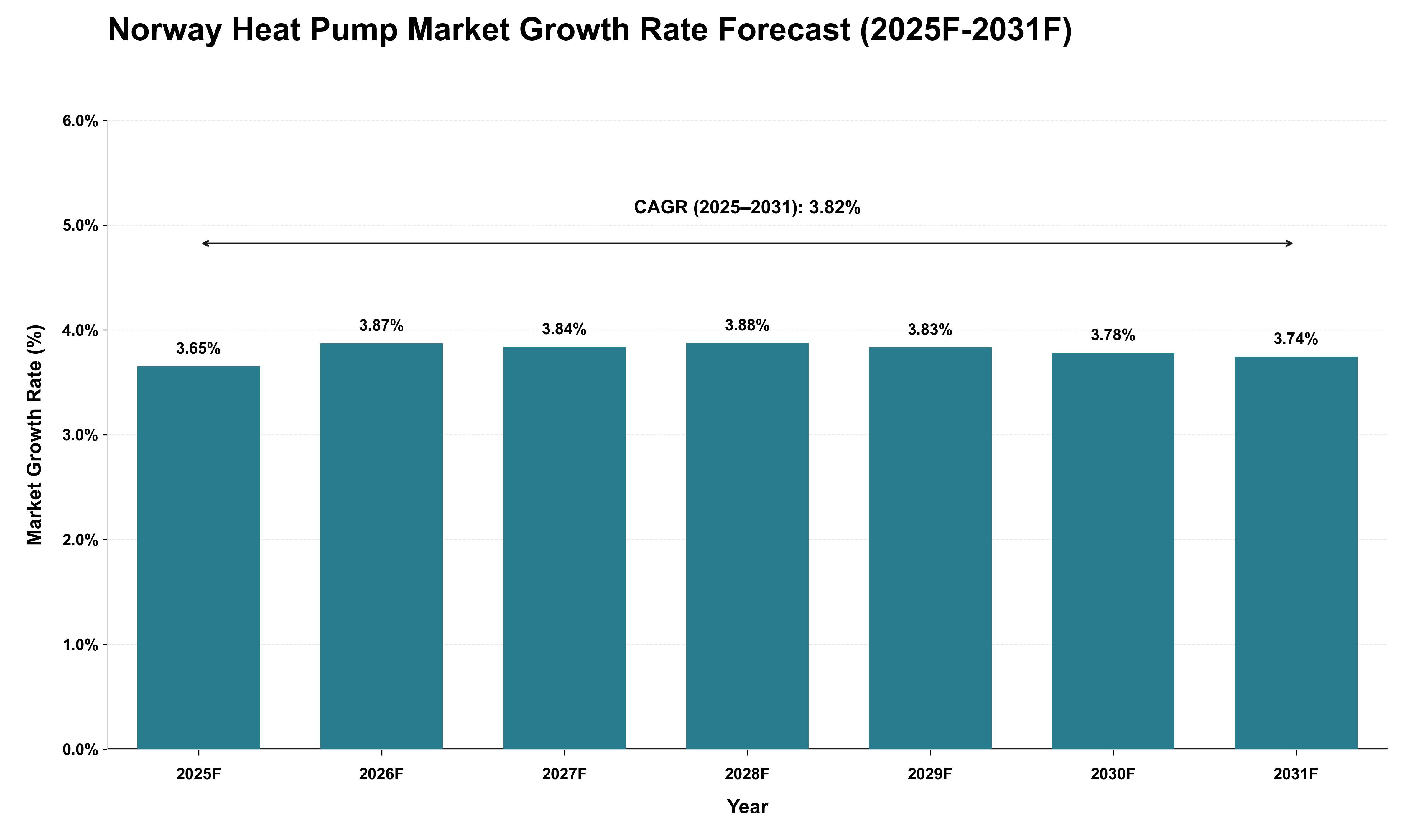
The Norway heat pump market will experience a steady growth trajectory driven by increasing energy efficiency mandates and a shift towards renewable energy sources. As the country enhances its commitment to reducing carbon emissions, the demand for heat pumps will rise, reflecting an anticipated compound annual growth rate (CAGR) of 3.82% from 2025 to 2031. This growth will be supported by evolving import dynamics, as Norway may increasingly rely on advanced heat pump technologies from international suppliers to meet domestic needs. The annual growth rates will fluctuate slightly, with peaks in 2028 at 3.88% and gradual declines thereafter, indicating potential cyclical trends influenced by global supply chain adjustments and fluctuating raw material costs. Overall, the interplay between domestic policy initiatives and international trade flows will shape the market landscape during this period.
Key Highlights of the Report:
- Norway Heat Pump Market Outlook
- Market Size of Norway Heat Pump Market, 2024
- Forecast of Norway Heat Pump Market, 2031
- Historical Data and Forecast of Norway Heat Pump Revenues & Volume for the Period 2021-2031
- Norway Heat Pump Market Trend Evolution
- Norway Heat Pump Market Drivers and Challenges
- Norway Heat Pump Price Trends
- Norway Heat Pump Porter`s Five Forces
- Norway Heat Pump Industry Life Cycle
- Historical Data and Forecast of Norway Heat Pump Market Revenues & Volume By Type for the Period 2021-2031
- Historical Data and Forecast of Norway Heat Pump Market Revenues & Volume By Air-to-Air for the Period 2021-2031
- Historical Data and Forecast of Norway Heat Pump Market Revenues & Volume By Air-to-Water for the Period 2021-2031
- Historical Data and Forecast of Norway Heat Pump Market Revenues & Volume By Water Source for the Period 2021-2031
- Historical Data and Forecast of Norway Heat Pump Market Revenues & Volume By Geothermal for the Period 2021-2031
- Historical Data and Forecast of Norway Heat Pump Market Revenues & Volume By Hybrid for the Period 2021-2031
- Historical Data and Forecast of Norway Heat Pump Market Revenues & Volume By Refrigerant for the Period 2021-2031
- Historical Data and Forecast of Norway Heat Pump Market Revenues & Volume By R410A for the Period 2021-2031
- Historical Data and Forecast of Norway Heat Pump Market Revenues & Volume By R407C for the Period 2021-2031
- Historical Data and Forecast of Norway Heat Pump Market Revenues & Volume By R744 for the Period 2021-2031
- Historical Data and Forecast of Norway Heat Pump Market Revenues & Volume By Rated Capacity for the Period 2021-2031
- Historical Data and Forecast of Norway Heat Pump Market Revenues & Volume By Up to 10 kW for the Period 2021-2031
- Historical Data and Forecast of Norway Heat Pump Market Revenues & Volume By 10-20 kW for the Period 2021-2031
- Historical Data and Forecast of Norway Heat Pump Market Revenues & Volume By 20-30 kW for the Period 2021-2031
- Historical Data and Forecast of Norway Heat Pump Market Revenues & Volume By >30 kW for the Period 2021-2031
- Historical Data and Forecast of Norway Heat Pump Market Revenues & Volume By End User for the Period 2021-2031
- Historical Data and Forecast of Norway Heat Pump Market Revenues & Volume By Residential for the Period 2021-2031
- Historical Data and Forecast of Norway Heat Pump Market Revenues & Volume By Commercial for the Period 2021-2031
- Historical Data and Forecast of Norway Heat Pump Market Revenues & Volume By Industrial for the Period 2021-2031
- Norway Heat Pump Import Export Trade Statistics
- Market Opportunity Assessment By Type
- Market Opportunity Assessment By Refrigerant
- Market Opportunity Assessment By Rated Capacity
- Market Opportunity Assessment By End User
- Norway Heat Pump Top Companies Market Share
- Norway Heat Pump Competitive Benchmarking By Technical and Operational Parameters
- Norway Heat Pump Company Profiles
- Norway Heat Pump Key Strategic Recommendations






































