Norway High Performance Trucks Market Top 5 Importing Countries and Market Competition (HHI) Analysis
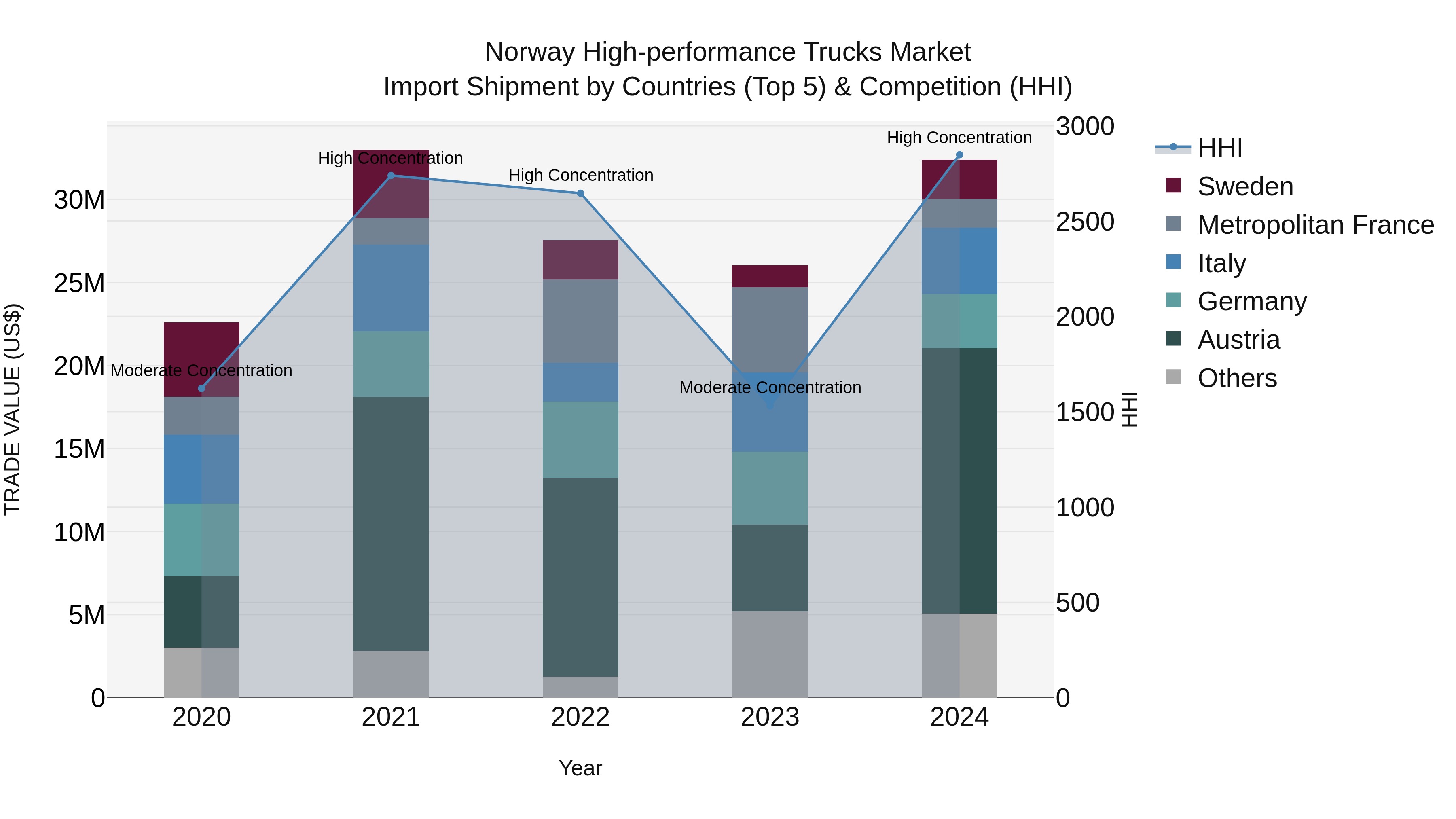
Norway`s high-performance truck import market experienced significant growth in 2024, with top exporters being Austria, Italy, Germany, Sweden, and Poland. The market concentration shifted from moderate to high, indicating a more competitive landscape. The impressive compound annual growth rate of 9.41% from 2020 to 2024, coupled with a notable growth rate of 24.47% in 2024, highlights the increasing demand for high-performance trucks in Norway. This trend suggests opportunities for market players to capitalize on the growing market and strategic partnerships with key exporting countries.
Key Highlights of the Report:
- Norway High-Performance Trucks Market Outlook
- Market Size of Norway High-Performance Trucks Market, 2025
- Forecast of Norway High-Performance Trucks Market, 2032
- Historical Data and Forecast of Norway High-Performance Trucks Revenues & Volume for the Period 2022 - 2032F
- Norway High-Performance Trucks Market Trend Evolution
- Norway High-Performance Trucks Market Drivers and Challenges
- Norway High-Performance Trucks Price Trends
- Norway High-Performance Trucks Porter`s Five Forces
- Norway High-Performance Trucks Industry Life Cycle
- Historical Data and Forecast of Norway High-Performance Trucks Market Revenues & Volume By Type for the Period 2022 - 2032F
- Historical Data and Forecast of Norway High-Performance Trucks Market Revenues & Volume By Pickup for the Period 2022 - 2032F
- Historical Data and Forecast of Norway High-Performance Trucks Market Revenues & Volume By M&HDV for the Period 2022 - 2032F
- Historical Data and Forecast of Norway High-Performance Trucks Market Revenues & Volume By Power Output for the Period 2022 - 2032F
- Historical Data and Forecast of Norway High-Performance Trucks Market Revenues & Volume By 250???400 for the Period 2022 - 2032F
- Historical Data and Forecast of Norway High-Performance Trucks Market Revenues & Volume By 401???550 for the Period 2022 - 2032F
- Historical Data and Forecast of Norway High-Performance Trucks Market Revenues & Volume By >550 HP for the Period 2022 - 2032F
- Historical Data and Forecast of Norway High-Performance Trucks Market Revenues & Volume By Application for the Period 2022 - 2032F
- Historical Data and Forecast of Norway High-Performance Trucks Market Revenues & Volume By Dumping for the Period 2022 - 2032F
- Historical Data and Forecast of Norway High-Performance Trucks Market Revenues & Volume By Distribution for the Period 2022 - 2032F
- Historical Data and Forecast of Norway High-Performance Trucks Market Revenues & Volume By Refrigeration for the Period 2022 - 2032F
- Historical Data and Forecast of Norway High-Performance Trucks Market Revenues & Volume By Container for the Period 2022 - 2032F
- Historical Data and Forecast of Norway High-Performance Trucks Market Revenues & Volume By Tanker for the Period 2022 - 2032F
- Historical Data and Forecast of Norway High-Performance Trucks Market Revenues & Volume By RMC for the Period 2022 - 2032F
- Norway High-Performance Trucks Import Export Trade Statistics
- Market Opportunity Assessment By Type
- Market Opportunity Assessment By Power Output
- Market Opportunity Assessment By Application
- Norway High-Performance Trucks Top Companies Market Share
- Norway High-Performance Trucks Competitive Benchmarking By Technical and Operational Parameters
- Norway High-Performance Trucks Company Profiles
- Norway High-Performance Trucks Key Strategic Recommendations






































