Norway Hospitality Furniture Market Top 5 Importing Countries and Market Competition (HHI) Analysis
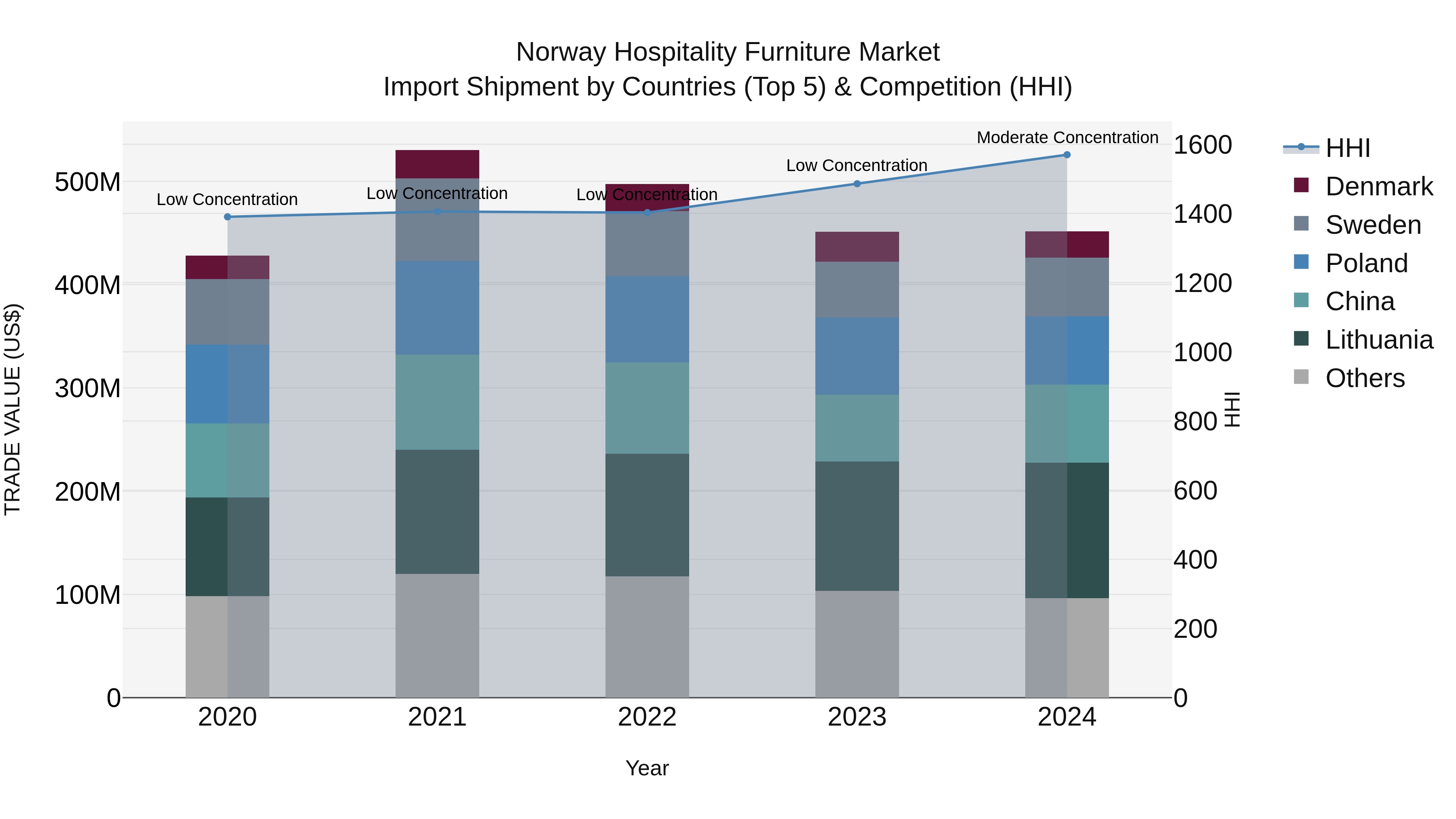
In 2024, Norway`s hospitality furniture import market saw increased concentration with top exporters being Lithuania, China, Poland, Sweden, and Denmark. The industry experienced steady growth with a CAGR of 1.34 from 2020 to 2024, and a slight growth rate of 0.1 from 2023 to 2024. This shift indicates a more competitive landscape and a growing demand for imported hospitality furniture in Norway. Stakeholders should monitor these trends closely to capitalize on emerging opportunities in the market.
Hospitality Furniture Market: Norway vs Top 5 Major Economies in 2027 (Europe)
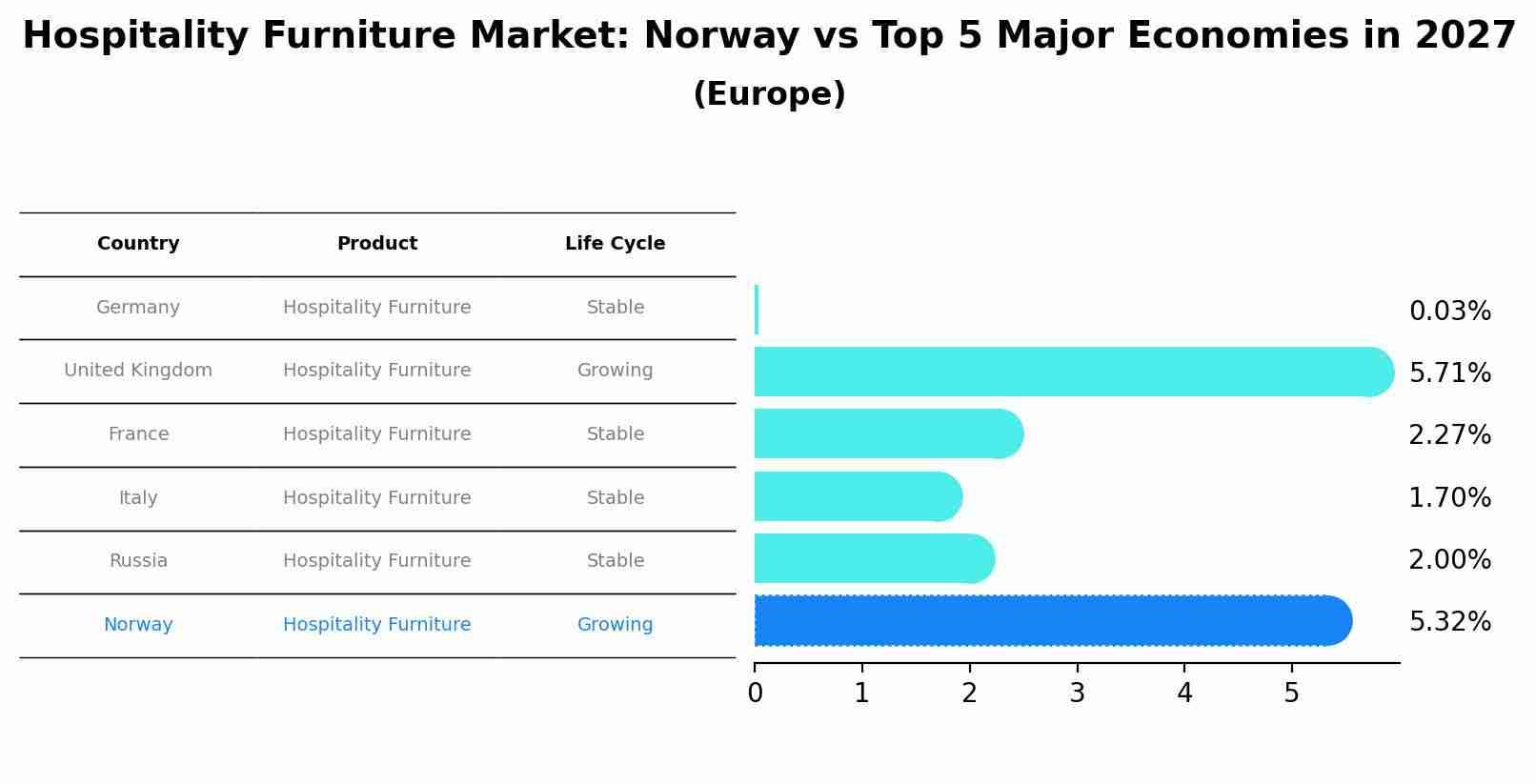
Norway's Hospitality Furniture market is anticipated to experience a growing growth rate of 5.32% by 2027, reflecting trends observed in the largest economy Germany, followed by United Kingdom, France, Italy and Russia.
Key Highlights of the Report:
- Norway Hospitality Furniture Market Outlook
- Market Size of Norway Hospitality Furniture Market, 2025
- Forecast of Norway Hospitality Furniture Market, 2032
- Historical Data and Forecast of Norway Hospitality Furniture Revenues & Volume for the Period 2022 - 2032F
- Norway Hospitality Furniture Market Trend Evolution
- Norway Hospitality Furniture Market Drivers and Challenges
- Norway Hospitality Furniture Price Trends
- Norway Hospitality Furniture Porter`s Five Forces
- Norway Hospitality Furniture Industry Life Cycle
- Historical Data and Forecast of Norway Hospitality Furniture Market Revenues & Volume By Type for the Period 2022 - 2032F
- Historical Data and Forecast of Norway Hospitality Furniture Market Revenues & Volume By Wooden Furniture for the Period 2022 - 2032F
- Historical Data and Forecast of Norway Hospitality Furniture Market Revenues & Volume By Leather & Fabric Furniture for the Period 2022 - 2032F
- Historical Data and Forecast of Norway Hospitality Furniture Market Revenues & Volume By Metal Furniture for the Period 2022 - 2032F
- Historical Data and Forecast of Norway Hospitality Furniture Market Revenues & Volume By Others for the Period 2022 - 2032F
- Historical Data and Forecast of Norway Hospitality Furniture Market Revenues & Volume By Applications for the Period 2022 - 2032F
- Historical Data and Forecast of Norway Hospitality Furniture Market Revenues & Volume By Economy Hotel for the Period 2022 - 2032F
- Historical Data and Forecast of Norway Hospitality Furniture Market Revenues & Volume By Extended-stay Hotel for the Period 2022 - 2032F
- Historical Data and Forecast of Norway Hospitality Furniture Market Revenues & Volume By Full-service Hotel for the Period 2022 - 2032F
- Historical Data and Forecast of Norway Hospitality Furniture Market Revenues & Volume By Luxury Hotel for the Period 2022 - 2032F
- Historical Data and Forecast of Norway Hospitality Furniture Market Revenues & Volume By Others for the Period 2022 - 2032F
- Historical Data and Forecast of Norway Hospitality Furniture Market Revenues & Volume By Industry Vertical for the Period 2022 - 2032F
- Historical Data and Forecast of Norway Hospitality Furniture Market Revenues & Volume By Hotels & Restaurants for the Period 2022 - 2032F
- Historical Data and Forecast of Norway Hospitality Furniture Market Revenues & Volume By Public Places for the Period 2022 - 2032F
- Historical Data and Forecast of Norway Hospitality Furniture Market Revenues & Volume By Corporate Offices for the Period 2022 - 2032F
- Historical Data and Forecast of Norway Hospitality Furniture Market Revenues & Volume By Others for the Period 2022 - 2032F
- Norway Hospitality Furniture Import Export Trade Statistics
- Market Opportunity Assessment By Type
- Market Opportunity Assessment By Applications
- Market Opportunity Assessment By Industry Vertical
- Norway Hospitality Furniture Top Companies Market Share
- Norway Hospitality Furniture Competitive Benchmarking By Technical and Operational Parameters
- Norway Hospitality Furniture Company Profiles
- Norway Hospitality Furniture Key Strategic Recommendations






































