Norway Industrial Rubber Market Top 5 Importing Countries and Market Competition (HHI) Analysis
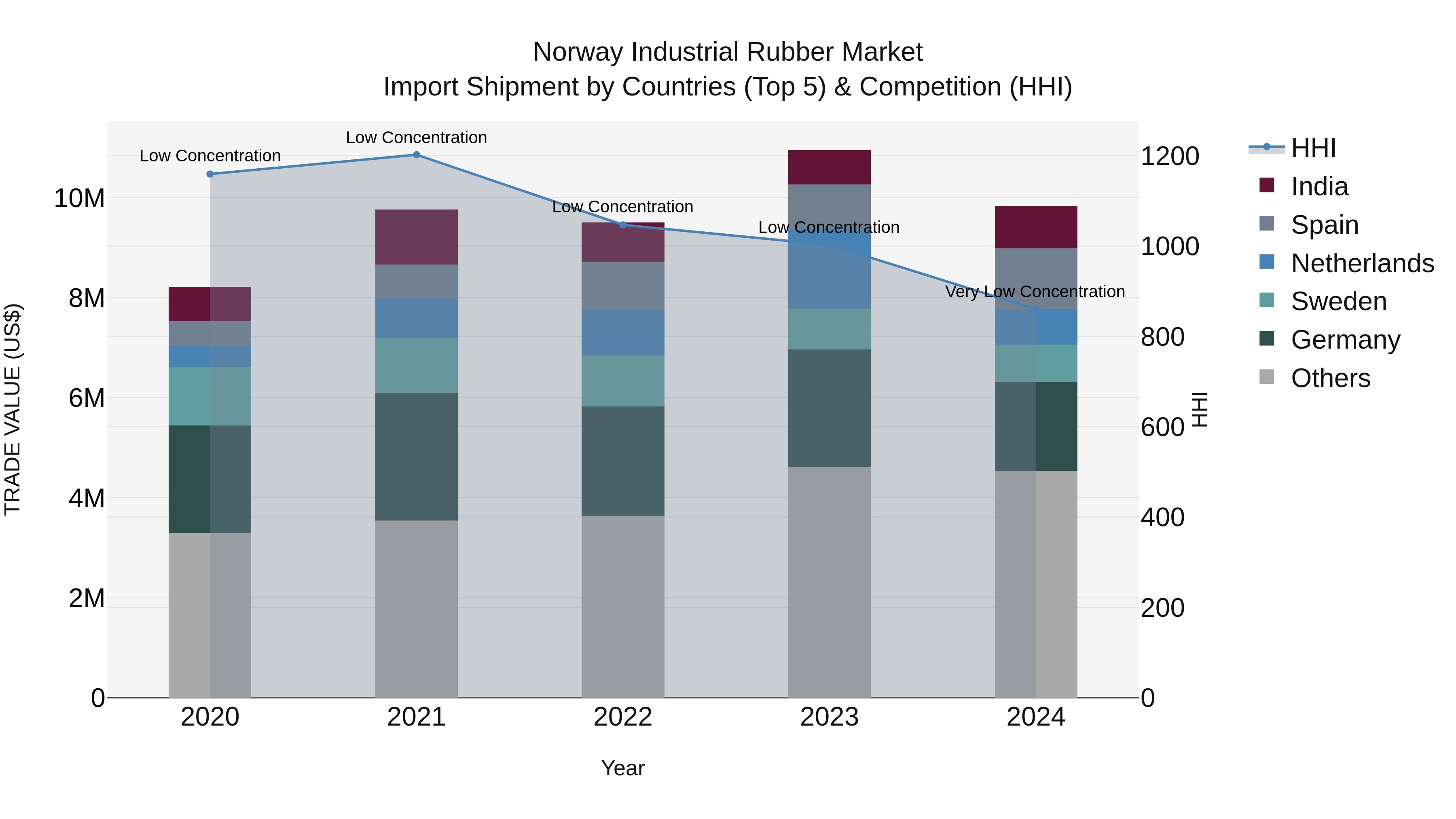
Norway`s industrial rubber import shipments in 2024 continued to see a diverse range of exporting countries, with Germany, Spain, India, China, and Sweden leading the pack. The market displayed low concentration in 2023, which further decreased to very low concentration in 2024. Despite a slight decline in growth rate from 2023 to 2024, the compound annual growth rate (CAGR) over the period of 2020-2024 remained positive at 4.59%. This indicates a stable and gradually expanding market for industrial rubber imports in Norway, driven by a mix of suppliers from various countries.
Industrial Rubber Market: Norway vs Top 5 Major Economies in 2027 (Europe)
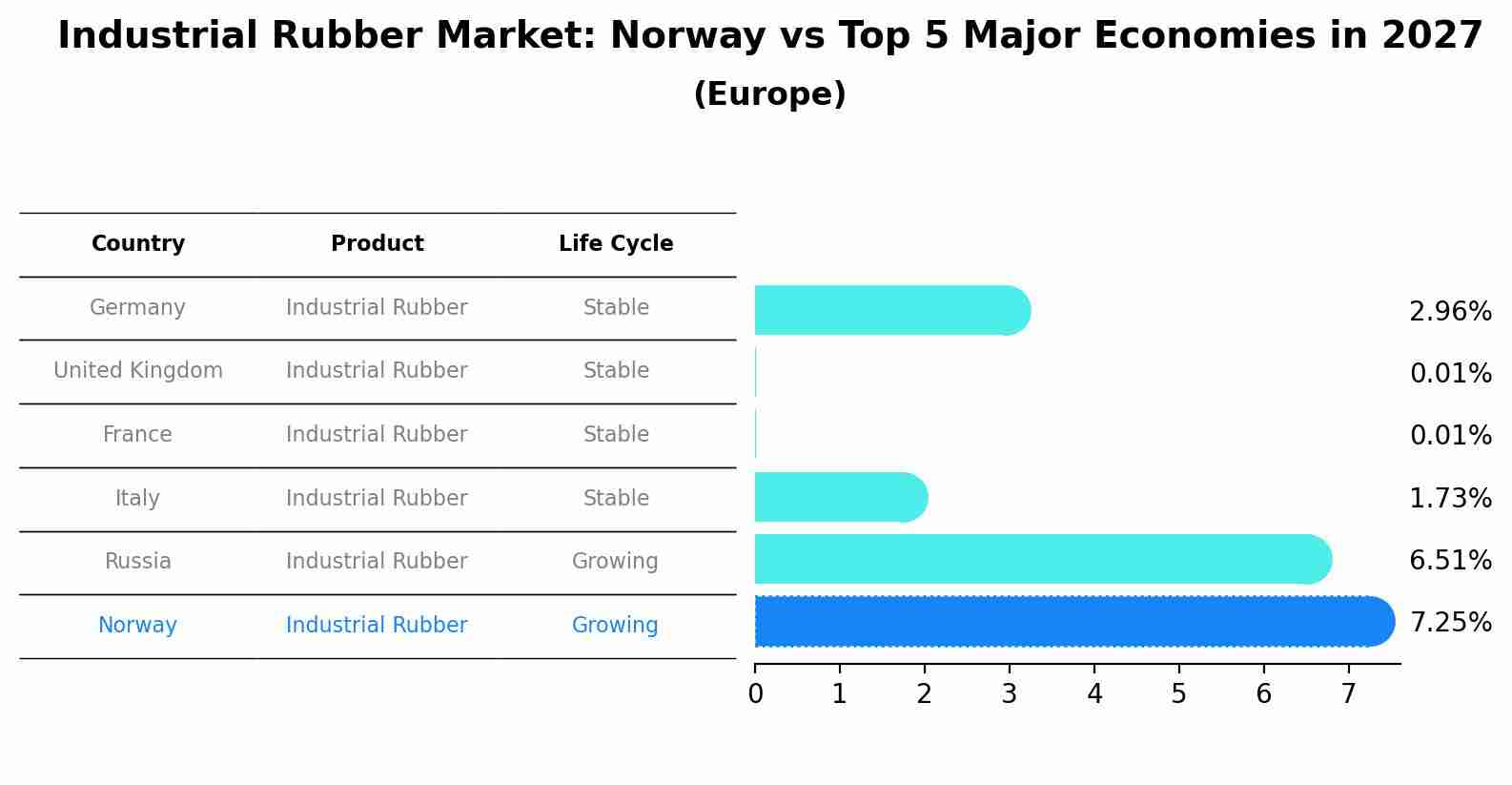
The Industrial Rubber market in Norway is projected to grow at a growing growth rate of 7.25% by 2027, highlighting the country's increasing focus on advanced technologies within the Europe region, where Germany holds the dominant position, followed closely by United Kingdom, France, Italy and Russia, shaping overall regional demand.
Norway Industrial Rubber Market Overview
The industrial rubber market in Norway is driven by the demand for rubber products used in various industrial applications, including seals, gaskets, and hoses. Industrial rubber is essential for providing flexibility, durability, and performance in machinery and equipment. The market benefits from advancements in rubber technology, increasing industrial activity, and the need for high-quality and reliable rubber products.
Drivers of the market
The industrial rubber market in Norway is driven by the demand for rubber materials used in various industrial applications, including seals, gaskets, and vibration dampers. Industrial rubber offers benefits such as durability, flexibility, and resistance to environmental factors. The market benefits from advancements in rubber formulation technologies, increasing demand for high-performance rubber products, and growing focus on enhancing industrial equipment and machinery.
Challenges of the market
The industrial rubber market in Norway is constrained by fluctuating raw material costs and the need for continuous innovation to meet diverse application requirements. Additionally, environmental regulations and competition from synthetic alternatives pose significant challenges to market players.
Government Policy of the market
Government policies in Norways industrial rubber market emphasize safety, performance, and environmental impact. Regulations ensure that rubber products meet standards for effectiveness and safety in various industrial applications. The government supports innovations that enhance rubber technologies while minimizing environmental impact.
Key Highlights of the Report:
- Norway Industrial Rubber Market Outlook
- Market Size of Norway Industrial Rubber Market, 2024
- Forecast of Norway Industrial Rubber Market, 2031
- Historical Data and Forecast of Norway Industrial Rubber Revenues & Volume for the Period 2021-2031
- Norway Industrial Rubber Market Trend Evolution
- Norway Industrial Rubber Market Drivers and Challenges
- Norway Industrial Rubber Price Trends
- Norway Industrial Rubber Porter`s Five Forces
- Norway Industrial Rubber Industry Life Cycle
- Historical Data and Forecast of Norway Industrial Rubber Market Revenues & Volume By Type for the Period 2021-2031
- Historical Data and Forecast of Norway Industrial Rubber Market Revenues & Volume By Natural Rubber for the Period 2021-2031
- Historical Data and Forecast of Norway Industrial Rubber Market Revenues & Volume By Synthetic Rubber for the Period 2021-2031
- Historical Data and Forecast of Norway Industrial Rubber Market Revenues & Volume By Application for the Period 2021-2031
- Historical Data and Forecast of Norway Industrial Rubber Market Revenues & Volume By Automotive for the Period 2021-2031
- Historical Data and Forecast of Norway Industrial Rubber Market Revenues & Volume By Building & Construction for the Period 2021-2031
- Historical Data and Forecast of Norway Industrial Rubber Market Revenues & Volume By Industrial Manufacturing for the Period 2021-2031
- Historical Data and Forecast of Norway Industrial Rubber Market Revenues & Volume By Polymer Modification for the Period 2021-2031
- Historical Data and Forecast of Norway Industrial Rubber Market Revenues & Volume By Wire & Cable for the Period 2021-2031
- Historical Data and Forecast of Norway Industrial Rubber Market Revenues & Volume By Electrical & Electronics for the Period 2021-2031
- Historical Data and Forecast of Norway Industrial Rubber Market Revenues & Volume By Coating, Sealant, & Adhesive for the Period 2021-2031
- Historical Data and Forecast of Norway Industrial Rubber Market Revenues & Volume By Others for the Period 2021-2031
- Historical Data and Forecast of Norway Industrial Rubber Market Revenues & Volume By Product for the Period 2021-2031
- Historical Data and Forecast of Norway Industrial Rubber Market Revenues & Volume By Mechanical Rubber Good for the Period 2021-2031
- Historical Data and Forecast of Norway Industrial Rubber Market Revenues & Volume By Rubber Hose for the Period 2021-2031
- Historical Data and Forecast of Norway Industrial Rubber Market Revenues & Volume By Rubber Belt for the Period 2021-2031
- Historical Data and Forecast of Norway Industrial Rubber Market Revenues & Volume By Rubber Roofing for the Period 2021-2031
- Historical Data and Forecast of Norway Industrial Rubber Market Revenues & Volume By Others for the Period 2021-2031
- Norway Industrial Rubber Import Export Trade Statistics
- Market Opportunity Assessment By Type
- Market Opportunity Assessment By Application
- Market Opportunity Assessment By Product
- Norway Industrial Rubber Top Companies Market Share
- Norway Industrial Rubber Competitive Benchmarking By Technical and Operational Parameters
- Norway Industrial Rubber Company Profiles
- Norway Industrial Rubber Key Strategic Recommendations






































