Norway Iodine Market Top 5 Importing Countries and Market Competition (HHI) Analysis
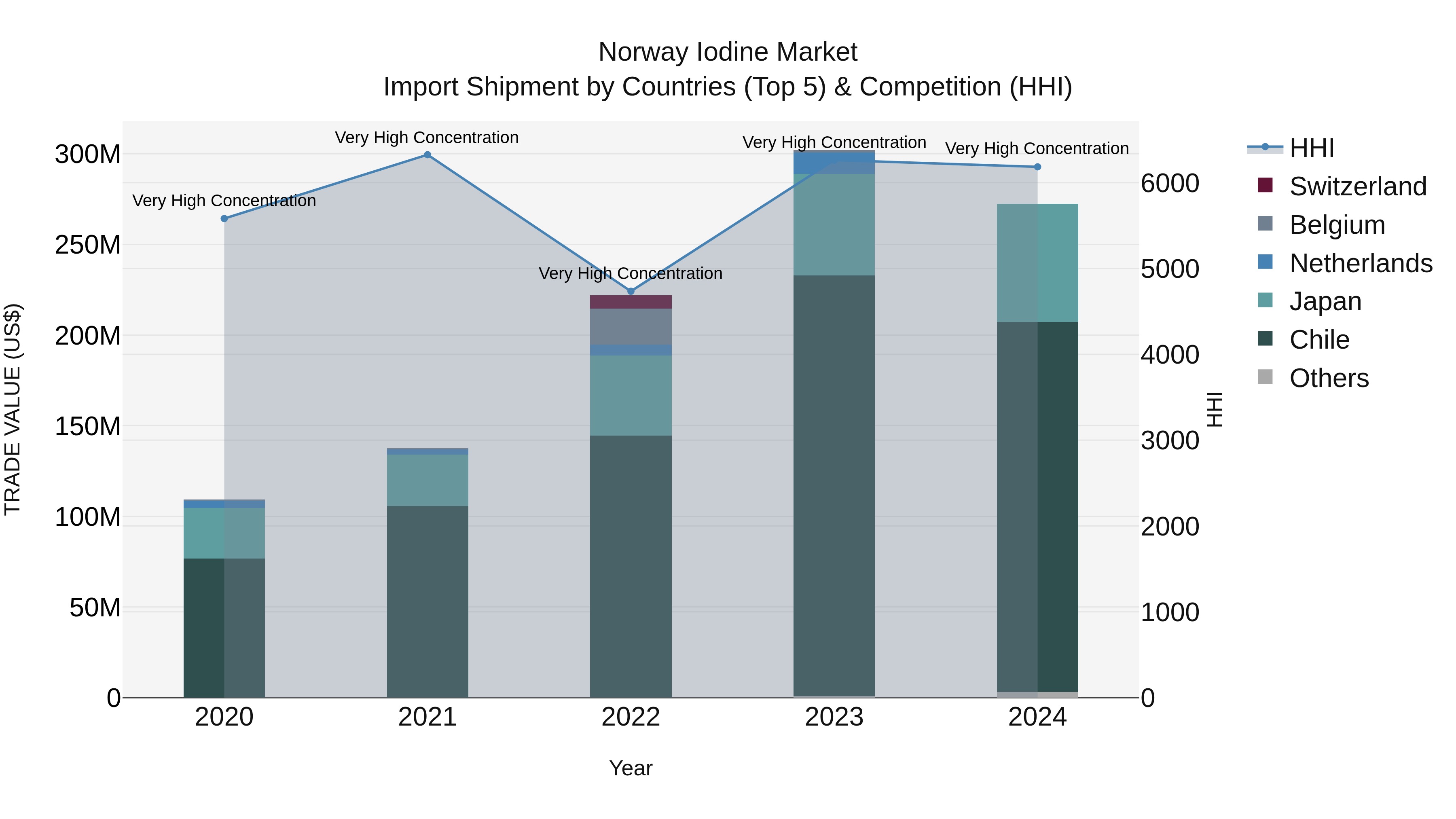
Norway`s iodine import market in 2024 continued to be dominated by key exporters such as Chile, Japan, USA, India, and Lithuania. Despite a slight decrease in growth rate from 2023 to 2024, the compound annual growth rate (CAGR) for the period 2020-2024 was impressive at 25.62%. The high Herfindahl-Hirschman Index (HHI) indicates a concentrated market structure, suggesting potential challenges and opportunities for both buyers and sellers in the iodine import industry in Norway.
Iodine Market: Norway vs Top 5 Major Economies in 2027 (Europe)
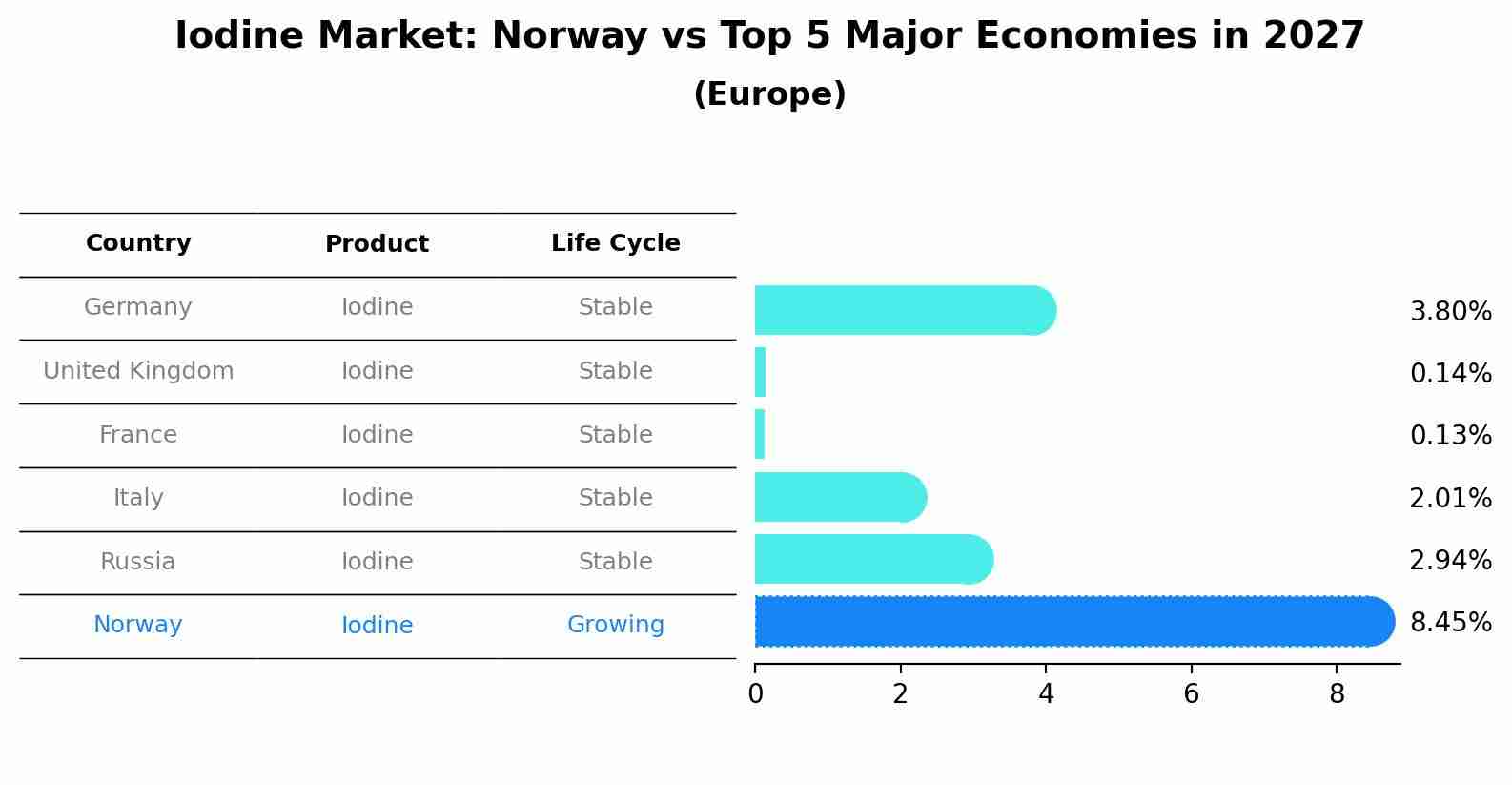
The Iodine market in Norway is projected to grow at a growing growth rate of 8.45% by 2027, highlighting the country's increasing focus on advanced technologies within the Europe region, where Germany holds the dominant position, followed closely by United Kingdom, France, Italy and Russia, shaping overall regional demand.
Norway Iodine Market Overview
The iodine market in Norway is influenced by the demand for iodine used in various applications, including pharmaceuticals, disinfectants, and chemical processes. Iodine is essential for its antiseptic properties and as a component in certain medications. The market benefits from advancements in iodine extraction and processing technologies, increasing demand for iodine-based products, and the need for high-quality iodine in various industries.
Drivers of the market
The iodine market in Norway is driven by the demand for iodine and its compounds in various applications, including pharmaceuticals, disinfectants, and industrial processes. Iodine provides benefits such as antimicrobial properties and essential nutrients. The market is influenced by advancements in iodine extraction and production technologies, increasing demand for iodine in healthcare and industrial applications, and the need for effective and safe iodine-based solutions. Additionally, the growing focus on health and safety is contributing to the growth of the iodine market.
Challenges of the market
The iodine market in Norway is affected by fluctuations in raw material costs and the need for compliance with environmental regulations related to iodine extraction and processing. Additionally, the market faces competition from alternative sources of iodine and must address concerns related to supply chain stability and regulatory compliance.
Government Policy of the market
In Norway, policies related to the iodine market emphasize safety, quality, and regulatory compliance. Regulations ensure that iodine products meet standards for purity and effectiveness in various applications, including medical and industrial uses. The government supports innovations in iodine technologies that enhance product quality and application effectiveness.
Key Highlights of the Report:
- Norway Iodine Market Outlook
- Market Size of Norway Iodine Market, 2024
- Forecast of Norway Iodine Market, 2031
- Historical Data and Forecast of Norway Iodine Revenues & Volume for the Period 2021-2031
- Norway Iodine Market Trend Evolution
- Norway Iodine Market Drivers and Challenges
- Norway Iodine Price Trends
- Norway Iodine Porter`s Five Forces
- Norway Iodine Industry Life Cycle
- Historical Data and Forecast of Norway Iodine Market Revenues & Volume By Source for the Period 2021-2031
- Historical Data and Forecast of Norway Iodine Market Revenues & Volume By Caliche Ore for the Period 2021-2031
- Historical Data and Forecast of Norway Iodine Market Revenues & Volume By Underground Brines for the Period 2021-2031
- Historical Data and Forecast of Norway Iodine Market Revenues & Volume By Recycling for the Period 2021-2031
- Historical Data and Forecast of Norway Iodine Market Revenues & Volume By Seaweeds for the Period 2021-2031
- Historical Data and Forecast of Norway Iodine Market Revenues & Volume By Form for the Period 2021-2031
- Historical Data and Forecast of Norway Iodine Market Revenues & Volume By Organic Compounds for the Period 2021-2031
- Historical Data and Forecast of Norway Iodine Market Revenues & Volume By Inorganic Salts & Complexes for the Period 2021-2031
- Historical Data and Forecast of Norway Iodine Market Revenues & Volume By Elemental & Isotopes for the Period 2021-2031
- Historical Data and Forecast of Norway Iodine Market Revenues & Volume By Application for the Period 2021-2031
- Historical Data and Forecast of Norway Iodine Market Revenues & Volume By X-Ray Contrast Media for the Period 2021-2031
- Historical Data and Forecast of Norway Iodine Market Revenues & Volume By Pharmaceuticals for the Period 2021-2031
- Historical Data and Forecast of Norway Iodine Market Revenues & Volume By Optical Polarizing Films for the Period 2021-2031
- Historical Data and Forecast of Norway Iodine Market Revenues & Volume By Catalyst in Polymer Processing for the Period 2021-2031
- Historical Data and Forecast of Norway Iodine Market Revenues & Volume By Animal Feed for the Period 2021-2031
- Historical Data and Forecast of Norway Iodine Market Revenues & Volume By Fluorochemicals for the Period 2021-2031
- Historical Data and Forecast of Norway Iodine Market Revenues & Volume By Human Nutrition for the Period 2021-2031
- Historical Data and Forecast of Norway Iodine Market Revenues & Volume By Othersfor the Period 2021-2031
- Norway Iodine Import Export Trade Statistics
- Market Opportunity Assessment By Source
- Market Opportunity Assessment By Form
- Market Opportunity Assessment By Application
- Norway Iodine Top Companies Market Share
- Norway Iodine Competitive Benchmarking By Technical and Operational Parameters
- Norway Iodine Company Profiles
- Norway Iodine Key Strategic Recommendations






































