Norway Kaolin Market Top 5 Importing Countries and Market Competition (HHI) Analysis
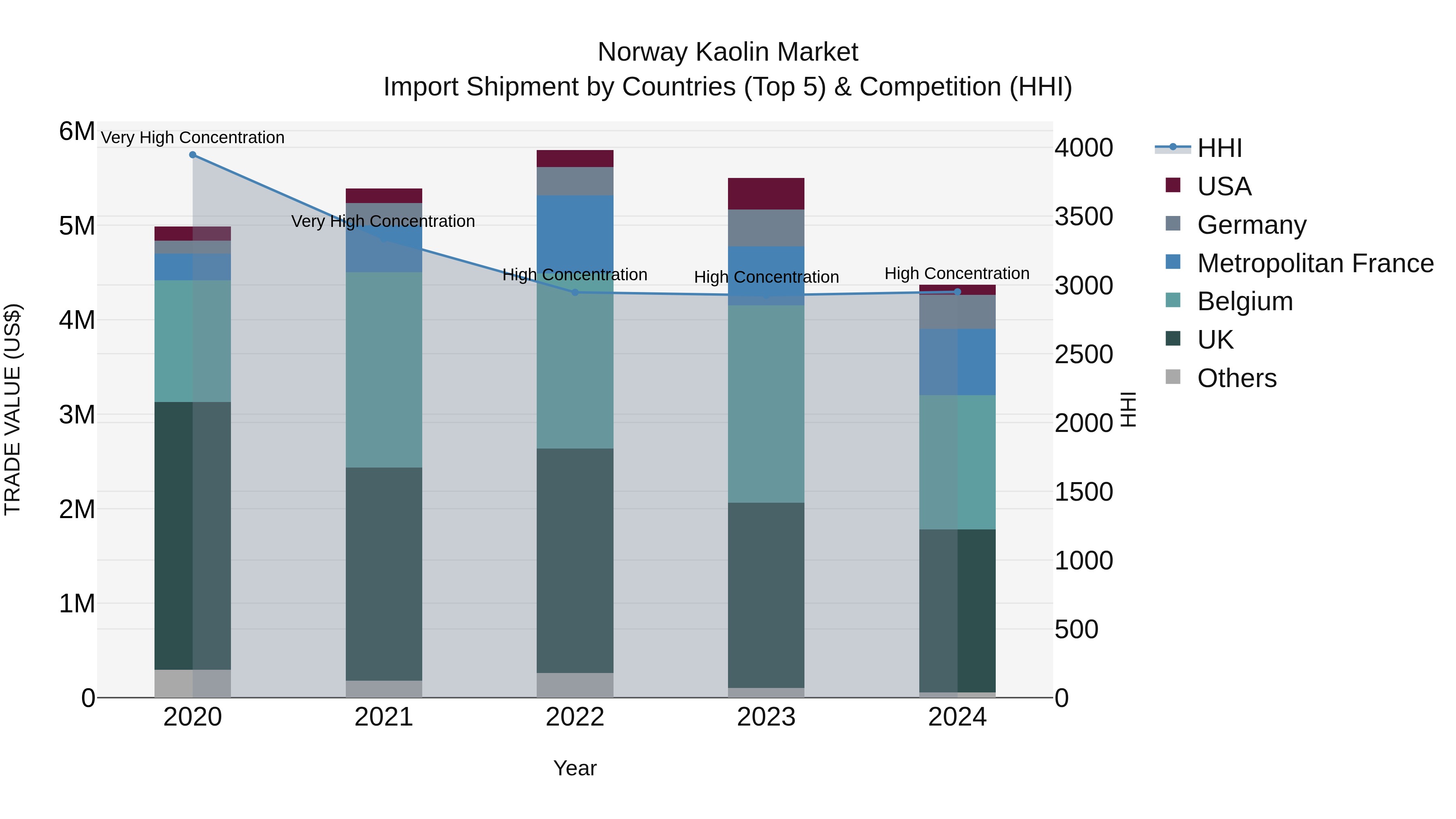
Norway`s kaolin import market in 2024 continued to be dominated by key exporting countries such as the UK, Belgium, Metropolitan France, Germany, and the USA. Despite a high concentration with a high Herfindahl-Hirschman Index (HHI), the market saw a negative Compound Annual Growth Rate (CAGR) of -3.26% from 2020 to 2024. The growth rate from 2023 to 2024 experienced a significant decline of -20.58%, indicating a challenging year for kaolin imports in Norway. These trends suggest a need for strategic adjustments in the kaolin import market to stimulate growth and competitiveness.
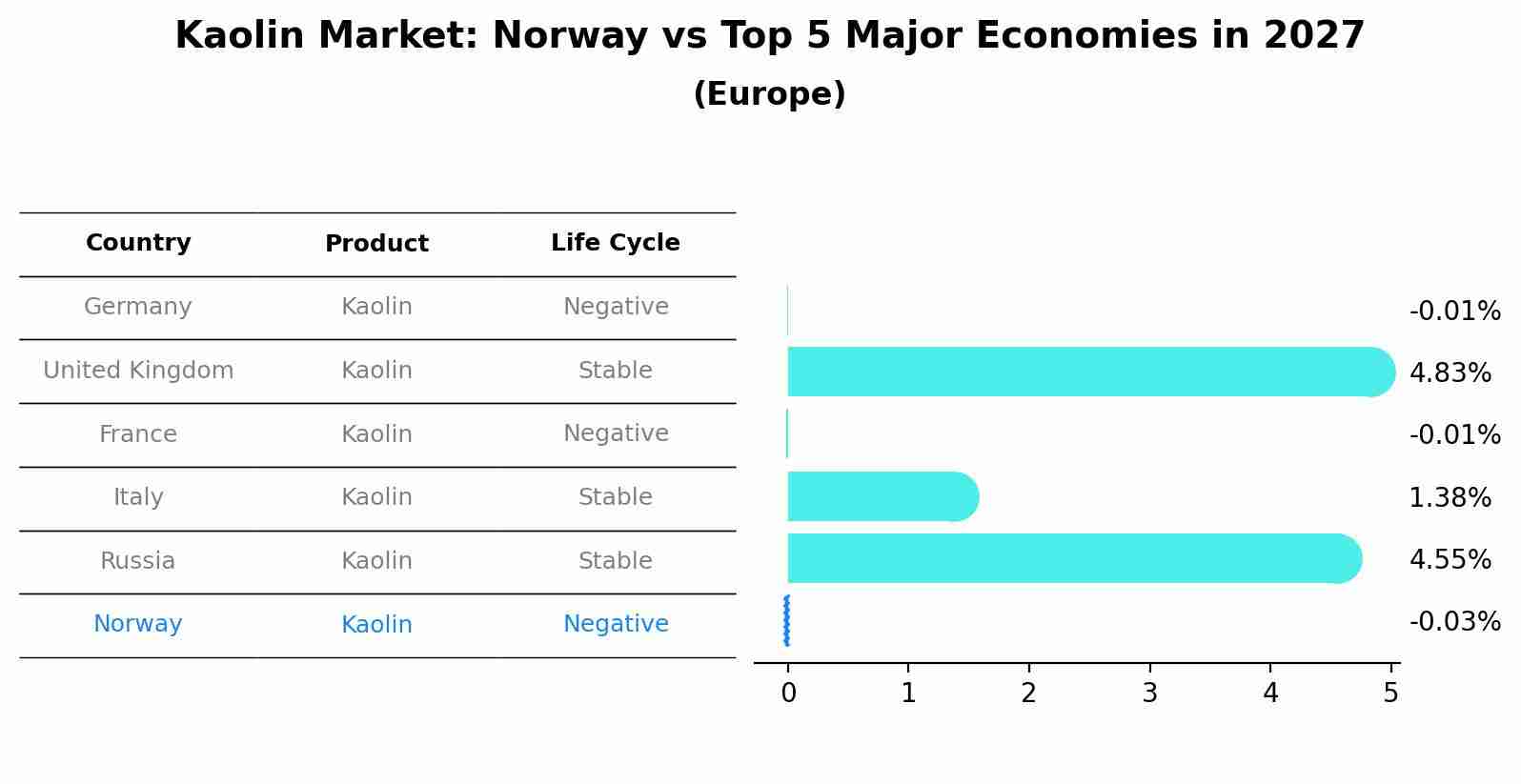
Kaolin Market: Norway vs Top 5 Major Economies in 2027 (Europe)
In the Europe region, the Kaolin market in Norway is projected to expand at a negative growth rate of -0.03% by 2027. The largest economy is Germany, followed by United Kingdom, France, Italy and Russia.
Norway Kaolin Market Overview
The kaolin market in Norway is influenced by the demand for this clay mineral used in ceramics, paper, and industrial applications. Kaolin is valued for its whiteness, fine particle size, and chemical properties. The market benefits from advancements in kaolin processing technologies, increasing use in various industries, and the need for high-quality kaolin products.
Drivers of the market
The kaolin market in Norway is driven by the demand for kaolin in various industrial applications, including ceramics, paper, and plastics. Kaolin is valued for its whiteness, fine particle size, and ability to improve product performance. The growth of the construction, ceramics, and paper industries, along with advancements in kaolin processing technologies, are contributing to the market`s expansion. Additionally, the increasing use of kaolin in high-performance applications and the development of new kaolin-based products are driving market growth.
Challenges of the market
The kaolin market in Norway encounters challenges related to fluctuating raw material prices and the need for continuous innovation to improve kaolin performance and applications. Ensuring the quality and consistency of kaolin products requires significant investment in R&D and quality control. Additionally, the market is competitive, with numerous global suppliers, which can impact pricing and market dynamics.
Government Policy of the market
Government policies in Norways kaolin market focus on quality, safety, and environmental impact. Regulations ensure that kaolin products meet standards for purity and effectiveness in various industrial applications. The government supports advancements in kaolin technologies that enhance product performance and reduce environmental impact.
Key Highlights of the Report:
- Norway Kaolin Market Outlook
- Market Size of Norway Kaolin Market, 2024
- Forecast of Norway Kaolin Market, 2031
- Historical Data and Forecast of Norway Kaolin Revenues & Volume for the Period 2021-2031
- Norway Kaolin Market Trend Evolution
- Norway Kaolin Market Drivers and Challenges
- Norway Kaolin Price Trends
- Norway Kaolin Porter`s Five Forces
- Norway Kaolin Industry Life Cycle
- Historical Data and Forecast of Norway Kaolin Market Revenues & Volume By Process for the Period 2021-2031
- Historical Data and Forecast of Norway Kaolin Market Revenues & Volume By Water-washed for the Period 2021-2031
- Historical Data and Forecast of Norway Kaolin Market Revenues & Volume By Airfloat for the Period 2021-2031
- Historical Data and Forecast of Norway Kaolin Market Revenues & Volume By Calcined for the Period 2021-2031
- Historical Data and Forecast of Norway Kaolin Market Revenues & Volume By Delaminated for the Period 2021-2031
- Historical Data and Forecast of Norway Kaolin Market Revenues & Volume By Surface-modified & Unprocessed for the Period 2021-2031
- Historical Data and Forecast of Norway Kaolin Market Revenues & Volume By End-users for the Period 2021-2031
- Historical Data and Forecast of Norway Kaolin Market Revenues & Volume By Ceramics & Sanitarywares for the Period 2021-2031
- Historical Data and Forecast of Norway Kaolin Market Revenues & Volume By Fiberglass for the Period 2021-2031
- Historical Data and Forecast of Norway Kaolin Market Revenues & Volume By Paints & Coatings for the Period 2021-2031
- Historical Data and Forecast of Norway Kaolin Market Revenues & Volume By Rubber for the Period 2021-2031
- Historical Data and Forecast of Norway Kaolin Market Revenues & Volume By Adhesives & Sealants for the Period 2021-2031
- Historical Data and Forecast of Norway Kaolin Market Revenues & Volume By Plastics for the Period 2021-2031
- Historical Data and Forecast of Norway Kaolin Market Revenues & Volume By Others for the Period 2021-2031
- Norway Kaolin Import Export Trade Statistics
- Market Opportunity Assessment By Process
- Market Opportunity Assessment By End-users
- Norway Kaolin Top Companies Market Share
- Norway Kaolin Competitive Benchmarking By Technical and Operational Parameters
- Norway Kaolin Company Profiles
- Norway Kaolin Key Strategic Recommendations






































