Norway Office Furniture Market Growth Rate Analysis (2025 - 2031)
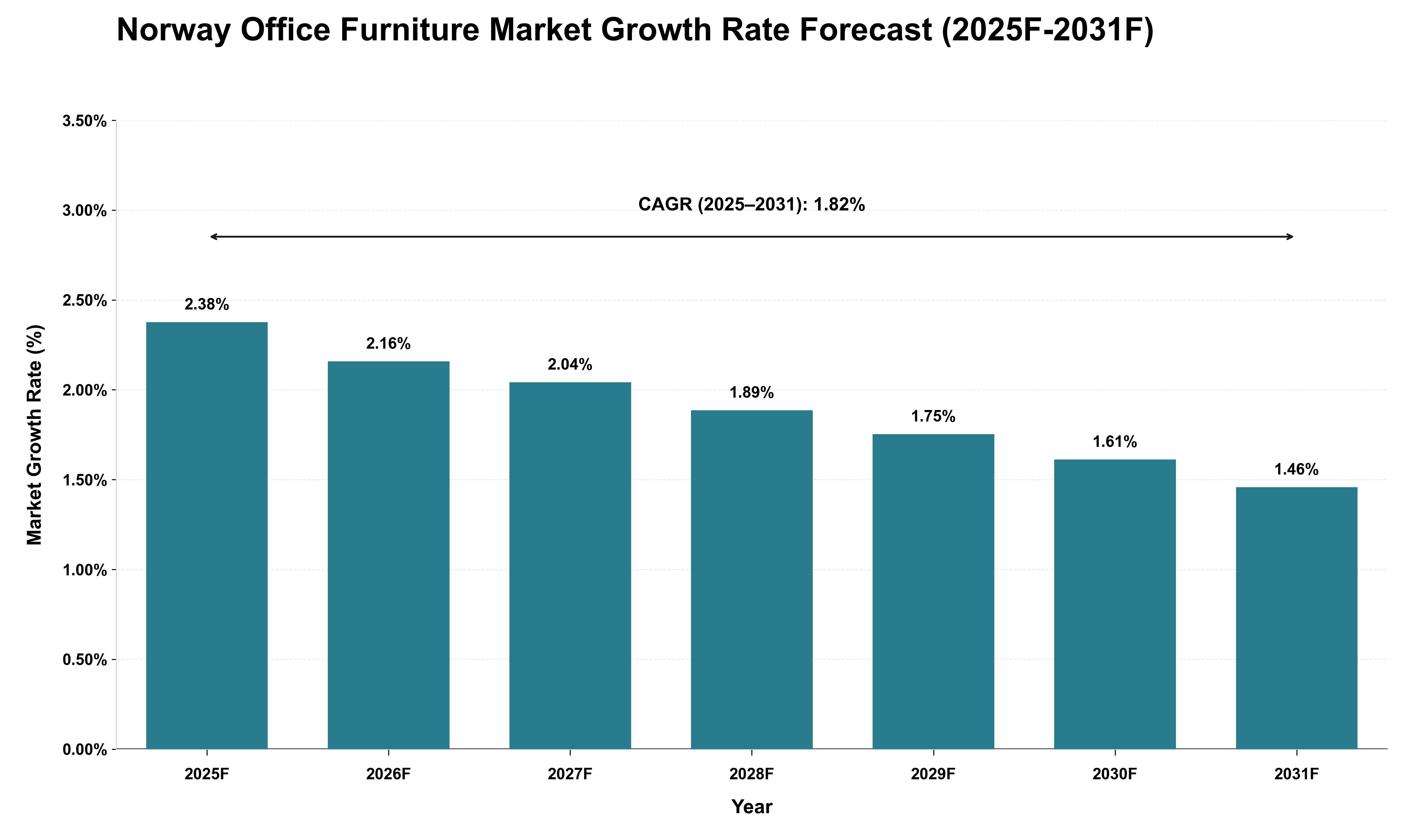
From 2025 onward, the Norway office furniture market is anticipated to experience a gradual deceleration in growth, with a compound annual growth rate (CAGR) of 1.82% reflecting underlying macroeconomic dynamics. The initial robust growth of 2.38% in 2025 will likely be driven by increased demand for ergonomic and flexible workspace solutions, as businesses adapt to evolving work environments. However, as the forecast progresses, input costs are expected to rise due to supply chain disruptions and inflationary pressures on raw materials, which will constrain profit margins and limit aggressive expansion strategies among manufacturers. Additionally, import dependencies on specific materials may exacerbate volatility in pricing and availability, further influencing market dynamics. By 2031, the growth rate is projected to taper off to 1.46%, indicating a potential recalibration of consumer preferences and business investment strategies within the office furniture sector amidst these economic challenges.
Key Highlights of the Report:
- Norway Office Furniture Market Outlook
- Market Size of Norway Office Furniture Market, 2025
- Forecast of Norway Office Furniture Market, 2032
- Historical Data and Forecast of Norway Office Furniture Revenues & Volume for the Period 2022 - 2032F
- Norway Office Furniture Market Trend Evolution
- Norway Office Furniture Market Drivers and Challenges
- Norway Office Furniture Price Trends
- Norway Office Furniture Porter`s Five Forces
- Norway Office Furniture Industry Life Cycle
- Historical Data and Forecast of Norway Office Furniture Market Revenues & Volume By Types for the Period 2022 - 2032F
- Historical Data and Forecast of Norway Office Furniture Market Revenues & Volume By Seating for the Period 2022 - 2032F
- Historical Data and Forecast of Norway Office Furniture Market Revenues & Volume By Tables for the Period 2022 - 2032F
- Historical Data and Forecast of Norway Office Furniture Market Revenues & Volume By Storage for the Period 2022 - 2032F
- Historical Data and Forecast of Norway Office Furniture Market Revenues & Volume By Desks for the Period 2022 - 2032F
- Historical Data and Forecast of Norway Office Furniture Market Revenues & Volume By Otherfor the Period 2022 - 2032F
- Historical Data and Forecast of Norway Office Furniture Market Revenues & Volume By Distribution Channel for the Period 2022 - 2032F
- Historical Data and Forecast of Norway Office Furniture Market Revenues & Volume By Home Centers for the Period 2022 - 2032F
- Historical Data and Forecast of Norway Office Furniture Market Revenues & Volume By Flagship Stores for the Period 2022 - 2032F
- Historical Data and Forecast of Norway Office Furniture Market Revenues & Volume By Specialty Stores for the Period 2022 - 2032F
- Historical Data and Forecast of Norway Office Furniture Market Revenues & Volume By Online Stores for the Period 2022 - 2032F
- Historical Data and Forecast of Norway Office Furniture Market Revenues & Volume By Otherfor the Period 2022 - 2032F
- Norway Office Furniture Import Export Trade Statistics
- Market Opportunity Assessment By Types
- Market Opportunity Assessment By Distribution Channel
- Norway Office Furniture Top Companies Market Share
- Norway Office Furniture Competitive Benchmarking By Technical and Operational Parameters
- Norway Office Furniture Company Profiles
- Norway Office Furniture Key Strategic Recommendations






































