Norway Optical Projector Market Top 5 Importing Countries and Market Competition (HHI) Analysis
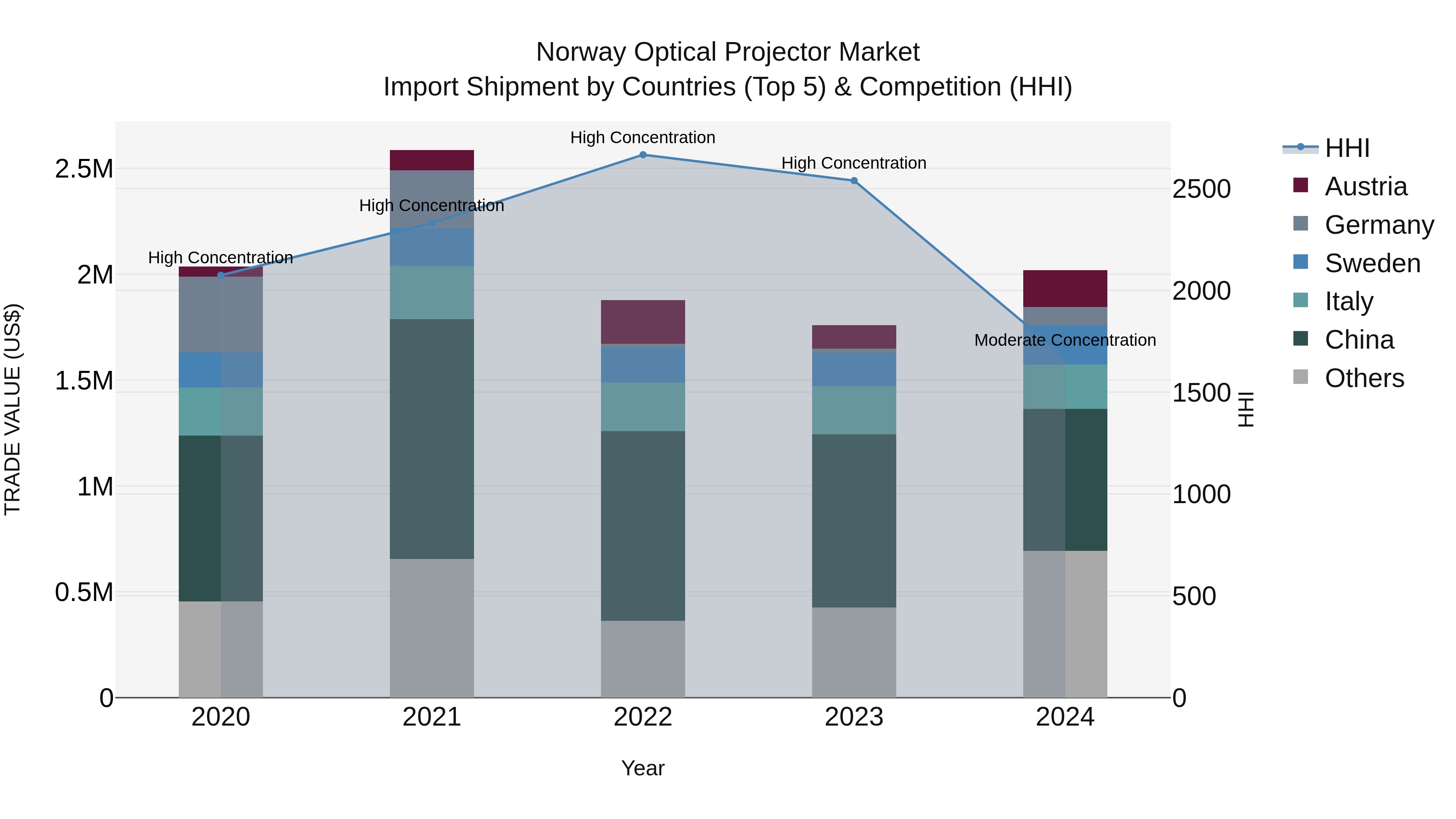
In 2024, Norway saw a shift in the concentration of optical projector imports, moving from high concentration in 2023 to moderate concentration. The top countries exporting to Norway remain diverse, with China, USA, Italy, Sweden, and Austria leading the way. Despite a slight decline in the compound annual growth rate (CAGR) from 2020 to 2024, the growth rate between 2023 and 2024 surged by 14.8%, indicating a positive momentum in the market. This data suggests a healthy competition among exporting countries and a growing demand for optical projectors in Norway.
Norway Optical Projector Market Overview
The optical projector market in Norway is influenced by the demand for high-quality imaging and projection solutions in various sectors, including education, entertainment, and business. Optical projectors are essential for delivering clear and vibrant images in presentations, screenings, and events. The market is driven by innovations in projector technology, such as LED and laser light sources, which offer improved brightness, color accuracy, and energy efficiency.
Drivers of the market
The optical projector market in Norway is influenced by the demand for advanced projection technologies in entertainment, education, and business sectors. The growth in digital cinema, interactive learning tools, and high-definition presentations drives the demand for optical projectors. Innovations in projector technology, such as laser and LED-based systems, offer improved brightness and image quality, further supporting market growth. The increasing use of projectors in events, conferences, and home theaters also contributes to the market`s expansion.
Challenges of the market
In the optical projector market, competition and technological advancements pose significant challenges. Companies need to innovate continuously to offer superior image quality and features. Additionally, managing production costs while meeting the demand for high-performance projectors is a persistent challenge.
Government Policy of the market
The optical projector market in Norway is affected by policies that encourage technological innovation and energy efficiency. The government promotes the use of advanced optical projectors through incentives for businesses investing in high-quality projection technologies. Additionally, regulations focus on improving the energy efficiency of optical projectors and reducing their environmental impact. Norways policies also support the development of new optical projection applications in various sectors, including education and entertainment.
Key Highlights of the Report:
- Norway Optical Projector Market Outlook
- Market Size of Norway Optical Projector Market, 2024
- Forecast of Norway Optical Projector Market, 2031
- Historical Data and Forecast of Norway Optical Projector Revenues & Volume for the Period 2021-2031
- Norway Optical Projector Market Trend Evolution
- Norway Optical Projector Market Drivers and Challenges
- Norway Optical Projector Price Trends
- Norway Optical Projector Porter`s Five Forces
- Norway Optical Projector Industry Life Cycle
- Historical Data and Forecast of Norway Optical Projector Market Revenues & Volume By Type for the Period 2021-2031
- Historical Data and Forecast of Norway Optical Projector Market Revenues & Volume By Digital Light Processing (DLP) for the Period 2021-2031
- Historical Data and Forecast of Norway Optical Projector Market Revenues & Volume By Liquid Crystal Display (LCD) for the Period 2021-2031
- Historical Data and Forecast of Norway Optical Projector Market Revenues & Volume By Liquid Crystal on Silicon (LCoS) for the Period 2021-2031
- Historical Data and Forecast of Norway Optical Projector Market Revenues & Volume By Application for the Period 2021-2031
- Historical Data and Forecast of Norway Optical Projector Market Revenues & Volume By Residential for the Period 2021-2031
- Historical Data and Forecast of Norway Optical Projector Market Revenues & Volume By Commercial for the Period 2021-2031
- Historical Data and Forecast of Norway Optical Projector Market Revenues & Volume By Industrial for the Period 2021-2031
- Norway Optical Projector Import Export Trade Statistics
- Market Opportunity Assessment By Type
- Market Opportunity Assessment By Application
- Norway Optical Projector Top Companies Market Share
- Norway Optical Projector Competitive Benchmarking By Technical and Operational Parameters
- Norway Optical Projector Company Profiles
- Norway Optical Projector Key Strategic Recommendations






































