Norway Organic Personal Care Ingredients Market Top 5 Importing Countries and Market Competition (HHI) Analysis
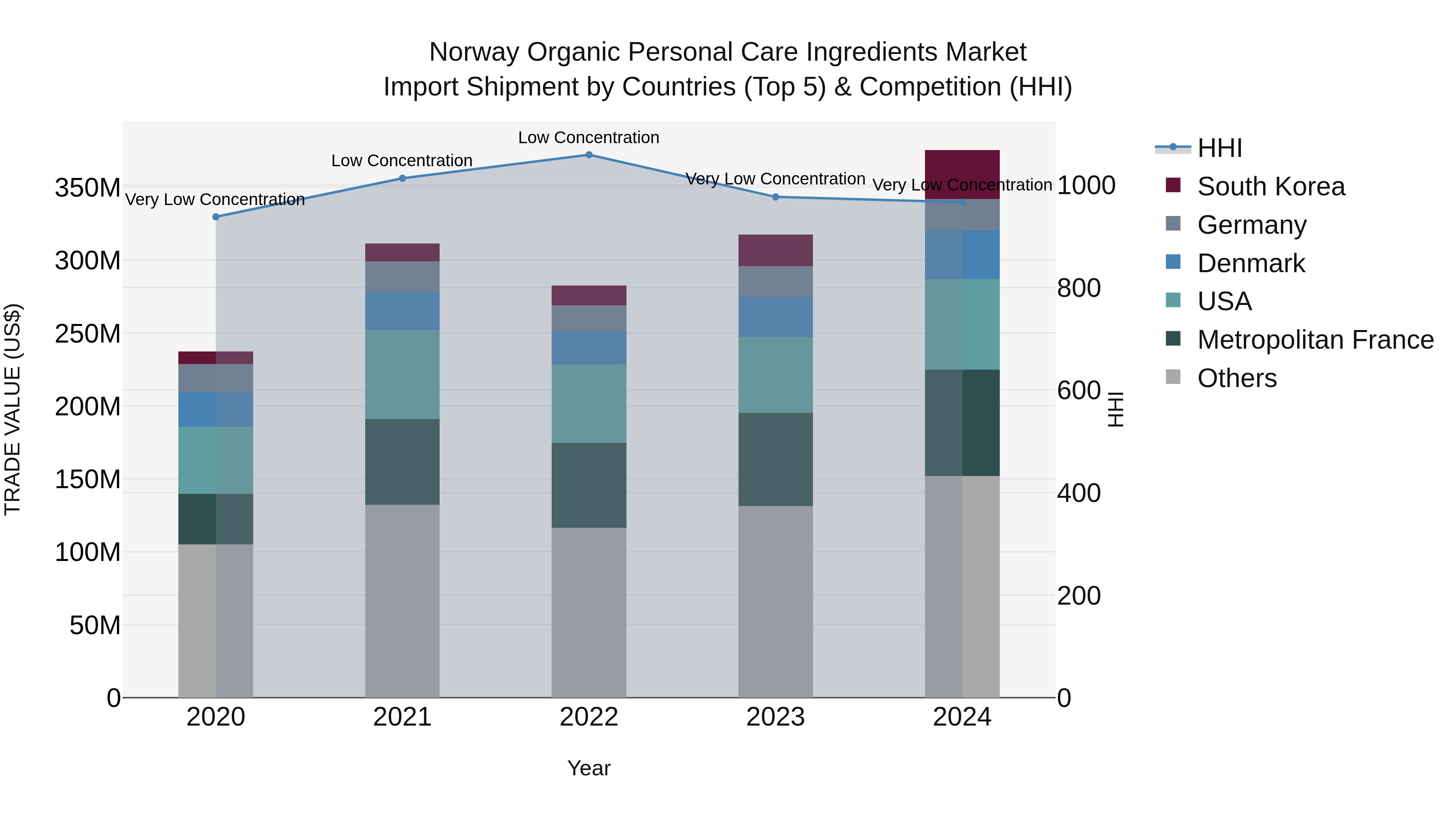
The organic personal care ingredients import market in Norway has continued to thrive in 2024, with a steady increase in shipments from top exporting countries such as Metropolitan France, USA, South Korea, Denmark, and Germany. The low concentration of the Herfindahl-Hirschman Index (HHI) indicates a competitive market landscape. The impressive Compound Annual Growth Rate (CAGR) of 12.15% from 2020 to 2024 showcases sustained growth, while the growth rate of 18.19% from 2023 to 2024 signifies a significant uptick in demand. Norway`s interest in organic personal care ingredients remains strong, driving the import market forward.
Norway Organic Personal Care Ingredients Market Overview
The Norway Organic Personal Care Ingredients Market is experiencing steady growth driven by increasing consumer awareness regarding the benefits of organic products. The market is witnessing a shift towards natural and sustainable ingredients due to rising concerns about chemical exposure and environmental impact. Key players in the market are focusing on innovation and product development to cater to the growing demand for organic personal care products. The trend towards clean beauty and eco-friendly formulations is shaping the market landscape, with a preference for ingredients such as plant-based extracts, essential oils, and botanicals. Regulatory support and certifications for organic products further boost market growth. Overall, the Norway Organic Personal Care Ingredients Market is poised for expansion as consumers seek safer and more environmentally friendly alternatives in their personal care routines.
Norway Organic Personal Care Ingredients Market Trends and Opportunities
The Norway Organic Personal Care Ingredients Market is experiencing a growing demand for natural and sustainable ingredients due to increasing consumer awareness about the benefits of organic products. Key trends in the market include the rise of clean beauty, the popularity of plant-based ingredients, and the preference for products free from harmful chemicals. Opportunities exist for companies to innovate and develop new organic ingredients that cater to specific skincare and haircare needs, as well as for companies to expand their product offerings to meet the growing demand. Additionally, partnerships with local farmers and suppliers to source organic raw materials can help companies differentiate themselves in the market and appeal to environmentally-conscious consumers. Overall, the Norway Organic Personal Care Ingredients Market presents promising prospects for companies to capitalize on the growing trend towards organic and natural beauty products.
Norway Organic Personal Care Ingredients Market Challenges
In the Norway Organic Personal Care Ingredients Market, some challenges include limited availability of locally sourced organic ingredients, high production costs due to stringent regulations and quality standards, and relatively lower consumer awareness and demand compared to other European countries. Additionally, competition from conventional personal care products and the need for continuous innovation to meet evolving consumer preferences and sustainability requirements pose challenges for companies operating in this market. Building trust and credibility among consumers, ensuring consistent supply chain management, and navigating complex certification processes are also key challenges faced by businesses in the organic personal care ingredients sector in Norway.
Norway Organic Personal Care Ingredients Market Drivers
The Norway Organic Personal Care Ingredients Market is primarily driven by the increasing consumer preference for natural and organic products due to rising awareness about the harmful effects of synthetic chemicals on skin and health. Consumers are becoming more conscious about the ingredients used in personal care products, leading to a shift towards organic options. Additionally, the growing trend of sustainability and environmental consciousness is driving the demand for organic personal care ingredients in Norway. The presence of stringent regulations promoting the use of natural and eco-friendly ingredients further contributes to the market growth. Moreover, the rising disposable income and changing lifestyles are also influencing consumers to opt for premium organic personal care products, fueling the market for organic ingredients in the country.
Norway Organic Personal Care Ingredients Market Government Policies
In Norway, the government has implemented strict regulations and standards for organic personal care ingredients, aiming to promote sustainability and consumer safety. The Norwegian Food Safety Authority oversees the certification process for organic ingredients, ensuring compliance with EU regulations and the Norwegian Organic Regulation. The government offers subsidies and incentives to encourage the use of organic ingredients in personal care products, supporting local farmers and businesses. Additionally, there are labeling requirements in place to inform consumers about the organic content of products, enhancing transparency and trust in the market. Overall, government policies in Norway prioritize the promotion of organic personal care ingredients to meet the growing demand for natural and sustainable products among consumers.
Norway Organic Personal Care Ingredients Market Future Outlook
The future outlook for the Norway Organic Personal Care Ingredients Market looks promising, driven by increasing consumer awareness of the benefits of organic and natural ingredients in personal care products. With a growing focus on sustainability and eco-friendly practices, consumers are seeking products that are free from harmful chemicals and are environmentally responsible. This trend is expected to propel the demand for organic personal care ingredients in Norway. Additionally, the government`s support for organic farming and regulations promoting the use of natural ingredients in cosmetics will further boost market growth. Key players in the industry are likely to invest in research and development to innovate new organic ingredients, creating opportunities for market expansion and product diversification in the coming years.
Key Highlights of the Report:
- Norway Organic Personal Care Ingredients Market Outlook
- Market Size of Norway Organic Personal Care Ingredients Market, 2024
- Forecast of Norway Organic Personal Care Ingredients Market, 2031
- Historical Data and Forecast of Norway Organic Personal Care Ingredients Revenues & Volume for the Period 2021- 2031
- Norway Organic Personal Care Ingredients Market Trend Evolution
- Norway Organic Personal Care Ingredients Market Drivers and Challenges
- Norway Organic Personal Care Ingredients Price Trends
- Norway Organic Personal Care Ingredients Porter's Five Forces
- Norway Organic Personal Care Ingredients Industry Life Cycle
- Historical Data and Forecast of Norway Organic Personal Care Ingredients Market Revenues & Volume By Type for the Period 2021- 2031
- Historical Data and Forecast of Norway Organic Personal Care Ingredients Market Revenues & Volume By Organic for the Period 2021- 2031
- Historical Data and Forecast of Norway Organic Personal Care Ingredients Market Revenues & Volume By Natural for the Period 2021- 2031
- Historical Data and Forecast of Norway Organic Personal Care Ingredients Market Revenues & Volume By Product for the Period 2021- 2031
- Historical Data and Forecast of Norway Organic Personal Care Ingredients Market Revenues & Volume By Natural surfactants for the Period 2021- 2031
- Historical Data and Forecast of Norway Organic Personal Care Ingredients Market Revenues & Volume By Emollients for the Period 2021- 2031
- Historical Data and Forecast of Norway Organic Personal Care Ingredients Market Revenues & Volume By Active ingredients for the Period 2021- 2031
- Historical Data and Forecast of Norway Organic Personal Care Ingredients Market Revenues & Volume By Sugar polymers for the Period 2021- 2031
- Historical Data and Forecast of Norway Organic Personal Care Ingredients Market Revenues & Volume By Natural preservatives for the Period 2021- 2031
- Historical Data and Forecast of Norway Organic Personal Care Ingredients Market Revenues & Volume By Others for the Period 2021- 2031
- Historical Data and Forecast of Norway Organic Personal Care Ingredients Market Revenues & Volume By Application for the Period 2021- 2031
- Historical Data and Forecast of Norway Organic Personal Care Ingredients Market Revenues & Volume By Skin care for the Period 2021- 2031
- Historical Data and Forecast of Norway Organic Personal Care Ingredients Market Revenues & Volume By Hair care for the Period 2021- 2031
- Historical Data and Forecast of Norway Organic Personal Care Ingredients Market Revenues & Volume By Oral care for the Period 2021- 2031
- Historical Data and Forecast of Norway Organic Personal Care Ingredients Market Revenues & Volume By Cosmetics for the Period 2021- 2031
- Historical Data and Forecast of Norway Organic Personal Care Ingredients Market Revenues & Volume By Others for the Period 2021- 2031
- Norway Organic Personal Care Ingredients Import Export Trade Statistics
- Market Opportunity Assessment By Type
- Market Opportunity Assessment By Product
- Market Opportunity Assessment By Application
- Norway Organic Personal Care Ingredients Top Companies Market Share
- Norway Organic Personal Care Ingredients Competitive Benchmarking By Technical and Operational Parameters
- Norway Organic Personal Care Ingredients Company Profiles
- Norway Organic Personal Care Ingredients Key Strategic Recommendations






































