Norway Polymer Emulsion Market Top 5 Importing Countries and Market Competition (HHI) Analysis
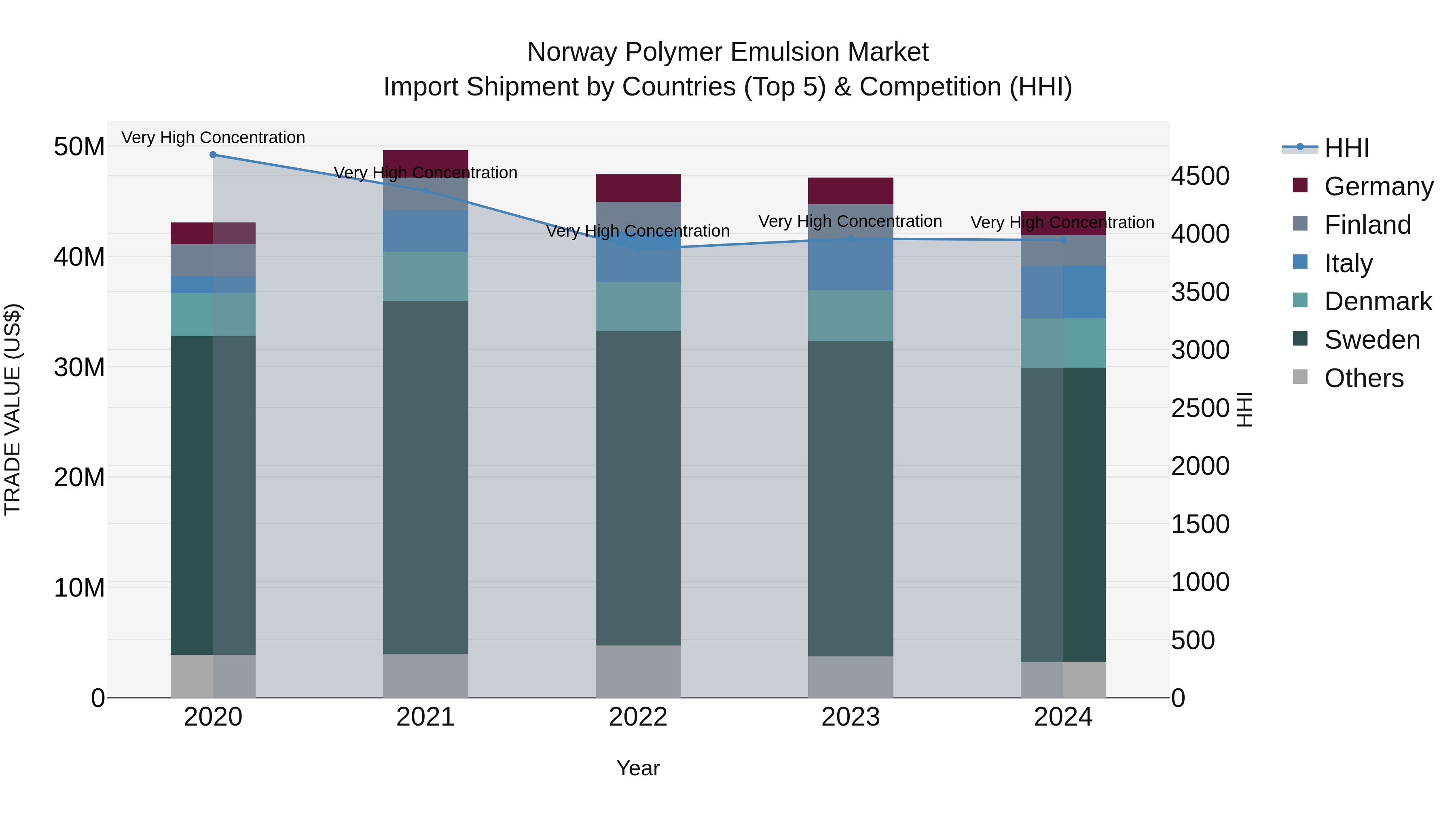
Norway`s polymer emulsion import market in 2024 continues to be dominated by a few key exporting countries, with Sweden, Italy, Denmark, Finland, and Germany leading the way. Despite a slight increase in concentration levels, the market remains highly competitive. The compound annual growth rate (CAGR) from 2020 to 2024 indicates steady, albeit modest, growth at 0.59%. However, there was a notable decline in the growth rate from 2023 to 2024, with a -6.4% decrease. This shift may signal a temporary slowdown or market adjustment within the industry.
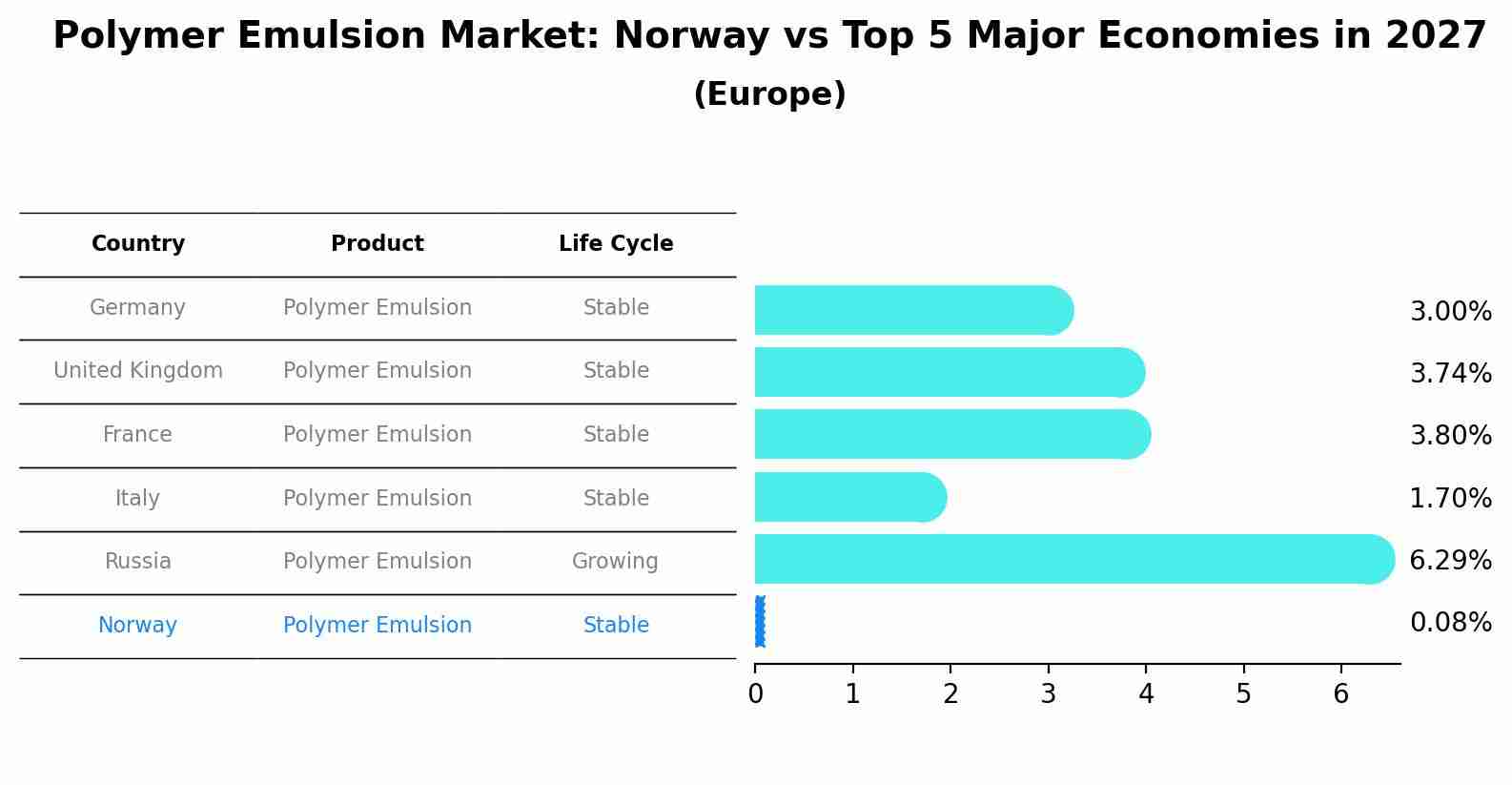
Polymer Emulsion Market: Norway vs Top 5 Major Economies in 2027 (Europe)
Norway's Polymer Emulsion market is anticipated to experience a stable growth rate of 0.08% by 2027, reflecting trends observed in the largest economy Germany, followed by United Kingdom, France, Italy and Russia.
Norway Polymer Emulsion Market Overview
Norway`s polymer emulsion market is integral to various applications, including paints, adhesives, and coatings. Polymer emulsions offer benefits such as ease of application and durability. The market is expanding due to increased demand in the construction and automotive sectors. However, it faces challenges related to the environmental impact of certain emulsions and fluctuations in the prices of raw materials.
Drivers of the market
The Norway Polymer Emulsion market is driven by the need for versatile and efficient materials in various industrial applications. Polymer emulsions are crucial in coatings, adhesives, and construction products due to their ability to provide superior performance and finish. The growing demand for water-based and environmentally friendly products in the coatings and construction industries supports market growth. Additionally, technological advancements in emulsion formulations contribute to their increased use.
Challenges of the market
In the Norway polymer emulsion market, challenges include the high cost of production and the need for technological advancements. Polymer emulsions are produced using complex processes that involve significant investment in technology and infrastructure. The high production costs can be a barrier to entry for new market players. Additionally, the market is influenced by environmental regulations that require the reduction of harmful emissions and the use of sustainable materials. Meeting these regulations requires ongoing investment in research and development. The market also faces competition from alternative technologies and materials that offer better performance or lower costs.
Government Policy of the market
For the polymer emulsion market in Norway, the government has established regulations to control the environmental impact of production and usage. Policies focus on reducing emissions and ensuring that polymer emulsions are safe for both consumers and the environment. The Norwegian government also encourages the development of new technologies that enhance the sustainability of polymer emulsions.
Key Highlights of the Report:
- Norway Polymer Emulsion Market Outlook
- Market Size of Norway Polymer Emulsion Market, 2024
- Forecast of Norway Polymer Emulsion Market, 2031
- Historical Data and Forecast of Norway Polymer Emulsion Revenues & Volume for the Period 2021-2031
- Norway Polymer Emulsion Market Trend Evolution
- Norway Polymer Emulsion Market Drivers and Challenges
- Norway Polymer Emulsion Price Trends
- Norway Polymer Emulsion Porter`s Five Forces
- Norway Polymer Emulsion Industry Life Cycle
- Historical Data and Forecast of Norway Polymer Emulsion Market Revenues & Volume By Type for the Period 2021-2031
- Historical Data and Forecast of Norway Polymer Emulsion Market Revenues & Volume By Acrylic Polymer Emulsion for the Period 2021-2031
- Historical Data and Forecast of Norway Polymer Emulsion Market Revenues & Volume By Vinyl Acetate Polymer Emulsion for the Period 2021-2031
- Historical Data and Forecast of Norway Polymer Emulsion Market Revenues & Volume By SB Latex for the Period 2021-2031
- Historical Data and Forecast of Norway Polymer Emulsion Market Revenues & Volume By Others for the Period 2021-2031
- Historical Data and Forecast of Norway Polymer Emulsion Market Revenues & Volume By Application for the Period 2021-2031
- Historical Data and Forecast of Norway Polymer Emulsion Market Revenues & Volume By Paints & Coatings for the Period 2021-2031
- Historical Data and Forecast of Norway Polymer Emulsion Market Revenues & Volume By Adhesives & Sealants for the Period 2021-2031
- Historical Data and Forecast of Norway Polymer Emulsion Market Revenues & Volume By Paper & Paperboard for the Period 2021-2031
- Historical Data and Forecast of Norway Polymer Emulsion Market Revenues & Volume By Others for the Period 2021-2031
- Historical Data and Forecast of Norway Polymer Emulsion Market Revenues & Volume By End-users for the Period 2021-2031
- Historical Data and Forecast of Norway Polymer Emulsion Market Revenues & Volume By Building & Construction for the Period 2021-2031
- Historical Data and Forecast of Norway Polymer Emulsion Market Revenues & Volume By Automotive for the Period 2021-2031
- Historical Data and Forecast of Norway Polymer Emulsion Market Revenues & Volume By Chemicals for the Period 2021-2031
- Historical Data and Forecast of Norway Polymer Emulsion Market Revenues & Volume By Textile & Coatings for the Period 2021-2031
- Historical Data and Forecast of Norway Polymer Emulsion Market Revenues & Volume By Others for the Period 2021-2031
- Norway Polymer Emulsion Import Export Trade Statistics
- Market Opportunity Assessment By Type
- Market Opportunity Assessment By Application
- Market Opportunity Assessment By End-users
- Norway Polymer Emulsion Top Companies Market Share
- Norway Polymer Emulsion Competitive Benchmarking By Technical and Operational Parameters
- Norway Polymer Emulsion Company Profiles
- Norway Polymer Emulsion Key Strategic Recommendations






































