Norway Printed Signage Market Top 5 Importing Countries and Market Competition (HHI) Analysis
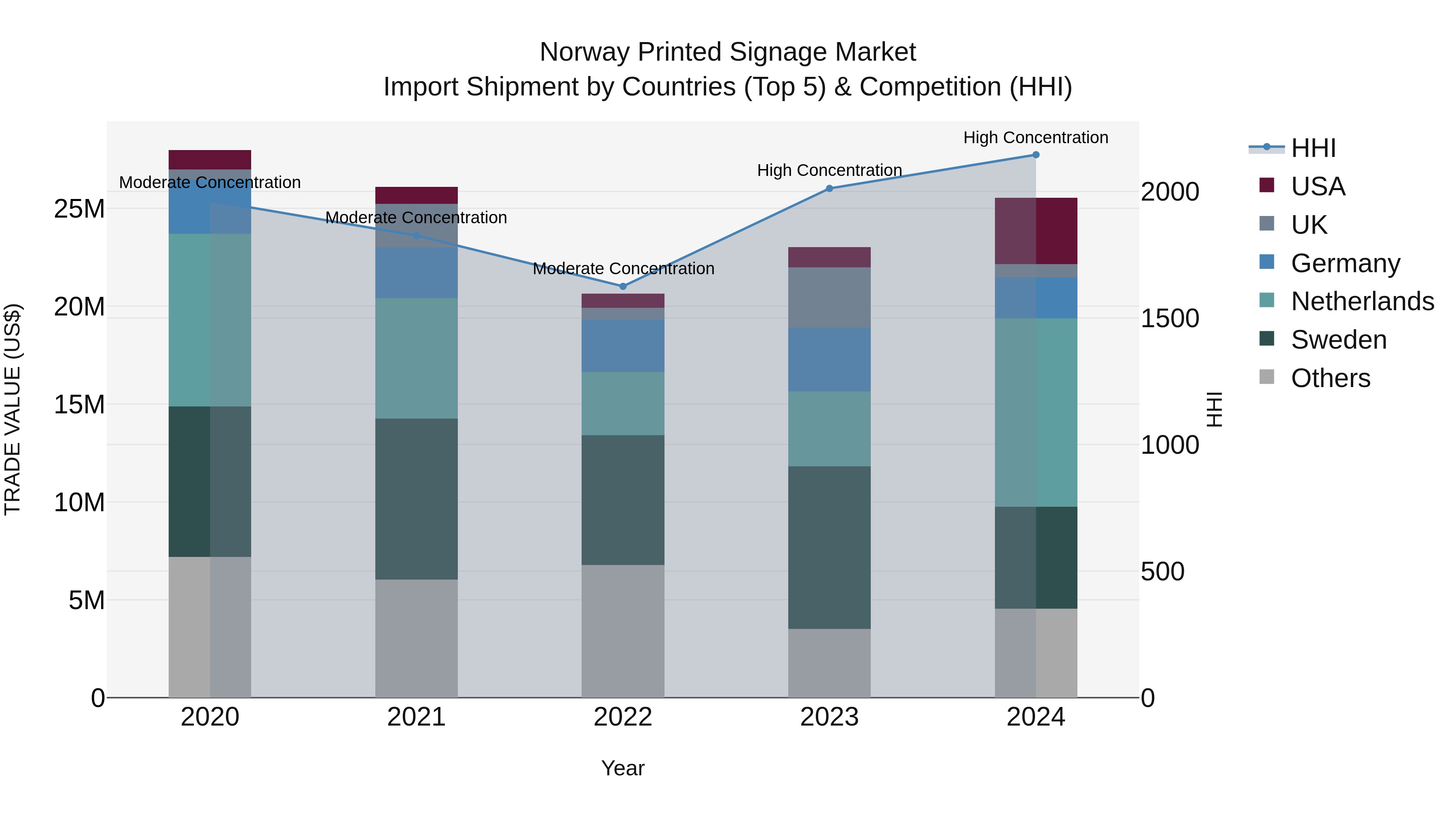
Norway continues to be a key market for printed signage imports, with top exporters in 2024 being Netherlands, Sweden, USA, Germany, and Denmark. The market shows a high concentration, with the Herfindahl-Hirschman Index (HHI) remaining elevated in 2024. Despite a slight negative compound annual growth rate (CAGR) from 2020 to 2024, there was a significant growth rate of 10.93% from 2023 to 2024, indicating potential opportunities for further expansion in the coming years.
Norway Printed Signage Market Synopsis
The Norway Printed Signage Market is a robust and growing industry driven by increasing demand for visually appealing and informative signage across various sectors such as retail, hospitality, transportation, and healthcare. The market offers a wide range of printed signage products including banners, posters, billboards, and vehicle wraps, catering to the diverse needs of businesses and organizations. With a focus on sustainability and innovation, the market is witnessing a shift towards eco-friendly materials and digital printing technologies. Key players in the industry are continuously investing in research and development to offer customized and high-quality signage solutions, leveraging advanced printing techniques and design capabilities. Overall, the Norway Printed Signage Market presents opportunities for growth and expansion, supported by a strong economy and the importance placed on effective visual communication in the country.
Norway Printed Signage Market Trends
In the Norway Printed Signage Market, there is a noticeable shift towards more sustainable and eco-friendly materials. Businesses and consumers are increasingly valuing environmentally friendly signage options, leading to a rise in demand for recycled and recyclable materials. Additionally, there is a growing interest in digital signage solutions, as they offer greater flexibility and customization options for businesses to effectively engage with their target audience. Personalized and interactive signage is also gaining popularity, as it helps enhance customer experience and drive more impactful messaging. Moreover, advancements in printing technology are enabling higher quality and more visually appealing signage products, further contributing to the market`s growth and innovation.
Norway Printed Signage Market Challenges
In the Norway Printed Signage Market, some key challenges include increasing competition from digital signage solutions, which offer dynamic and interactive display options. Another challenge is the shift towards sustainability and environmentally friendly practices, leading to a demand for eco-friendly materials and production processes in the signage industry. Additionally, economic fluctuations and uncertainties can impact businesses in the market, affecting their investment in printed signage. Companies also need to stay updated with technological advancements to meet the evolving needs of customers who are looking for innovative and visually appealing signage solutions. Overall, navigating these challenges requires companies in the Norway Printed Signage Market to adapt their strategies, focus on sustainability, and differentiate themselves in a competitive landscape.
Norway Printed Signage Market Investment Opportunities
In the Norway Printed Signage Market, there are several investment opportunities for growth and innovation. With the increasing focus on sustainability and eco-friendly solutions, investing in environmentally friendly signage materials and printing techniques could be lucrative. Additionally, the demand for digital signage solutions is on the rise, presenting opportunities for investments in advanced digital printing technologies and software for dynamic and interactive signage displays. Collaborating with local businesses and organizations to provide customized and localized signage solutions can also lead to long-term partnerships and revenue growth. Furthermore, investing in research and development to stay ahead of trends in design, materials, and technology will be crucial for success in the competitive Norwegian market.
Jordan Agar Market Government Policies
In Norway, the Printed Signage Market is governed by various regulations and policies aimed at promoting sustainability and ensuring consumer safety. The Norwegian government has strict guidelines in place regarding the use of environmentally friendly materials for printed signage, encouraging businesses to minimize their environmental impact. Additionally, there are regulations concerning the size, placement, and content of signage to maintain aesthetic standards and preserve the local landscape. Compliance with these policies is enforced through regular inspections and penalties for non-compliance. Overall, the government`s focus on sustainability and aesthetics in the Printed Signage Market reflects Norway`s commitment to environmental conservation and maintaining the country`s scenic beauty.
Norway Printed Signage Market Future Outlook
The future outlook for the Norway Printed Signage Market is positive, driven by the growing demand for visually appealing and informative signage across various industries such as retail, hospitality, and transportation. The market is expected to witness steady growth due to the increasing focus on enhancing brand visibility and customer engagement. Furthermore, technological advancements in printing techniques and materials are likely to fuel innovation in the sector, leading to more customized and interactive signage solutions. With a strong emphasis on sustainability and eco-friendly practices, there is also a shift towards using recyclable materials in signage production. Overall, the Norway Printed Signage Market is poised for expansion, supported by evolving consumer preferences and the need for effective communication in a competitive business landscape.
Key Highlights of the Report:
- Norway Printed Signage Market Outlook
- Market Size of Norway Printed Signage Market, 2024
- Forecast of Norway Printed Signage Market, 2031
- Historical Data and Forecast of Norway Printed Signage Revenues & Volume for the Period 2021- 2031
- Norway Printed Signage Market Trend Evolution
- Norway Printed Signage Market Drivers and Challenges
- Norway Printed Signage Price Trends
- Norway Printed Signage Porter's Five Forces
- Norway Printed Signage Industry Life Cycle
- Historical Data and Forecast of Norway Printed Signage Market Revenues & Volume By Product for the Period 2021- 2031
- Historical Data and Forecast of Norway Printed Signage Market Revenues & Volume By Billboard for the Period 2021- 2031
- Historical Data and Forecast of Norway Printed Signage Market Revenues & Volume By Backlit Display for the Period 2021- 2031
- Historical Data and Forecast of Norway Printed Signage Market Revenues & Volume By Pop Display for the Period 2021- 2031
- Historical Data and Forecast of Norway Printed Signage Market Revenues & Volume By Banner for the Period 2021- 2031
- Historical Data and Forecast of Norway Printed Signage Market Revenues & Volume By Corporate Graphics for the Period 2021- 2031
- Historical Data and Forecast of Norway Printed Signage Market Revenues & Volume By Others for the Period 2021- 2031
- Historical Data and Forecast of Norway Printed Signage Market Revenues & Volume By Type for the Period 2021- 2031
- Historical Data and Forecast of Norway Printed Signage Market Revenues & Volume By Indoor Printed Signage for the Period 2021- 2031
- Historical Data and Forecast of Norway Printed Signage Market Revenues & Volume By Outdoor Printed Signage for the Period 2021- 2031
- Historical Data and Forecast of Norway Printed Signage Market Revenues & Volume By End-user Vertical for the Period 2021- 2031
- Historical Data and Forecast of Norway Printed Signage Market Revenues & Volume By BFSI for the Period 2021- 2031
- Historical Data and Forecast of Norway Printed Signage Market Revenues & Volume By Retail for the Period 2021- 2031
- Historical Data and Forecast of Norway Printed Signage Market Revenues & Volume By Sports and Leisure for the Period 2021- 2031
- Historical Data and Forecast of Norway Printed Signage Market Revenues & Volume By Entertainment for the Period 2021- 2031
- Historical Data and Forecast of Norway Printed Signage Market Revenues & Volume By Transportation and Logistics for the Period 2021- 2031
- Historical Data and Forecast of Norway Printed Signage Market Revenues & Volume By Healthcare for the Period 2021- 2031
- Historical Data and Forecast of Norway Printed Signage Market Revenues & Volume By Others for the Period 2021- 2031
- Norway Printed Signage Import Export Trade Statistics
- Market Opportunity Assessment By Product
- Market Opportunity Assessment By Type
- Market Opportunity Assessment By End-user Vertical
- Norway Printed Signage Top Companies Market Share
- Norway Printed Signage Competitive Benchmarking By Technical and Operational Parameters
- Norway Printed Signage Company Profiles
- Norway Printed Signage Key Strategic Recommendations






































