Norway Rear Spoiler Market Top 5 Importing Countries and Market Competition (HHI) Analysis
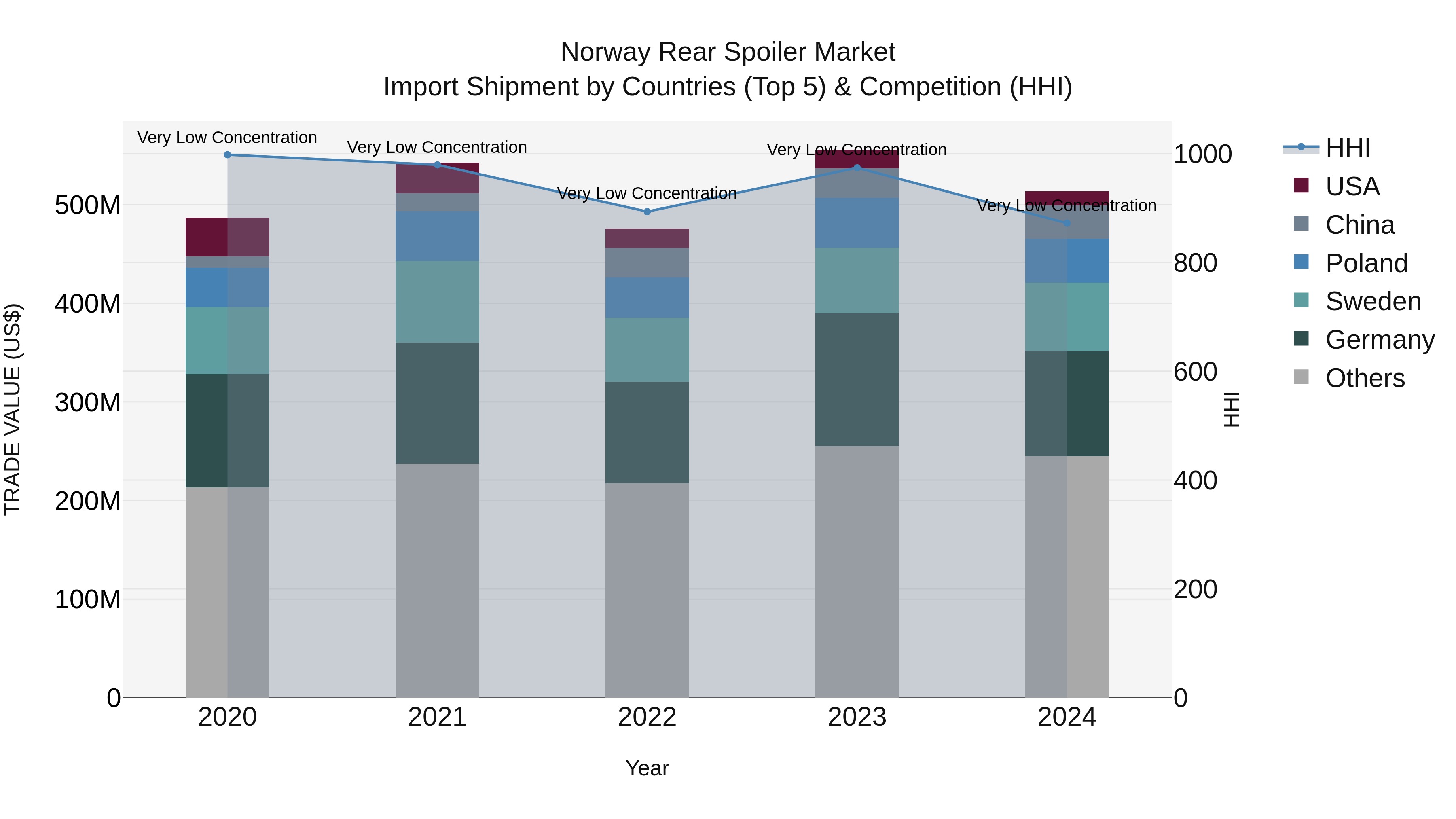
In 2024, Germany, Sweden, Poland, China, and the Netherlands emerged as the top exporting countries of rear spoilers to Norway. Despite the low concentration of the market, the Compound Annual Growth Rate (CAGR) for 2020-2024 was 1.35%, indicating steady growth. However, there was a slight decline in the growth rate from 2023 to 2024 at -7.51%. This suggests a potential shift in market dynamics or external factors influencing the import shipments of rear spoilers to Norway. Further analysis is recommended to understand the underlying factors driving these trends.
Key Highlights of the Report:
- Norway Rear Spoiler Market Outlook
- Market Size of Norway Rear Spoiler Market, 2025
- Forecast of Norway Rear Spoiler Market, 2032
- Historical Data and Forecast of Norway Rear Spoiler Revenues & Volume for the Period 2022 - 2032F
- Norway Rear Spoiler Market Trend Evolution
- Norway Rear Spoiler Market Drivers and Challenges
- Norway Rear Spoiler Price Trends
- Norway Rear Spoiler Porter`s Five Forces
- Norway Rear Spoiler Industry Life Cycle
- Historical Data and Forecast of Norway Rear Spoiler Market Revenues & Volume By Fuel for the Period 2022 - 2032F
- Historical Data and Forecast of Norway Rear Spoiler Market Revenues & Volume By ICE for the Period 2022 - 2032F
- Historical Data and Forecast of Norway Rear Spoiler Market Revenues & Volume By BEV for the Period 2022 - 2032F
- Historical Data and Forecast of Norway Rear Spoiler Market Revenues & Volume By Vehicle Type for the Period 2022 - 2032F
- Historical Data and Forecast of Norway Rear Spoiler Market Revenues & Volume By Hatchback for the Period 2022 - 2032F
- Historical Data and Forecast of Norway Rear Spoiler Market Revenues & Volume By SUV for the Period 2022 - 2032F
- Historical Data and Forecast of Norway Rear Spoiler Market Revenues & Volume By MPV for the Period 2022 - 2032F
- Historical Data and Forecast of Norway Rear Spoiler Market Revenues & Volume By Material for the Period 2022 - 2032F
- Historical Data and Forecast of Norway Rear Spoiler Market Revenues & Volume By ABS for the Period 2022 - 2032F
- Historical Data and Forecast of Norway Rear Spoiler Market Revenues & Volume By Carbon Fibre for the Period 2022 - 2032F
- Historical Data and Forecast of Norway Rear Spoiler Market Revenues & Volume By Fibre Glass for the Period 2022 - 2032F
- Historical Data and Forecast of Norway Rear Spoiler Market Revenues & Volume By Sheet Metal for the Period 2022 - 2032F
- Norway Rear Spoiler Import Export Trade Statistics
- Market Opportunity Assessment By Fuel
- Market Opportunity Assessment By Vehicle Type
- Market Opportunity Assessment By Material
- Norway Rear Spoiler Top Companies Market Share
- Norway Rear Spoiler Competitive Benchmarking By Technical and Operational Parameters
- Norway Rear Spoiler Company Profiles
- Norway Rear Spoiler Key Strategic Recommendations






































