Norway Retro Reflective Materials Market Top 5 Importing Countries and Market Competition (HHI) Analysis
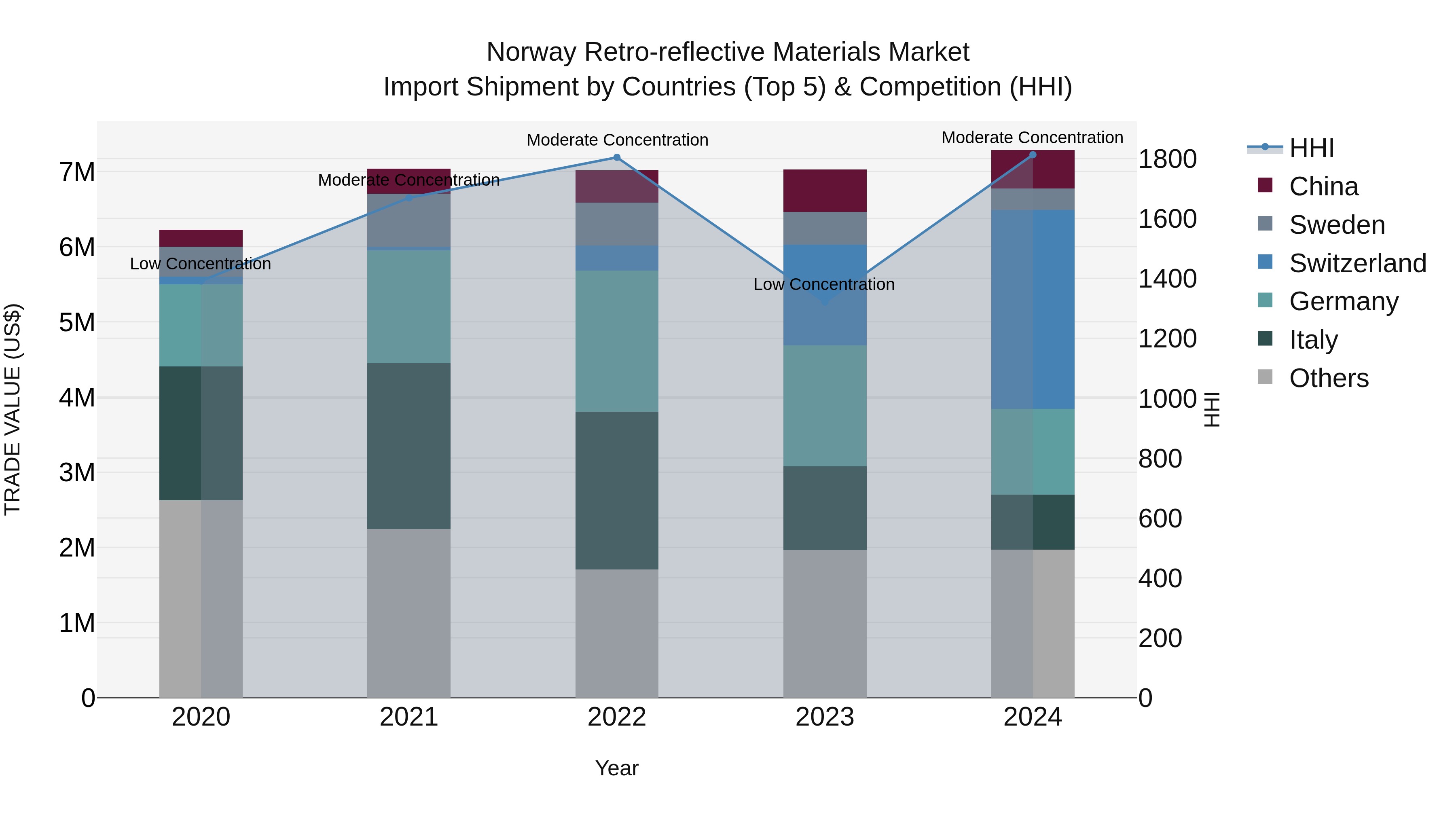
Norway`s import shipments of retro-reflective materials in 2024 saw a shift in concentration levels, moving from low to moderate concentration. The top exporting countries to Norway were Switzerland, Germany, Italy, China, and the USA. With a steady compound annual growth rate (CAGR) of 4.0% from 2020 to 2024 and a growth rate of 3.63% in 2024 alone, the market for retro-reflective materials in Norway appears to be on a positive trajectory. This data suggests a growing demand for these materials in the country, potentially driven by various factors such as road safety initiatives or infrastructure development projects.
Key Highlights of the Report:
- Norway Retro-Reflective Materials Market Outlook
- Market Size of Norway Retro-Reflective Materials Market, 2025
- Forecast of Norway Retro-Reflective Materials Market, 2032
- Historical Data and Forecast of Norway Retro-Reflective Materials Revenues & Volume for the Period 2022 - 2032F
- Norway Retro-Reflective Materials Market Trend Evolution
- Norway Retro-Reflective Materials Market Drivers and Challenges
- Norway Retro-Reflective Materials Price Trends
- Norway Retro-Reflective Materials Porter`s Five Forces
- Norway Retro-Reflective Materials Industry Life Cycle
- Historical Data and Forecast of Norway Retro-Reflective Materials Market Revenues & Volume By Technology for the Period 2022 - 2032F
- Historical Data and Forecast of Norway Retro-Reflective Materials Market Revenues & Volume By Microprismatic for the Period 2022 - 2032F
- Historical Data and Forecast of Norway Retro-Reflective Materials Market Revenues & Volume By Glass & Ceramic Beads for the Period 2022 - 2032F
- Historical Data and Forecast of Norway Retro-Reflective Materials Market Revenues & Volume By Product Type for the Period 2022 - 2032F
- Historical Data and Forecast of Norway Retro-Reflective Materials Market Revenues & Volume By Films for the Period 2022 - 2032F
- Historical Data and Forecast of Norway Retro-Reflective Materials Market Revenues & Volume By Paints for the Period 2022 - 2032F
- Historical Data and Forecast of Norway Retro-Reflective Materials Market Revenues & Volume By Application for the Period 2022 - 2032F
- Historical Data and Forecast of Norway Retro-Reflective Materials Market Revenues & Volume By Traffic & Work Zone for the Period 2022 - 2032F
- Historical Data and Forecast of Norway Retro-Reflective Materials Market Revenues & Volume By Conspicuity for the Period 2022 - 2032F
- Historical Data and Forecast of Norway Retro-Reflective Materials Market Revenues & Volume By Fleet & Vehicle Registration for the Period 2022 - 2032F
- Historical Data and Forecast of Norway Retro-Reflective Materials Market Revenues & Volume By Personal Safety for the Period 2022 - 2032F
- Norway Retro-Reflective Materials Import Export Trade Statistics
- Market Opportunity Assessment By Technology
- Market Opportunity Assessment By Product Type
- Market Opportunity Assessment By Application
- Norway Retro-Reflective Materials Top Companies Market Share
- Norway Retro-Reflective Materials Competitive Benchmarking By Technical and Operational Parameters
- Norway Retro-Reflective Materials Company Profiles
- Norway Retro-Reflective Materials Key Strategic Recommendations






































