Norway Spinning Machinery Market Growth Rate Analysis (2025 - 2031)
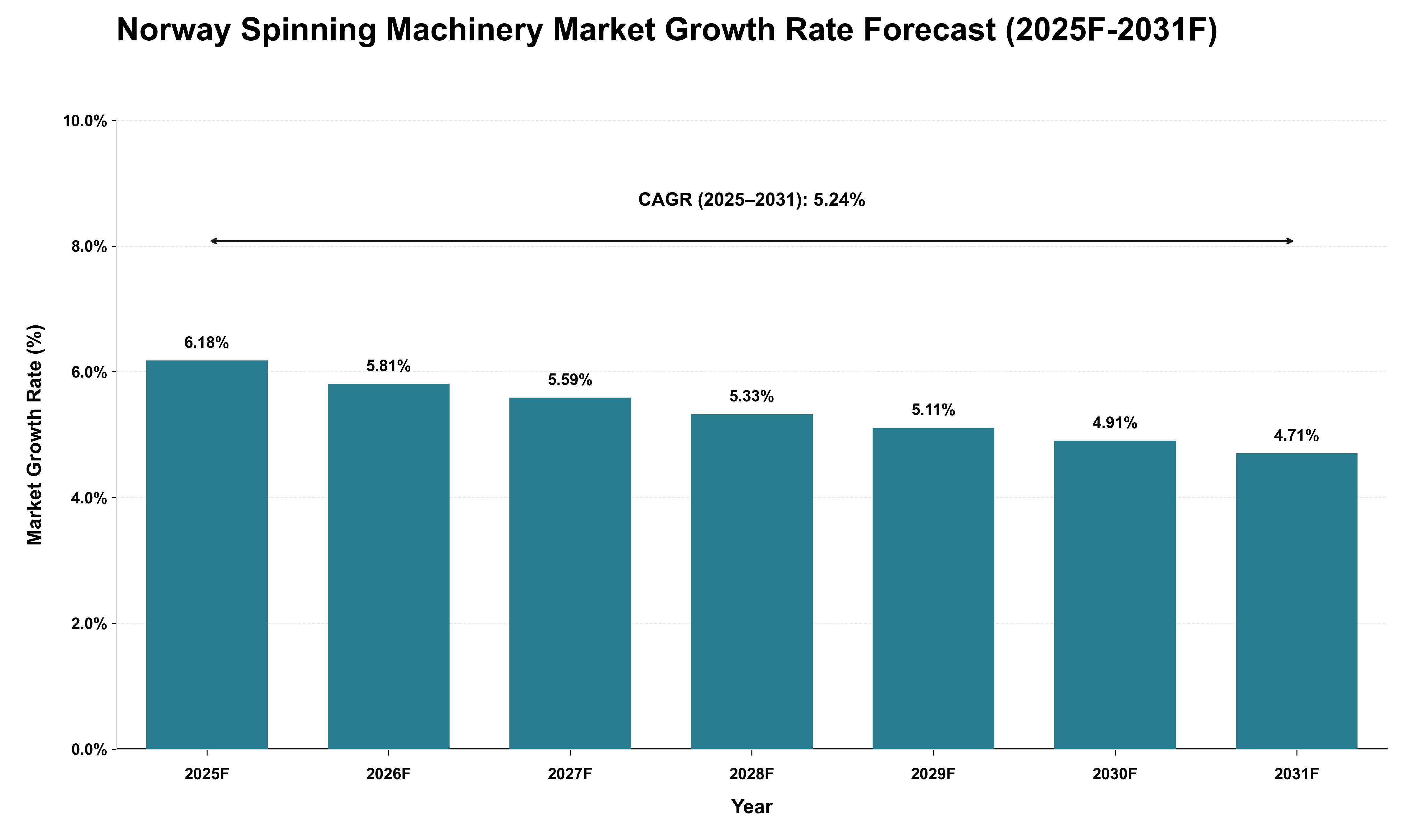
From 2025 onward, the Norway spinning machinery market will likely experience a robust growth trajectory, driven by increasing demand for advanced textile production technologies and a shift towards sustainable manufacturing practices. The projected compound annual growth rate (CAGR) of 5.24% reflects an underlying resilience in the sector, supported by macroeconomic factors such as rising disposable incomes and a growing emphasis on high-quality textiles. Annual growth rates will initially peak at 6.18% in 2025 before gradually tapering to 4.71% by 2031, indicating a natural cyclical adjustment as market dynamics evolve. Import dependencies may also play a critical role, as Norway's reliance on foreign technology and components could influence pricing and availability, impacting overall market performance. As global supply chains stabilize post-pandemic, the sector is expected to adapt to these changes while capitalizing on innovations that enhance productivity and efficiency in textile manufacturing processes.
Key Highlights of the Report:
- Norway Spinning Machinery Market Outlook
- Market Size of Norway Spinning Machinery Market, 2024
- Forecast of Norway Spinning Machinery Market, 2031
- Historical Data and Forecast of Norway Spinning Machinery Revenues & Volume for the Period 2021-2031
- Norway Spinning Machinery Market Trend Evolution
- Norway Spinning Machinery Market Drivers and Challenges
- Norway Spinning Machinery Price Trends
- Norway Spinning Machinery Porter`s Five Forces
- Norway Spinning Machinery Industry Life Cycle
- Historical Data and Forecast of Norway Spinning Machinery Market Revenues & Volume By Type for the Period 2021-2031
- Historical Data and Forecast of Norway Spinning Machinery Market Revenues & Volume By Ring for the Period 2021-2031
- Historical Data and Forecast of Norway Spinning Machinery Market Revenues & Volume By Rotor Spinning for the Period 2021-2031
- Historical Data and Forecast of Norway Spinning Machinery Market Revenues & Volume By Material for the Period 2021-2031
- Historical Data and Forecast of Norway Spinning Machinery Market Revenues & Volume By Natural for the Period 2021-2031
- Historical Data and Forecast of Norway Spinning Machinery Market Revenues & Volume By Synthetic for the Period 2021-2031
- Historical Data and Forecast of Norway Spinning Machinery Market Revenues & Volume By Others for the Period 2021-2031
- Historical Data and Forecast of Norway Spinning Machinery Market Revenues & Volume By End-Use Industry for the Period 2021-2031
- Historical Data and Forecast of Norway Spinning Machinery Market Revenues & Volume By Clothing for the Period 2021-2031
- Historical Data and Forecast of Norway Spinning Machinery Market Revenues & Volume By Textile for the Period 2021-2031
- Historical Data and Forecast of Norway Spinning Machinery Market Revenues & Volume By Other Industry for the Period 2021-2031
- Norway Spinning Machinery Import Export Trade Statistics
- Market Opportunity Assessment By Type
- Market Opportunity Assessment By Material
- Market Opportunity Assessment By End-Use Industry
- Norway Spinning Machinery Top Companies Market Share
- Norway Spinning Machinery Competitive Benchmarking By Technical and Operational Parameters
- Norway Spinning Machinery Company Profiles
- Norway Spinning Machinery Key Strategic Recommendations






































