Norway Sugar Confectionery Market Growth Rate Analysis (2021-2031)
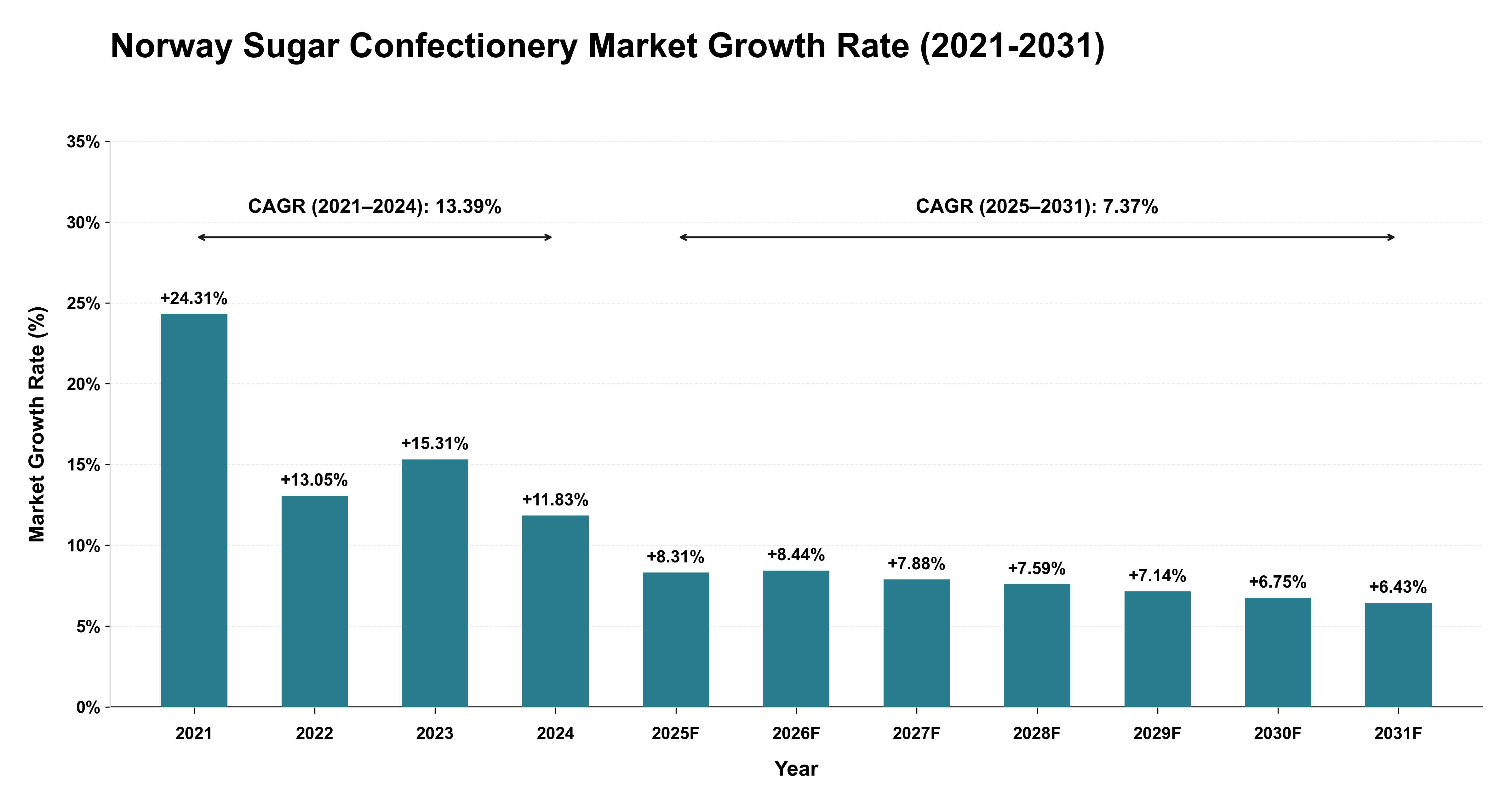
The Norway Sugar Confectionery Market experienced robust growth from 2021 to 2024, with a significant CAGR of 13.39%. This period was marked by strong consumer demand and market expansion. However, moving forward to 2025-2031, the forecast indicates a slowdown in growth with a CAGR of 7.37%. This deceleration suggests a phase of stabilizing expansion and market maturation following the initial surge. The annual trajectory from 2025 onwards demonstrates a gradual but consistent decrease in growth rates, reflecting a shift towards a more sustainable pace of development in the sugar confectionery segment. This trend aligns with expectations of market consolidation and normalized demand dynamics in the coming years, indicating a more mature and stable market landscape for sugar confectionery products in Norway.
Key Highlights of the Report:
- Norway Sugar Confectionery Market Outlook
- Market Size of Norway Sugar Confectionery Market, 2025
- Forecast of Norway Sugar Confectionery Market, 2032
- Historical Data and Forecast of Norway Sugar Confectionery Revenues & Volume for the Period 2022 - 2032F
- Norway Sugar Confectionery Market Trend Evolution
- Norway Sugar Confectionery Market Drivers and Challenges
- Norway Sugar Confectionery Price Trends
- Norway Sugar Confectionery Porter`s Five Forces
- Norway Sugar Confectionery Industry Life Cycle
- Historical Data and Forecast of Norway Sugar Confectionery Market Revenues & Volume By Product Type for the Period 2022 - 2032F
- Historical Data and Forecast of Norway Sugar Confectionery Market Revenues & Volume By Hard-Boiled Sweets for the Period 2022 - 2032F
- Historical Data and Forecast of Norway Sugar Confectionery Market Revenues & Volume By Caramel & Toffees for the Period 2022 - 2032F
- Historical Data and Forecast of Norway Sugar Confectionery Market Revenues & Volume By Gums & Jellies for the Period 2022 - 2032F
- Historical Data and Forecast of Norway Sugar Confectionery Market Revenues & Volume By Medicated Confectionery for the Period 2022 - 2032F
- Historical Data and Forecast of Norway Sugar Confectionery Market Revenues & Volume By Mints for the Period 2022 - 2032F
- Historical Data and Forecast of Norway Sugar Confectionery Market Revenues & Volume By Othersfor the Period 2022 - 2032F
- Historical Data and Forecast of Norway Sugar Confectionery Market Revenues & Volume By Packaging Type for the Period 2022 - 2032F
- Historical Data and Forecast of Norway Sugar Confectionery Market Revenues & Volume By Sachet for the Period 2022 - 2032F
- Historical Data and Forecast of Norway Sugar Confectionery Market Revenues & Volume By Box for the Period 2022 - 2032F
- Historical Data and Forecast of Norway Sugar Confectionery Market Revenues & Volume By Others for the Period 2022 - 2032F
- Historical Data and Forecast of Norway Sugar Confectionery Market Revenues & Volume By Distribution Channel for the Period 2022 - 2032F
- Historical Data and Forecast of Norway Sugar Confectionery Market Revenues & Volume By Retail Stores for the Period 2022 - 2032F
- Historical Data and Forecast of Norway Sugar Confectionery Market Revenues & Volume By Online Stores for the Period 2022 - 2032F
- Historical Data and Forecast of Norway Sugar Confectionery Market Revenues & Volume By Others for the Period 2022 - 2032F
- Norway Sugar Confectionery Import Export Trade Statistics
- Market Opportunity Assessment By Product Type
- Market Opportunity Assessment By Packaging Type
- Market Opportunity Assessment By Distribution Channel
- Norway Sugar Confectionery Top Companies Market Share
- Norway Sugar Confectionery Competitive Benchmarking By Technical and Operational Parameters
- Norway Sugar Confectionery Company Profiles
- Norway Sugar Confectionery Key Strategic Recommendations






































