Norway Textile Fabric Market Growth Rate Analysis (2021-2031)
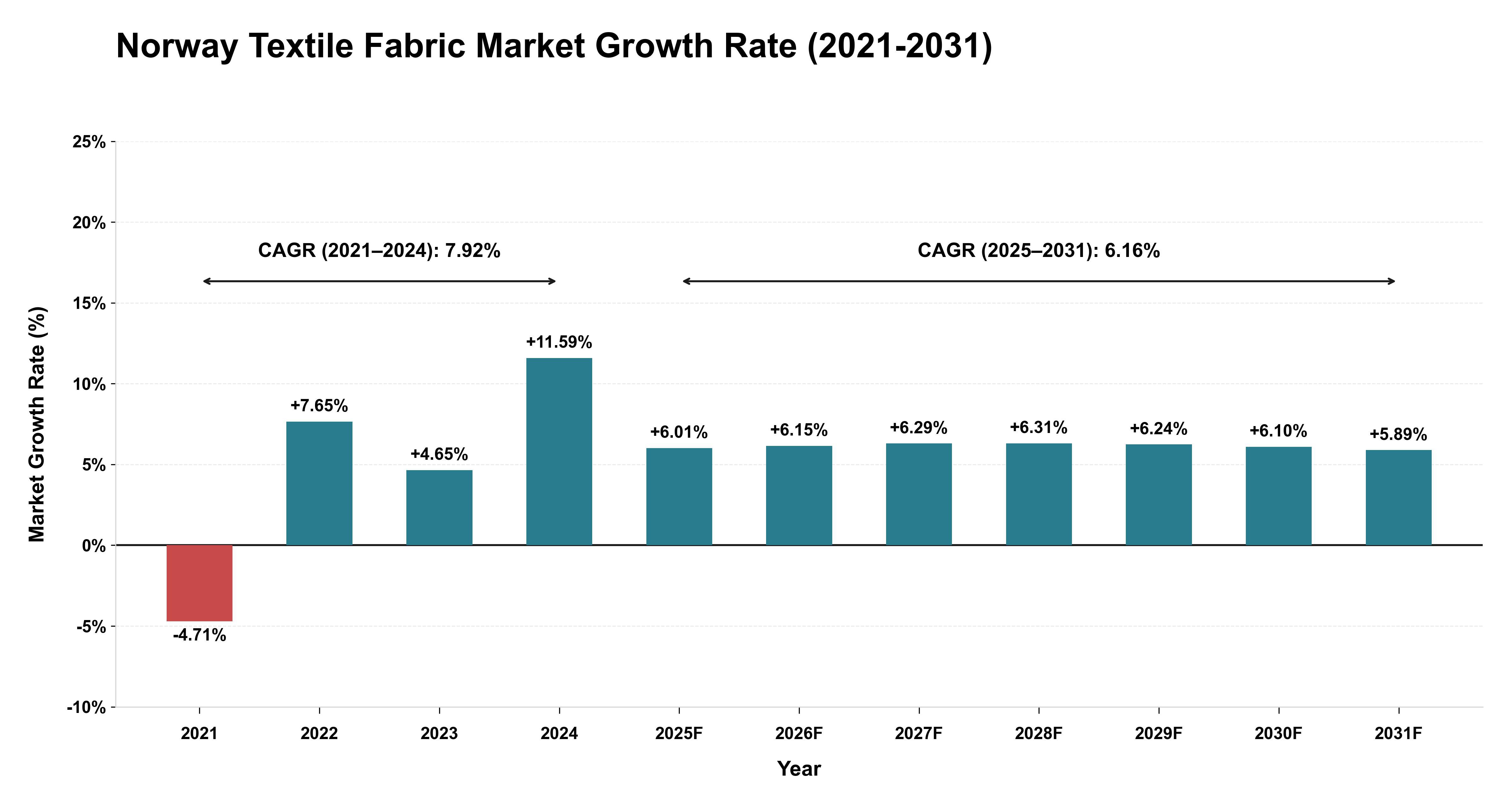
The Norway Textile Fabric Market experienced a turbulent period in 2021 with a contraction of -4.71%, attributed to external shocks. However, the market swiftly rebounded in 2022, registering a robust growth of 7.65%, signaling resilience and adaptability. Subsequently, from 2023 to 2024, the market sustained steady growth rates of 4.65% and 11.59%, respectively, indicating a strong recovery phase and increased consumer confidence. Looking ahead to the forecast period from 2025 to 2031, the market is expected to exhibit a more moderate yet stable growth trajectory, with a CAGR of 6.16%. This trend suggests a phase of stabilizing expansion and maturation following the post-recovery boom, reflecting a more mature and balanced market landscape characterized by sustainable growth patterns and evolving consumer preferences.
Key Highlights of the Report:
- Norway Textile Fabric Market Outlook
- Market Size of Norway Textile Fabric Market, 2025
- Forecast of Norway Textile Fabric Market, 2032
- Historical Data and Forecast of Norway Textile Fabric Revenues & Volume for the Period 2022 - 2032F
- Norway Textile Fabric Market Trend Evolution
- Norway Textile Fabric Market Drivers and Challenges
- Norway Textile Fabric Price Trends
- Norway Textile Fabric Porter`s Five Forces
- Norway Textile Fabric Industry Life Cycle
- Historical Data and Forecast of Norway Textile Fabric Market Revenues & Volume By Fabric Type for the Period 2022 - 2032F
- Historical Data and Forecast of Norway Textile Fabric Market Revenues & Volume By Cotton for the Period 2022 - 2032F
- Historical Data and Forecast of Norway Textile Fabric Market Revenues & Volume By 65/35% for the Period 2022 - 2032F
- Historical Data and Forecast of Norway Textile Fabric Market Revenues & Volume By 50/50% for the Period 2022 - 2032F
- Historical Data and Forecast of Norway Textile Fabric Market Revenues & Volume By 35/65% for the Period 2022 - 2032F
- Historical Data and Forecast of Norway Textile Fabric Market Revenues & Volume By 40/60% for the Period 2022 - 2032F
- Historical Data and Forecast of Norway Textile Fabric Market Revenues & Volume By 10/90% for the Period 2022 - 2032F
- Historical Data and Forecast of Norway Textile Fabric Market Revenues & Volume By Polyester for the Period 2022 - 2032F
- Historical Data and Forecast of Norway Cotton Textile Fabric Market Revenues & Volume By Others for the Period 2022 - 2032F
- Historical Data and Forecast of Norway Textile Fabric Market Revenues & Volume By Application for the Period 2022 - 2032F
- Historical Data and Forecast of Norway Textile Fabric Market Revenues & Volume By T-Shirt for the Period 2022 - 2032F
- Historical Data and Forecast of Norway Textile Fabric Market Revenues & Volume By Sportswear for the Period 2022 - 2032F
- Historical Data and Forecast of Norway Textile Fabric Market Revenues & Volume By Outdoor Clothing for the Period 2022 - 2032F
- Historical Data and Forecast of Norway Textile Fabric Market Revenues & Volume By Performance Wear for the Period 2022 - 2032F
- Norway Textile Fabric Import Export Trade Statistics
- Market Opportunity Assessment By Fabric Type
- Market Opportunity Assessment By Application
- Norway Textile Fabric Top Companies Market Share
- Norway Textile Fabric Competitive Benchmarking By Technical and Operational Parameters
- Norway Textile Fabric Company Profiles
- Norway Textile Fabric Key Strategic Recommendations






































