Norway Textile Yarn Market Growth Rate Analysis (2025 - 2031)
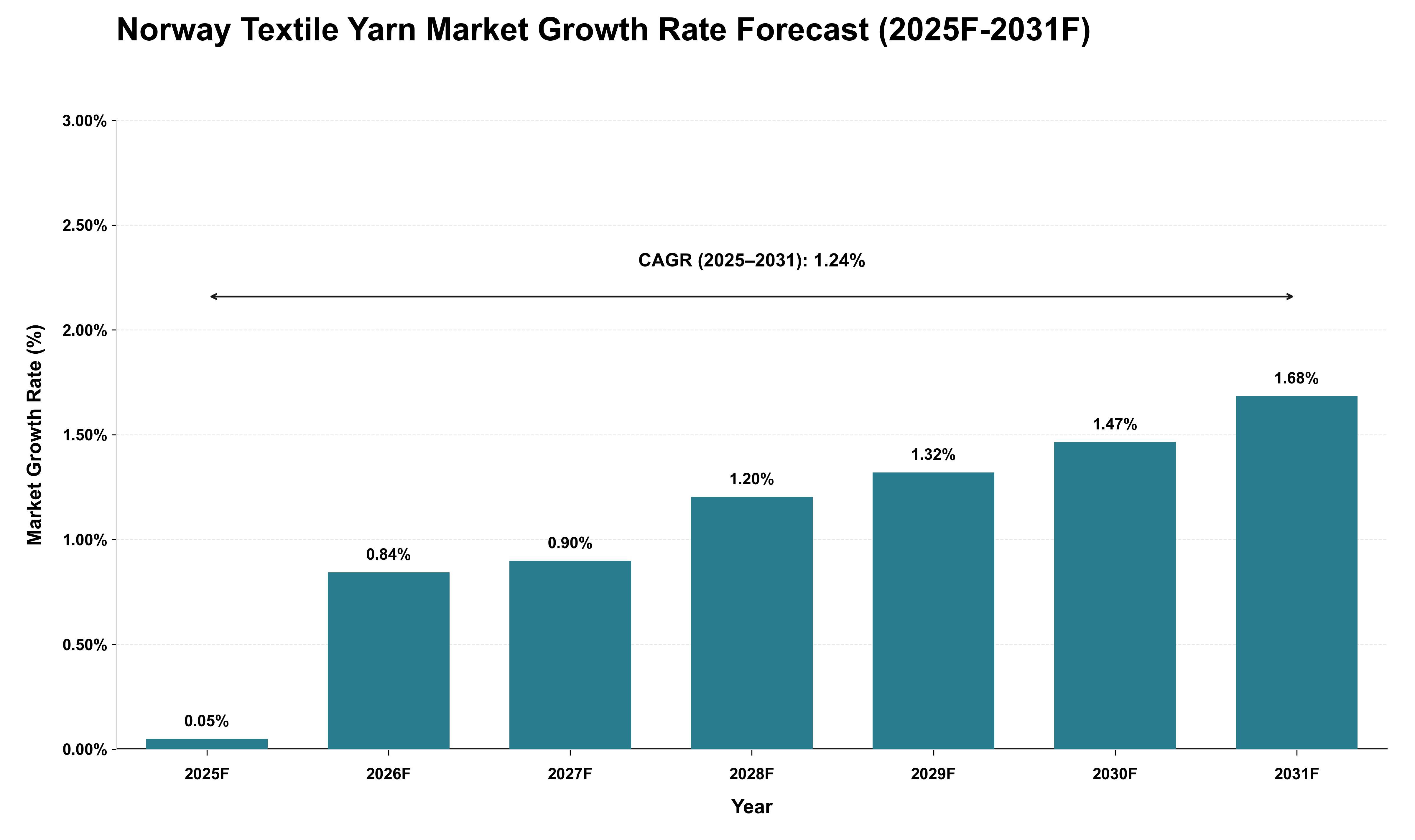
The outlook for the Norway textile yarn market will be shaped by several macroeconomic factors, including global supply chain dynamics, consumer demand shifts towards sustainable textiles, and fluctuating import dependencies. As the forecasted CAGR of 1.24% suggests, growth will initially be modest, with annual increases starting at 0.05% in 2025 and gradually accelerating to 1.68% by 2031. This trajectory reflects an anticipated recovery in consumer spending and a potential rebound in manufacturing activity post-pandemic, which will drive demand for textile yarns. Additionally, Norway's reliance on imports for raw materials may influence pricing and availability, impacting production costs and market competitiveness. The gradual increase in growth rates indicates a response to evolving market conditions and consumer preferences that favor innovative and eco-friendly products within the textile sector.
Key Highlights of the Report:
- Norway Textile Yarn Market Outlook
- Market Size of Norway Textile Yarn Market, 2024
- Forecast of Norway Textile Yarn Market, 2031
- Historical Data and Forecast of Norway Textile Yarn Revenues & Volume for the Period 2021-2031
- Norway Textile Yarn Market Trend Evolution
- Norway Textile Yarn Market Drivers and Challenges
- Norway Textile Yarn Price Trends
- Norway Textile Yarn Porter`s Five Forces
- Norway Textile Yarn Industry Life Cycle
- Historical Data and Forecast of Norway Textile Yarn Market Revenues & Volume By Sources for the Period 2021-2031
- Historical Data and Forecast of Norway Textile Yarn Market Revenues & Volume By Chemical for the Period 2021-2031
- Historical Data and Forecast of Norway Textile Yarn Market Revenues & Volume By Animal for the Period 2021-2031
- Historical Data and Forecast of Norway Textile Yarn Market Revenues & Volume By Plant for the Period 2021-2031
- Historical Data and Forecast of Norway Textile Yarn Market Revenues & Volume By Others for the Period 2021-2031
- Historical Data and Forecast of Norway Textile Yarn Market Revenues & Volume By Applications for the Period 2021-2031
- Historical Data and Forecast of Norway Textile Yarn Market Revenues & Volume By Home Textile for the Period 2021-2031
- Historical Data and Forecast of Norway Textile Yarn Market Revenues & Volume By Apparel for the Period 2021-2031
- Historical Data and Forecast of Norway Textile Yarn Market Revenues & Volume By Industrial for the Period 2021-2031
- Historical Data and Forecast of Norway Textile Yarn Market Revenues & Volume By Artificial Subtype for the Period 2021-2031
- Historical Data and Forecast of Norway Textile Yarn Market Revenues & Volume By Viscose for the Period 2021-2031
- Historical Data and Forecast of Norway Textile Yarn Market Revenues & Volume By Polyester for the Period 2021-2031
- Historical Data and Forecast of Norway Textile Yarn Market Revenues & Volume By Acrylic for the Period 2021-2031
- Historical Data and Forecast of Norway Textile Yarn Market Revenues & Volume By Nylon for the Period 2021-2031
- Historical Data and Forecast of Norway Textile Yarn Market Revenues & Volume By Type for the Period 2021-2031
- Historical Data and Forecast of Norway Textile Yarn Market Revenues & Volume By Artificial for the Period 2021-2031
- Historical Data and Forecast of Norway Textile Yarn Market Revenues & Volume By Natural Type for the Period 2021-2031
- Norway Textile Yarn Import Export Trade Statistics
- Market Opportunity Assessment By Sources
- Market Opportunity Assessment By Applications
- Market Opportunity Assessment By Artificial Subtype
- Market Opportunity Assessment By Type
- Norway Textile Yarn Top Companies Market Share
- Norway Textile Yarn Competitive Benchmarking By Technical and Operational Parameters
- Norway Textile Yarn Company Profiles
- Norway Textile Yarn Key Strategic Recommendations






































