Oman Agriculture Market Size, Share & Growth Rate
The Oman Agriculture Market was estimated at USD 339 Million in 2025 and is projected to reach USD 470 Million by 2032, growing at a CAGR of 4.8% from 2026 to 2032. This growth trajectory is largely driven by government initiatives aimed at enhancing food security and encouraging sustainable farming practices. Additionally, a shift towards modern agricultural techniques, including precision farming and organic cultivation, is anticipated to stimulate further advancements in the sector.
Oman Agriculture Market Year-wise Growth Rate and Key Drivers
This graph highlights how the Oman Agriculture Market has steadily grown over the years, supported by major growth factors.
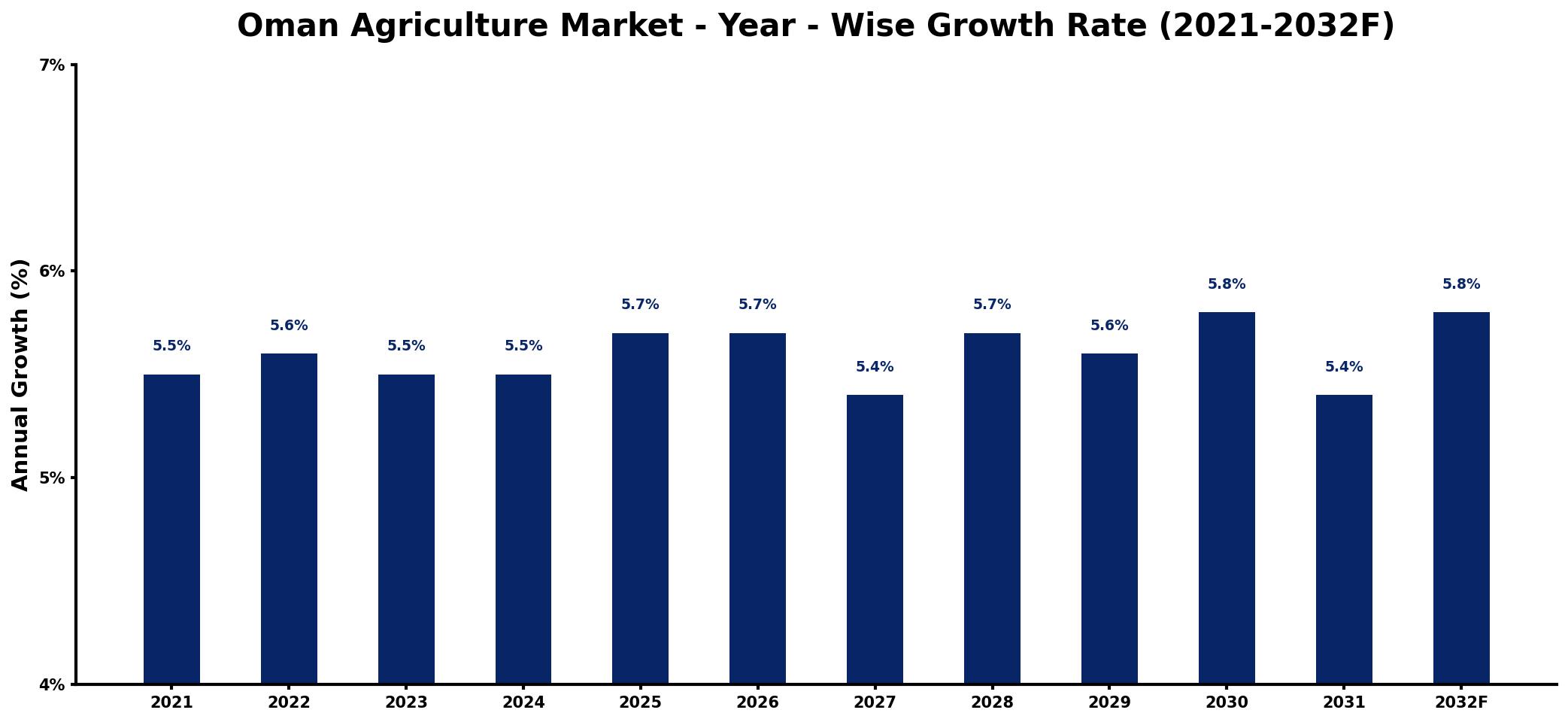
The table below presents the year‑wise growth rates along with the key drivers influencing the market
| Year | Growth Rate | Major Drivers |
| 2021 | 5.5% | Rising consumer health awareness |
| 2022 | 5.6% | Increased investment in technology |
| 2023 | 5.5% | Growing demand for organic produce |
| 2024 | 5.5% | Expansion of export markets |
| 2025 | 5.7% | Enhanced irrigation infrastructure development |
| 2026 | 5.7% | Adoption of sustainable practices |
| 2027 | 5.4% | Emergence of local cooperatives |
| 2028 | 5.7% | Improved supply chain efficiency |
| 2029 | 5.6% | Diversification of crop production |
| 2030 | 5.8% | Strengthened government support initiatives |
| 2031 | 5.4% | Growing urban farming trends |
| 2032 | 5.8% | Rising popularity of local products |
Note: Market size estimations and growth projections presented in this report are based on 6Wresearch's proprietary forecasting methodology, utilizing the latest available industry data, government publications, and primary research inputs.
Oman Agriculture Market Synopsis
Oman's agricultural landscape is defined by its limited arable land and significant reliance on traditional farming methods. Despite these constraints, key crops such as dates and various fruits and vegetables remain pivotal to the local economy, supported by the governments commitment to achieving greater food self-sufficiency.
The sector is currently navigating challenges such as water scarcity and the impacts of climate change, yet there is an evident push towards adopting modern techniques. This modernization includes increasing investment in agribusiness ventures, which aim to enhance the overall productivity and sustainability of Omans agricultural practices.
Oman Agriculture Market Key Takeaways
- Significant growth opportunities driven by government support and modernization efforts.
- A strong focus on sustainable practices and technology adoption to boost productivity.
- The market is evolving with an increasing demand for organic produce among consumers.
- Investment potential in infrastructure development, such as irrigation systems and cold storage facilities.
- Emerging trends in vertical farming and greenhouse cultivation are addressing climatic challenges.
Evaluation of Restraints in Oman Agriculture Market
The Omani agriculture sector faces considerable constraints primarily due to its inherent environmental challenges. Limited freshwater resources hinder agricultural productivity, while the countrys harsh climatic conditions can adversely affect crop yields. Moreover, a reliance on imported food products exacerbates vulnerabilities within the market, making it susceptible to fluctuations in global supply chains. Addressing these issues will require strategic investment in sustainable practices and improved water management techniques.
Oman Agriculture Market Trends
The trend towards sustainable agriculture is gaining momentum, with farmers increasingly adopting precision farming methods, including the utilization of drones and sensor technologies. Additionally, organic farming is becoming more popular as awareness of health and environmental issues rises among consumers. This shift is complemented by innovations in vertical farming and greenhouse technologies, which aim to maximize productivity while managing the constraints of limited land and water resources.
Oman Agriculture Market Opportunities
Investors looking at the Oman Agriculture Market will find diverse opportunities emerging from the sector's transition towards modern agriculture. The adoption of precision agriculture technologies offers significant potential to enhance crop yields while minimizing resource usage. Greenhouse farming presents an appealing avenue for cultivating high-value crops throughout the year, while the increasing consumer preference for organic produce creates openings for those focused on sustainability. Furthermore, investing in critical infrastructure, such as efficient irrigation systems, can bolster growth and profitability in this evolving market.
Government Initiatives in the Oman Agriculture Market
The Omani government has instituted a range of supportive policies aimed at enhancing agricultural productivity and sustainability. These initiatives include subsidies for agricultural inputs and financial incentives designed to encourage the adoption of advanced farming technologies. Additionally, the government is focusing on water conservation strategies and improving irrigation practices to bolster food security. Extension services and educational programs for farmers are also integral to enhancing skillsets and optimizing crop yields in the sector.
Future Insights of the Oman Agriculture Market
Looking ahead to 2026-2032, the Oman Agriculture Market appears poised for substantial growth driven by continued government support and increased investments in technology. As the focus on sustainability intensifies, the adoption of smart agriculture practices will likely enhance both productivity and resource management. The expansion of organic farming and innovative agricultural techniques is expected to attract both domestic and foreign investors, further solidifying the sector's importance in Omans economy.
Oman Agriculture Market Latest Developments (2025 - 2026)
Recent developments in the Oman Agriculture Market indicate a growing emphasis on sustainable farming methods, with several pilot projects underway to showcase innovative agricultural technologies. Efforts to promote local produce and enhance food security continue to gain traction, driven by public awareness campaigns and educational initiatives for farmers. Collaborations between the government and private sector are beginning to yield promising results, paving the way for future advancements in the agricultural landscape.
Oman Agriculture Market - Key Attractiveness of the Report
- 10 Years of Market Numbers
- Historical Data Starting from 2022 to 2025
- Base Year: 2025
- Forecast Data until 2032
- Key Performance Indicators Impacting the Market
- Major Upcoming Developments and Projects
Key Highlights of the Report:
- Oman Agriculture Market Outlook
- Market Size of Oman Agriculture Market, 2025
- Forecast of Oman Agriculture Market, 2032
- Historical Data and Forecast of Oman Agriculture Revenues & Volume for the Period 2022-2032F
- Oman Agriculture Market Trend Evolution
- Oman Agriculture Market Drivers and Challenges
- Oman Agriculture Price Trends
- Oman Agriculture Porter's Five Forces
- Oman Agriculture Industry Life Cycle
- Historical Data and Forecast of Oman Agriculture Market Revenues & Volume By Type for the Period 2022-2032F
- Historical Data and Forecast of Oman Agriculture Market Revenues & Volume By Animal Produce for the Period 2022-2032F
- Historical Data and Forecast of Oman Agriculture Market Revenues & Volume By Crop Production for the Period 2022-2032F
- Historical Data and Forecast of Oman Agriculture Market Revenues & Volume By Distribution Channel for the Period 2022-2032F
- Historical Data and Forecast of Oman Agriculture Market Revenues & Volume By Supermarkets/Hypermarkets for the Period 2022-2032F
- Historical Data and Forecast of Oman Agriculture Market Revenues & Volume By Convenience Stores for the Period 2022-2032F
- Historical Data and Forecast of Oman Agriculture Market Revenues & Volume By E-Commerce for the Period 2022-2032F
- Historical Data and Forecast of Oman Agriculture Market Revenues & Volume By Others for the Period 2022-2032F
- Historical Data and Forecast of Oman Agriculture Market Revenues & Volume By Nature for the Period 2022-2032F
- Historical Data and Forecast of Oman Agriculture Market Revenues & Volume By Organic for the Period 2022-2032F
- Historical Data and Forecast of Oman Agriculture Market Revenues & Volume By Conventional for the Period 2022-2032F
- Oman Agriculture Import Export Trade Statistics
- Market Opportunity Assessment By Type
- Market Opportunity Assessment By Distribution Channel
- Market Opportunity Assessment By Nature
- Oman Agriculture Top Companies Market Share
- Oman Agriculture Competitive Benchmarking By Technical and Operational Parameters
- Oman Agriculture Company Profiles
- Oman Agriculture Key Strategic Recommendations






































