Oman Aircraft Engine Market Size, Share & Growth Rate
The Oman Aircraft Engine Market was estimated at USD 1037 Million in 2025 and is projected to reach USD 1887 Million by 2032, growing at a CAGR of 8.9% from 2026 to 2032. This growth trajectory is primarily fueled by the increasing demand for air travel in the region, as well as substantial investments made by the government in aviation infrastructure. The strategic positioning of Oman as a hub connecting Europe, Asia, and Africa further amplifies the need for advanced and efficient aircraft engines.
Oman Aircraft Engine Market Year-wise Growth Rate and Key Drivers
This graph highlights how the Oman Aircraft Engine Market has steadily grown over the years, supported by major growth factors.
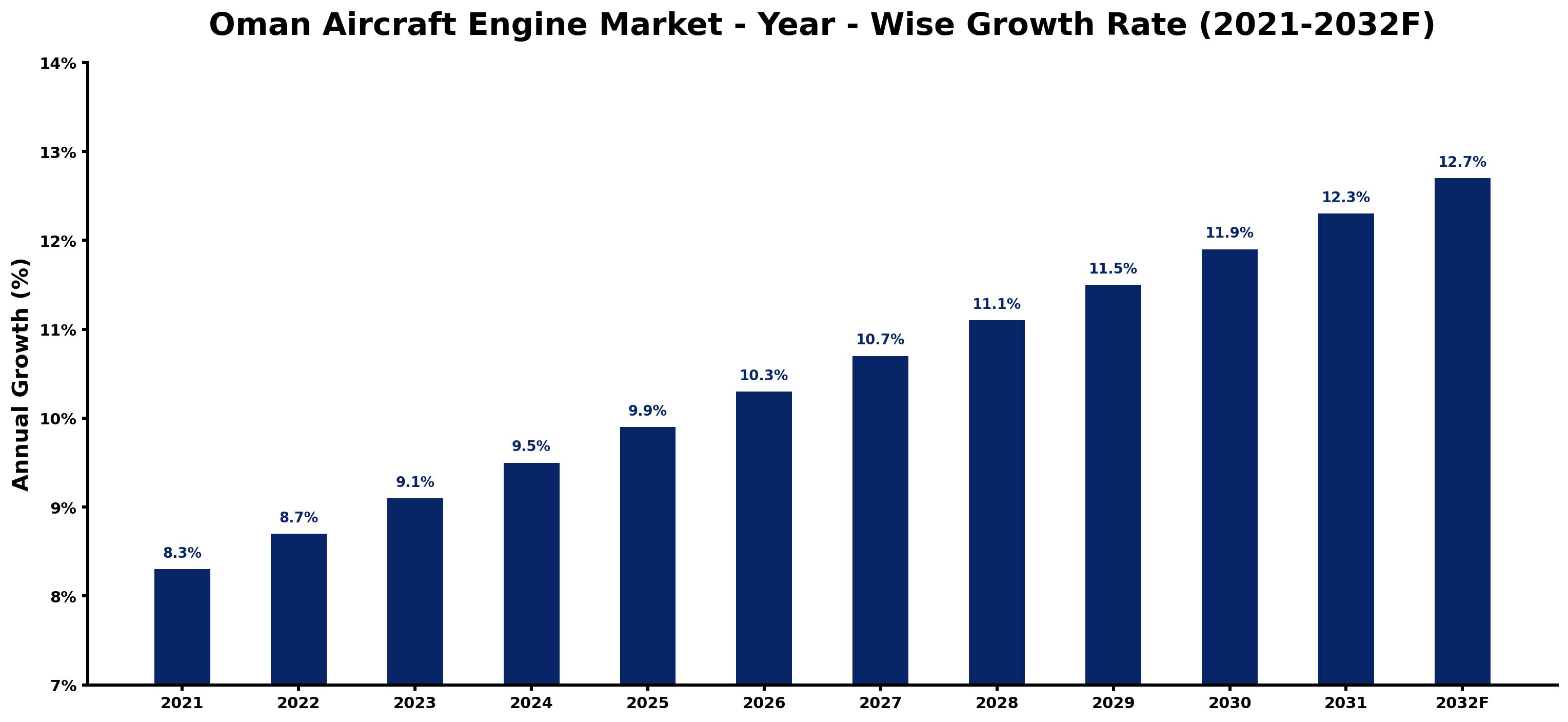
The table below presents the year‑wise growth rates along with the key drivers influencing the market
| Year | Growth Rate | Major Drivers |
| 2021 | 8.3% | Rapid growth in telecom and data center sectors |
| 2022 | 8.7% | Rising electricity demand across industries |
| 2023 | 9.1% | Expansion of transportation and logistics networks |
| 2024 | 9.5% | Rising electricity demand across industries |
| 2025 | 9.9% | Expansion of manufacturing activities |
| 2026 | 10.3% | Increasing adoption of advanced technologies |
| 2027 | 10.7% | Increasing smart city development projects |
| 2028 | 11.1% | Government infrastructure modernization initiatives |
| 2029 | 11.5% | Expansion of manufacturing activities |
| 2030 | 11.9% | Increasing smart city development projects |
| 2031 | 12.3% | Expansion of commercial construction activities |
| 2032 | 12.7% | Increasing adoption of advanced technologies |
Note - Market size estimations and growth projections presented in this report are based on 6Wresearch's advanced forecasting approach, validated with industry datasets as of June 2026.
Oman Aircraft Engine Market Synopsis
While the Oman Aircraft Engine Market has seen steady growth in recent years, the focus is shifting toward enhancing operational efficiency and sustainability. With airlines expanding their fleets and seeking more fuel-efficient engines, the market's momentum is expected to accelerate significantly.
As the aviation sector continues to develop, the demand for comprehensive maintenance, repair, and overhaul (MRO) services will also grow. This reflects a broader trend of collaboration between local companies and international manufacturers, enhancing the service offerings in Oman's aviation landscape.
Oman Aircraft Engine Market Key Takeaways
- The market is experiencing a shift towards more fuel-efficient and technologically advanced aircraft engines.
- Oman's strategic location supports its role as a significant air travel hub, increasing engine demand.
- Investment opportunities are emerging in both engine supply and MRO services.
- Government policies are fostering a favorable environment for growth in the aviation sector.
- The integration of digital technologies is enhancing predictive maintenance capabilities in the market.
Evaluation of Restraints in Oman Aircraft Engine Market
Despite its growth potential, the Oman Aircraft Engine Market faces significant challenges. One major restraint is the limited domestic manufacturing capability for aircraft engines, leading to heavy reliance on imports. This reliance creates vulnerability in supply chains, impacting pricing and availability. Additionally, maintaining pace with rapid technological advancements poses a challenge, as companies must continually innovate to meet global standards. Compliance with stringent aviation regulations further complicates operational dynamics in the sector, necessitating continuous adjustments for local operators.
Oman Aircraft Engine Market Trends
Several trends are emerging within the Oman Aircraft Engine Market that are expected to shape its future. There is an increasing emphasis on lightweight materials and innovative design to enhance engine performance while minimizing environmental impact. The growing interest in electric and hybrid propulsion systems marks a pivotal shift towards sustainability in aviation. Furthermore, digitalization and predictive maintenance are on the rise, allowing for enhanced optimization of engine performance and reduced downtime for operators.
Oman Aircraft Engine Market Opportunities
Investment opportunities in the Oman Aircraft Engine Market are plentiful, particularly as the government invests heavily in aviation infrastructure development. Companies can explore partnerships with local airlines for both supply and servicing of aircraft engines. Additionally, there is significant potential in research and development, particularly in advanced engine technologies that align with global sustainability goals. Collaborating with Oman's aviation authorities will also enable businesses to provide tailored solutions to meet the evolving needs of the sector.
Government Initiatives in the Oman Aircraft Engine Market
The government of Oman has put forth various initiatives aimed at bolstering the aircraft engine market. Policies are in place to promote investment in the aerospace industry, which includes infrastructure development for aviation and enhancing local aviation companies' capabilities. Partnerships with international aerospace firms facilitate the transfer of technology and knowledge, while incentives such as tax breaks are offered to attract foreign investment in this vital sector. Collectively, these measures are designed to position Oman as a regional center for aerospace innovation.
Future Insights of the Oman Aircraft Engine Market
Looking ahead to 2026-2032, the Oman Aircraft Engine Market is poised for substantial expansion. Increasing air travel demand will drive the need for new and replacement aircraft engines, particularly as airlines seek to modernize their fleets. Alongside this, ongoing investments in aviation infrastructure will create a supportive ecosystem for market growth. Advances in engine technology aimed at improving fuel efficiency and reducing emissions will further propel the market forward, ensuring a robust outlook for stakeholders involved in Oman's aviation sector.
Oman Aircraft Engine Market Latest Developments (May 2025 - June 2026)
Recent developments in the Oman Aircraft Engine Market indicate a growing focus on partnerships between local companies and international manufacturers. Collaborative initiatives are being launched to enhance MRO services and upgrade engine technology. Furthermore, the trend towards integrating digital solutions for predictive maintenance is gaining traction, improving operational efficiency among regional airlines. This momentum reflects a broader commitment to enhancing capabilities in the aviation sector, positioning Oman as an increasingly competitive player in the global market.
Oman Aircraft Engine Market - Key Attractiveness of the Report
- 10 Years of Market Numbers
- Historical Data Starting from 2022 to 2025
- Base Year: 2025
- Forecast Data until 2032
- Key Performance Indicators Impacting the Market
- Major Upcoming Developments and Projects
Key Highlights of the Report:
- Oman Aircraft Engine Market Outlook
- Market Size of Oman Aircraft Engine Market, 2025
- Forecast of Oman Aircraft Engine Market, 2032
- Historical Data and Forecast of Oman Aircraft Engine Revenues & Volume for the Period 2022-2032F
- Oman Aircraft Engine Market Trend Evolution
- Oman Aircraft Engine Market Drivers and Challenges
- Oman Aircraft Engine Price Trends
- Oman Aircraft Engine Porter's Five Forces
- Oman Aircraft Engine Industry Life Cycle
- Historical Data and Forecast of Oman Aircraft Engine Market Revenues & Volume By Type for the Period 2022-2032F
- Historical Data and Forecast of Oman Aircraft Engine Market Revenues & Volume By Turboprop for the Period 2022-2032F
- Historical Data and Forecast of Oman Aircraft Engine Market Revenues & Volume By Turbofan for the Period 2022-2032F
- Historical Data and Forecast of Oman Aircraft Engine Market Revenues & Volume By Turboshaft for the Period 2022-2032F
- Historical Data and Forecast of Oman Aircraft Engine Market Revenues & Volume By Piston Engine for the Period 2022-2032F
- Historical Data and Forecast of Oman Aircraft Engine Market Revenues & Volume By Application for the Period 2022-2032F
- Historical Data and Forecast of Oman Aircraft Engine Market Revenues & Volume By Military Aviation for the Period 2022-2032F
- Historical Data and Forecast of Oman Aircraft Engine Market Revenues & Volume By Commercial Aviation for the Period 2022-2032F
- Historical Data and Forecast of Oman Aircraft Engine Market Revenues & Volume By General Aviation for the Period 2022-2032F
- Historical Data and Forecast of Oman Aircraft Engine Market Revenues & Volume By Platform for the Period 2022-2032F
- Historical Data and Forecast of Oman Aircraft Engine Market Revenues & Volume By Fixed Wing for the Period 2022-2032F
- Historical Data and Forecast of Oman Aircraft Engine Market Revenues & Volume By Rotary Wing for the Period 2022-2032F
- Oman Aircraft Engine Import Export Trade Statistics
- Market Opportunity Assessment By Type
- Market Opportunity Assessment By Application
- Market Opportunity Assessment By Platform
- Oman Aircraft Engine Top Companies Market Share
- Oman Aircraft Engine Competitive Benchmarking By Technical and Operational Parameters
- Oman Aircraft Engine Company Profiles
- Oman Aircraft Engine Key Strategic Recommendations






































