Oman Ascorbic Acid Market Size, Share & Growth Rate
The Oman Ascorbic Acid Market was estimated at USD 376 Million in 2025 and is projected to reach USD 496 Million by 2032, growing at a CAGR of 4.0% from 2026 to 2032. This upward trajectory is primarily fueled by rising health awareness among consumers and a growing inclination towards functional foods and dietary supplements. Additionally, the increasing applications of ascorbic acid in pharmaceuticals and cosmetics further solidify its role in driving market expansion.
Oman Ascorbic Acid Market Year-wise Growth Rate and Key Drivers
This graph highlights how the Oman Ascorbic Acid Market has steadily grown over the years, supported by major growth factors.
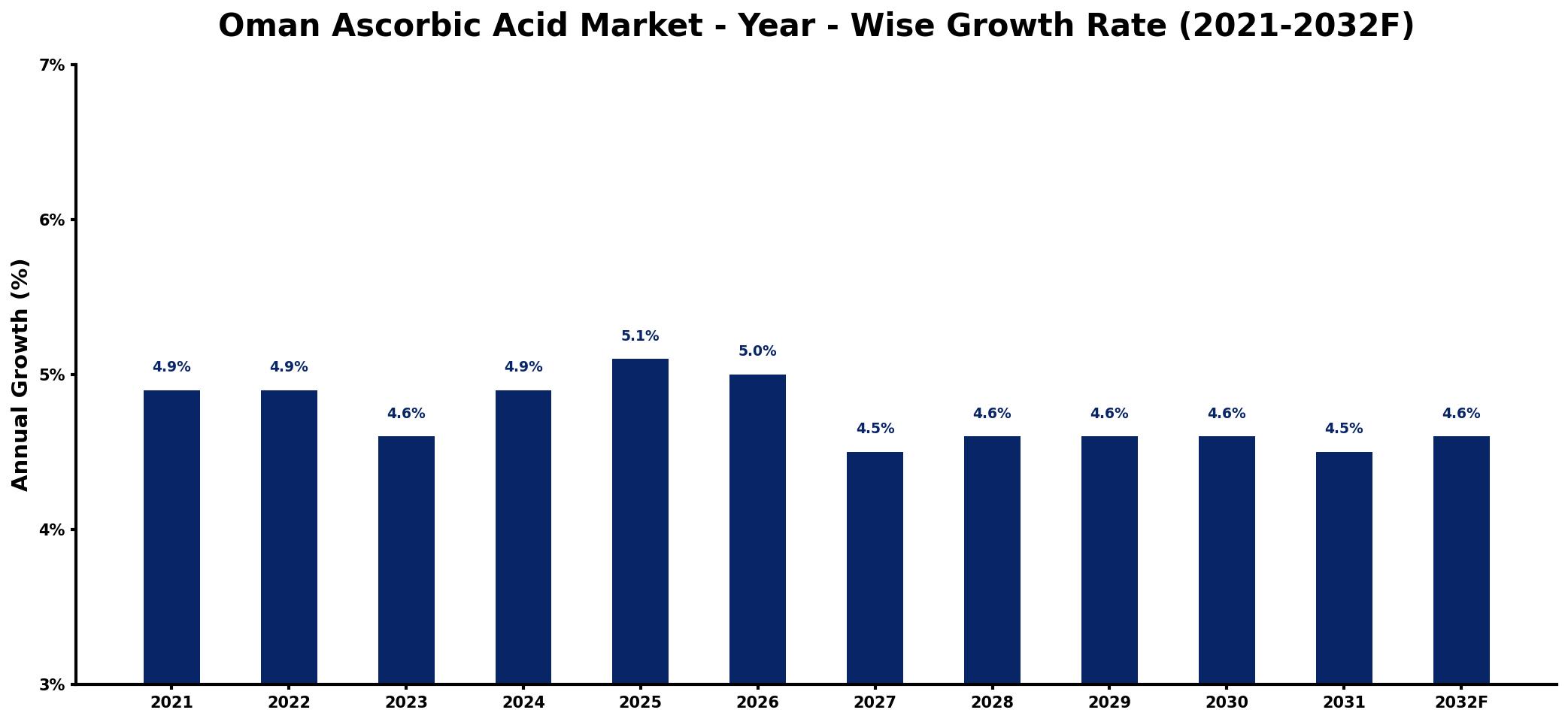
The table below presents the year‑wise growth rates along with the key drivers influencing the market
| Year | Growth Rate | Major Drivers |
| 2021 | 4.9% | rising health awareness initiatives |
| 2022 | 4.9% | expanding dietary supplement market |
| 2023 | 4.6% | increased consumer health consciousness |
| 2024 | 4.9% | growing functional food sector |
| 2025 | 5.1% | enhanced investment in wellness |
| 2026 | 5.0% | rising demand for natural products |
| 2027 | 4.5% | increased applications in cosmetics |
| 2028 | 4.6% | growing popularity of organic products |
| 2029 | 4.6% | expanding pharmaceutical industry needs |
| 2030 | 4.6% | increased exports to neighboring markets |
| 2031 | 4.5% | growing demand in food industry |
| 2032 | 4.6% | rising interest in preventive health |
Note: Market size estimations and growth projections presented in this report are based on 6Wresearch's proprietary forecasting methodology, utilizing the latest available industry data, government publications, and primary research inputs.
Oman Ascorbic Acid Market Synopsis
The most significant force shaping the Oman Ascorbic Acid Market today is the escalating demand for vitamin C, particularly as consumers become more health-conscious. This heightened awareness is translating into increased consumption of dietary supplements and fortified food products, which are becoming staples in daily nutrition.
Furthermore, the market dynamics are influenced by major importers who dominate the supply chain, sourcing ascorbic acid from international suppliers due to limited domestic production capabilities. Manufacturers are keenly focused on innovation and quality control to distinguish their offerings in a competitive landscape.
Oman Ascorbic Acid Market Key Takeaways
- Steady growth driven by heightened consumer awareness of health benefits associated with vitamin C.
- The market is predominantly reliant on imported ascorbic acid, given limited local production.
- Investment in research and development is paramount for manufacturers aiming to innovate new products.
- Regulatory policies are shaping market dynamics by ensuring product quality and safety.
- Increasing applications across the food, beverage, pharmaceutical, and cosmetic industries are pivotal for market expansion.
Evaluation of Restraints in Oman Ascorbic Acid Market
Despite its growth, the Oman Ascorbic Acid Market faces significant constraints that could hinder its progress. Chief among these is the intense competition from both local and international manufacturers, which can drive prices down and compress margins. Additionally, fluctuating raw material prices pose challenges for cost management, while regulatory barriers can complicate the importation process. A lack of consumer awareness regarding the benefits of ascorbic acid may also limit market growth, highlighting the need for educational initiatives within the distribution channels.
Oman Ascorbic Acid Market Trends
The trend towards health and wellness continues to gain momentum, driving the demand for ascorbic acid across various sectors. Fortified foods and dietary supplements are becoming increasingly popular as consumers seek products that enhance immunity and overall health. Additionally, the cosmetic industry is witnessing a surge in the use of ascorbic acid for its antioxidant properties, promoting its incorporation into skincare formulations. The pursuit of natural and organic ingredients is steering manufacturers towards innovative solutions, thus reshaping product lines to align with evolving consumer preferences.
Oman Ascorbic Acid Market Opportunities
Investment opportunities within the Oman Ascorbic Acid Market are on the rise, driven by the burgeoning demand for vitamin C across multiple industries. Companies can explore avenues for establishing local manufacturing units to reduce dependency on imports, thereby capitalizing on the market potential. Moreover, focusing on research and development to introduce innovative formulations tailored to specific consumer needs can lead to lucrative returns. The increasing trend of preventive healthcare presents an avenue for growth, enabling market players to tap into diverse customer segments.
Government Initiatives in the Oman Ascorbic Acid Market
The Omani government has taken proactive steps to regulate the ascorbic acid market, emphasizing product quality and safety compliance. This includes requiring manufacturers and distributors to secure necessary licenses and certifications to operate effectively. Policies aimed at promoting domestic production are also in place, providing incentives for local manufacturers to enhance their capabilities. These initiatives are designed to foster a competitive market environment while safeguarding consumer interests, thereby supporting the overall growth of the ascorbic acid industry.
Future Insights of the Oman Ascorbic Acid Market
Looking ahead to 2026-2032, the outlook for the Oman Ascorbic Acid Market is highly positive. The demand for vitamin C products is anticipated to rise consistently as consumers prioritize health and wellness. Increased disposable incomes coupled with a shift towards preventive healthcare are expected to catalyze this growth. Additionally, the food and beverage sector's continued reliance on ascorbic acid as a preservative and antioxidant will play a critical role in expanding the market. The trend towards natural and organic products will also pave the way for innovative applications, further diversifying the market landscape.
Oman Ascorbic Acid Market Latest Developments (2025 - 2026)
Recent developments in the Oman Ascorbic Acid Market indicate a growing interest from manufacturers in enhancing production efficiency and product quality. Innovations in extraction and formulation processes are being prioritized to meet consumer demand for high-quality, effective products. Regulatory frameworks are being updated to adapt to market changes, ensuring that safety and compliance standards are maintained. Furthermore, collaboration between public and private sectors is being emphasized to encourage domestic production and distribution of ascorbic acid, reflecting a broader commitment to fostering a robust market ecosystem.
Oman Ascorbic Acid Market - Key Attractiveness of the Report
- 10 Years of Market Numbers
- Historical Data Starting from 2022 to 2025
- Base Year: 2025
- Forecast Data until 2032
- Key Performance Indicators Impacting the Market
- Major Upcoming Developments and Projects
Key Highlights of the Report:
- Oman Ascorbic Acid Market Outlook
- Market Size of Oman Ascorbic Acid Market, 2025
- Forecast of Oman Ascorbic Acid Market, 2032
- Historical Data and Forecast of Oman Ascorbic Acid Revenues & Volume for the Period 2022-2032F
- Oman Ascorbic Acid Market Trend Evolution
- Oman Ascorbic Acid Market Drivers and Challenges
- Oman Ascorbic Acid Price Trends
- Oman Ascorbic Acid Porter's Five Forces
- Oman Ascorbic Acid Industry Life Cycle
- Historical Data and Forecast of Oman Ascorbic Acid Market Revenues & Volume By Grade for the Period 2022-2032F
- Historical Data and Forecast of Oman Ascorbic Acid Market Revenues & Volume By Food & Pharmaceutical for the Period 2022-2032F
- Historical Data and Forecast of Oman Ascorbic Acid Market Revenues & Volume By Industrial for the Period 2022-2032F
- Historical Data and Forecast of Oman Ascorbic Acid Market Revenues & Volume By Application for the Period 2022-2032F
- Historical Data and Forecast of Oman Ascorbic Acid Market Revenues & Volume By Food & Beverages for the Period 2022-2032F
- Historical Data and Forecast of Oman Ascorbic Acid Market Revenues & Volume By Pharmaceutical for the Period 2022-2032F
- Historical Data and Forecast of Oman Ascorbic Acid Market Revenues & Volume By Cosmetics for the Period 2022-2032F
- Historical Data and Forecast of Oman Ascorbic Acid Market Revenues & Volume By Chemicals for the Period 2022-2032F
- Historical Data and Forecast of Oman Ascorbic Acid Market Revenues & Volume By Agriculture for the Period 2022-2032F
- Historical Data and Forecast of Oman Ascorbic Acid Market Revenues & Volume By Others for the Period 2022-2032F
- Oman Ascorbic Acid Import Export Trade Statistics
- Market Opportunity Assessment By Grade
- Market Opportunity Assessment By Application
- Oman Ascorbic Acid Top Companies Market Share
- Oman Ascorbic Acid Competitive Benchmarking By Technical and Operational Parameters
- Oman Ascorbic Acid Company Profiles
- Oman Ascorbic Acid Key Strategic Recommendations






































