Oman Automotive collision repair Market Size, Share & Growth Rate
The Oman Automotive collision repair Market was estimated at USD 720 Million in 2025 and is projected to reach USD 1268 Million by 2032, growing at a CAGR of 8.4% from 2026 to 2032. This growth trajectory is primarily driven by an uptick in vehicle ownership alongside rising incidents of road accidents. As Oman's economy continues to develop, an increasing number of vehicles on the road naturally leads to a higher demand for repair services, particularly in urbanized areas.
Oman Automotive collision repair Market Year-wise Growth Rate and Key Drivers
This graph highlights how the Oman Automotive collision repair Market has steadily grown over the years, supported by major growth factors.
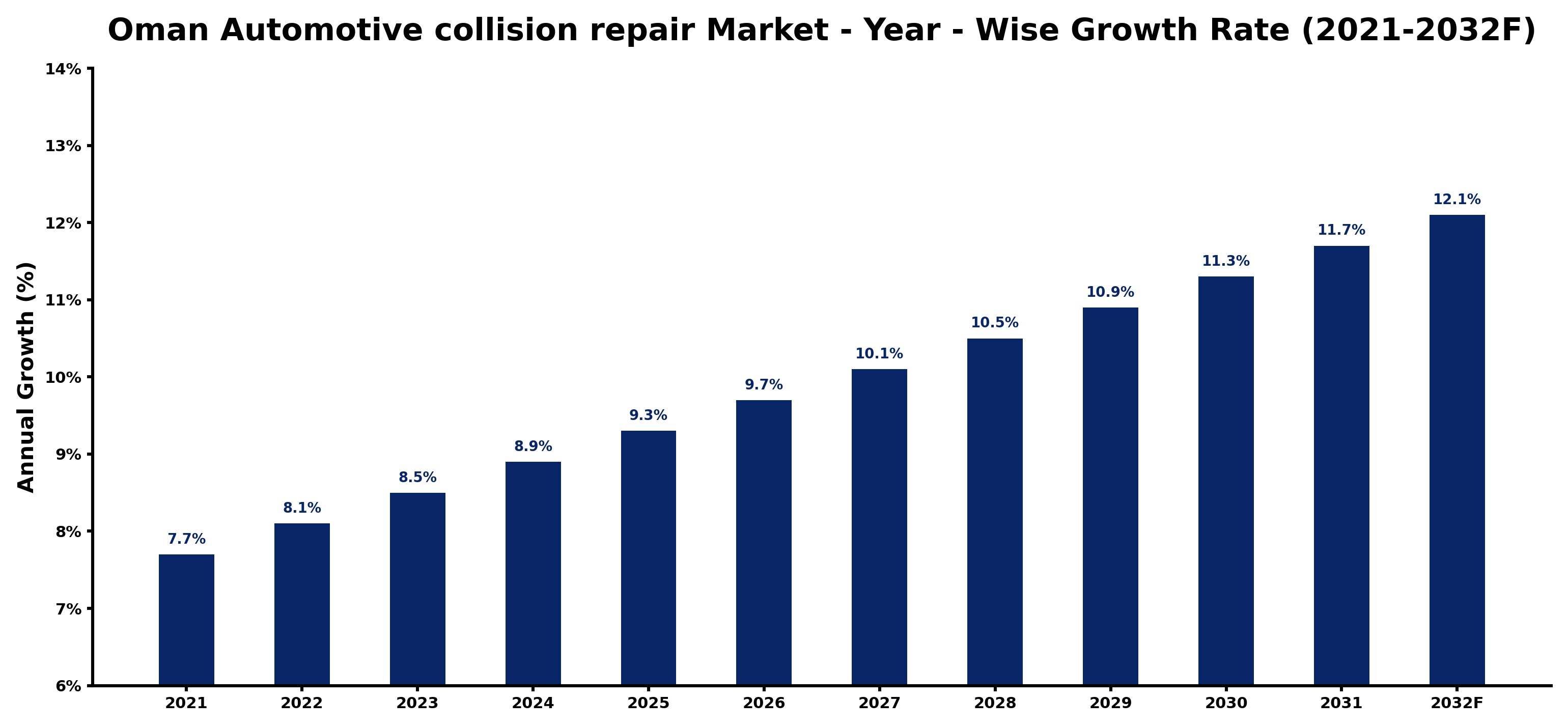
The table below presents the year‑wise growth rates along with the key drivers influencing the market
| Year | Growth Rate | Major Drivers |
| 2021 | 7.7% | Rising vehicle ownership rates |
| 2022 | 8.1% | Increased demand for repairs |
| 2023 | 8.5% | Technological advancements in repairs |
| 2024 | 8.9% | Growth in insurance coverage |
| 2025 | 9.3% | Expansion of service centers |
| 2026 | 9.7% | Higher disposable income levels |
| 2027 | 10.1% | Increased road safety regulations |
| 2028 | 10.5% | Industrial activity supported growth |
| 2029 | 10.9% | Rising awareness of maintenance |
| 2030 | 11.3% | Enhanced customer service offerings |
| 2031 | 11.7% | Urbanization driving repair needs |
| 2032 | 12.1% | Sustainability trends influencing repairs |
Note - Market size estimations and growth projections presented in this report are based on 6Wresearch's advanced forecasting approach, validated with industry datasets as of June 2026.
Oman Automotive collision repair Market Synopsis
In Oman, the automotive collision repair market is characterized by a diverse ecosystem comprising independent repair shops and authorized service centers. A significant demand for cosmetic repairs is emerging, driven by consumers increasingly desiring aesthetics alongside functionality. Furthermore, insurance coverage for collision damages is becoming more commonplace, which enhances repair service accessibility for vehicle owners.
The market is increasingly pivoting toward eco-friendly practices, with many repair shops adopting sustainable materials in their services. These shifts are reshaping consumer expectations and pushing businesses to align with modern environmental values, thus presenting a competitive edge in a saturated market.
Oman Automotive collision repair Market Key Takeaways
- The market is expanding rapidly due to rising vehicle ownership and road incidents.
- Technological advancements are enhancing the efficiency and quality of collision repairs.
- Eco-friendly practices and sustainable materials are becoming standard in the industry.
- Specialized services for luxury vehicles are gaining traction amid a growing premium car segment.
- Digitalization is improving customer interactions and operational efficiency in repair shops.
Evaluation of Restraints in Oman Automotive collision repair Market
Despite its growth potential, the Oman automotive collision repair market faces substantial constraints. A significant challenge is the shortage of skilled labor, which hampers the efficiency and quality of repair services. This shortage often results in prolonged turnaround times, ultimately affecting customer satisfaction. Additionally, limited access to cutting-edge technology and rising material costs further pressure profit margins. Finally, fluctuating insurance regulations complicate business operations, making it crucial for repair shops to remain adaptable to ever-changing demands.
Oman Automotive collision repair Market Trends
Several key trends are shaping the Oman automotive collision repair market. One prominent trend is the growing integration of advanced technologies such as computerized diagnostics and automated repair processes. These innovations not only enhance efficiency but also ensure a higher standard of repair accuracy. Concurrently, the emphasis on sustainability is influencing repair practices, with many shops opting for eco-friendly materials and processes. The rise of specialized services tailored for high-end vehicles is also noteworthy, as the influx of premium cars on the road necessitates unique repair approaches. Lastly, digitalization is streamlining operations, with online platforms increasingly utilized for appointment scheduling and customer communication.
Oman Automotive collision repair Market Opportunities
The Oman automotive collision repair market is ripe with investment opportunities. As the number of vehicles increases, the demand for repair and maintenance services is set to grow significantly. Investors can find lucrative prospects in establishing collision repair shops that specialize in niche services, such as eco-friendly solutions or paintless dent repair. Additionally, forging partnerships with insurance companies and car dealerships can provide a stable customer base, ensuring consistent business flow. Such ventures can not only drive profitability but also contribute to the overall enhancement of service standards in the market.
Government Initiatives in the Oman Automotive collision repair Market
The government of Oman is proactive in regulating the automotive collision repair sector, primarily through the Ministry of Commerce, Industry, and Investment Promotion. Efforts to ensure compliance with safety and quality standards are paramount. Additionally, initiatives promoting the use of genuine spare parts and skills enhancement for repair technicians through training programs are underway. Monitoring and control of repair service pricing are also essential government measures to protect consumers from malpractices, fostering a competitive yet equitable market landscape.
Future Insights of the Oman Automotive collision repair Market
Looking forward to 2026-2032, the Oman automotive collision repair market is expected to maintain a positive growth trajectory. The ongoing increase in vehicle ownership, spurred by population growth and economic expansion, will lead to a higher frequency of accidents and, consequently, a greater demand for repair services. Advances in technology and materials will pave the way for specialized repair techniques, enhancing service offerings. With stringent safety regulations being implemented, vehicle owners are likely to prioritize professional repair services to ensure compliance, thereby supporting market growth in the years to come.
Oman Automotive collision repair Market Latest Developments (May 2025 - June 2026)
Recent developments in the Oman automotive collision repair sector include a noticeable shift towards adopting advanced repair technologies, such as automated painting systems and digital tracking for repair progress. There has also been an increase in workshops focusing on sustainable repair practices, with many businesses promoting eco-friendly solutions as a competitive advantage. Furthermore, the integration of customer-centric digital platforms for scheduling and payments is streamlining operations, enhancing the overall customer experience.
Oman Automotive collision repair Market - Key Attractiveness of the Report
- 10 Years of Market Numbers
- Historical Data Starting from 2022 to 2025
- Base Year: 2025
- Forecast Data until 2032
- Key Performance Indicators Impacting the Market
- Major Upcoming Developments and Projects
Key Highlights of the Report:
- Oman Automotive collision repair Market Outlook
- Market Size of Oman Automotive collision repair Market, 2025
- Forecast of Oman Automotive collision repair Market, 2032
- Historical Data and Forecast of Oman Automotive collision repair Revenues & Volume for the Period 2022-2032F
- Oman Automotive collision repair Market Trend Evolution
- Oman Automotive collision repair Market Drivers and Challenges
- Oman Automotive collision repair Price Trends
- Oman Automotive collision repair Porter's Five Forces
- Oman Automotive collision repair Industry Life Cycle
- Historical Data and Forecast of Oman Automotive collision repair Market Revenues & Volume By Vehicle Type for the Period 2022-2032F
- Historical Data and Forecast of Oman Automotive collision repair Market Revenues & Volume By Light-duty for the Period 2022-2032F
- Historical Data and Forecast of Oman Automotive collision repair Market Revenues & Volume By Heavy-duty for the Period 2022-2032F
- Historical Data and Forecast of Oman Automotive collision repair Market Revenues & Volume By Product for the Period 2022-2032F
- Historical Data and Forecast of Oman Automotive collision repair Market Revenues & Volume By Paints & coatings for the Period 2022-2032F
- Historical Data and Forecast of Oman Automotive collision repair Market Revenues & Volume By Consumables for the Period 2022-2032F
- Historical Data and Forecast of Oman Automotive collision repair Market Revenues & Volume By Spare parts for the Period 2022-2032F
- Historical Data and Forecast of Oman Automotive collision repair Market Revenues & Volume By Service Channel for the Period 2022-2032F
- Historical Data and Forecast of Oman Automotive collision repair Market Revenues & Volume By DIY for the Period 2022-2032F
- Historical Data and Forecast of Oman Automotive collision repair Market Revenues & Volume By DIFM for the Period 2022-2032F
- Historical Data and Forecast of Oman Automotive collision repair Market Revenues & Volume By OE for the Period 2022-2032F
- Oman Automotive collision repair Import Export Trade Statistics
- Market Opportunity Assessment By Vehicle Type
- Market Opportunity Assessment By Product
- Market Opportunity Assessment By Service Channel
- Oman Automotive collision repair Top Companies Market Share
- Oman Automotive collision repair Competitive Benchmarking By Technical and Operational Parameters
- Oman Automotive collision repair Company Profiles
- Oman Automotive collision repair Key Strategic Recommendations






































