Oman Automotive Reversing Radar Market Size, Share & Growth Rate
The Oman Automotive Reversing Radar Market was estimated at USD 1044 Million in 2025 and is projected to reach USD 1780 Million by 2032, growing at a CAGR of 7.9% from 2026 to 2032. This growth trajectory is largely fueled by an increasing awareness of vehicle safety among consumers and a corresponding demand for advanced driver assistance systems. As urbanization progresses and parking challenges intensify, the need for reversing radar technology becomes even more pronounced, promising to reshape the market landscape significantly over the next several years.
Oman Automotive Reversing Radar Market Year-wise Growth Rate and Key Drivers
This graph highlights how the Oman Automotive Reversing Radar Market has steadily grown over the years, supported by major growth factors.
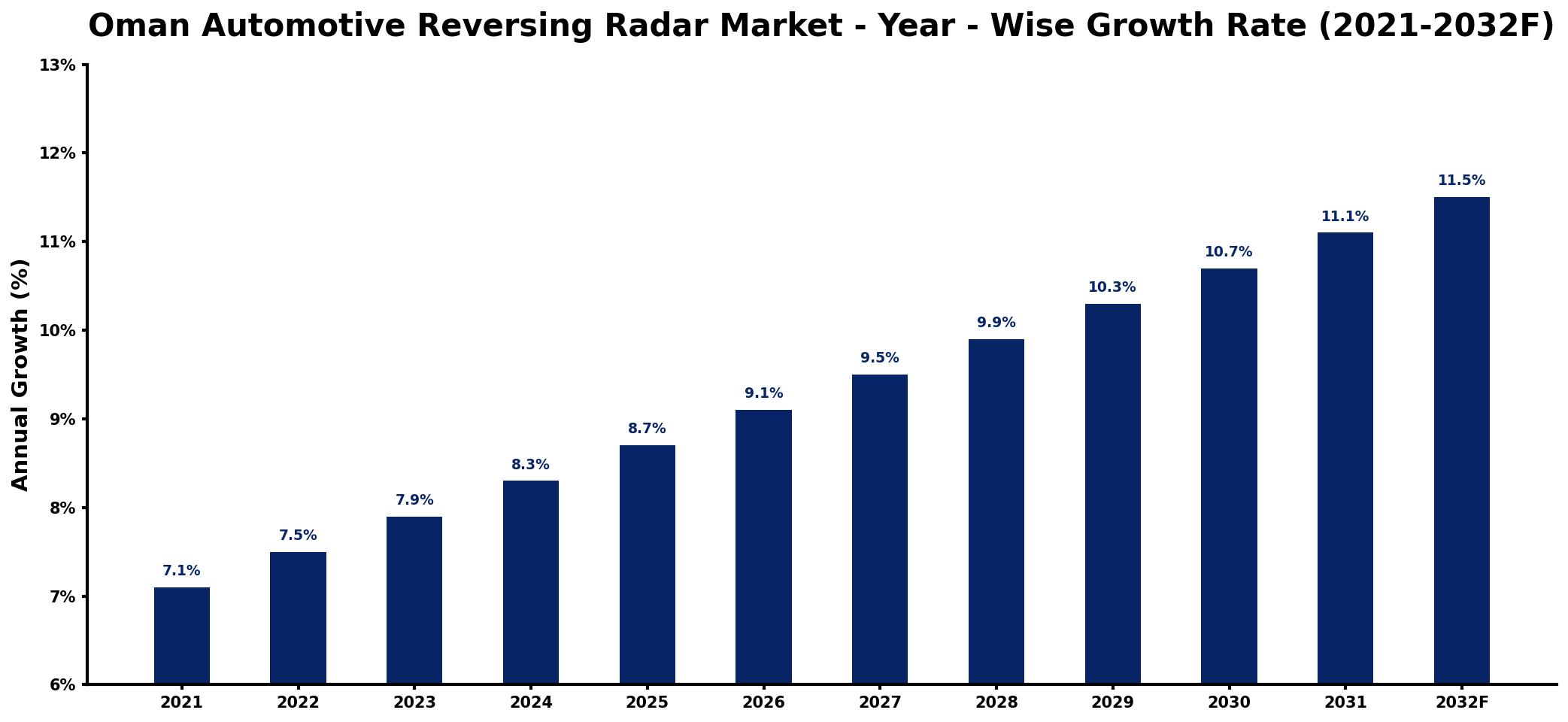
The table below presents the year‑wise growth rates along with the key drivers influencing the market
| Year | Growth Rate | Major Drivers |
| 2021 | 7.1% | Rising consumer safety awareness |
| 2022 | 7.5% | Increased vehicle technology adoption |
| 2023 | 7.9% | Growing demand for advanced features |
| 2024 | 8.3% | Expansion of vehicle production facilities |
| 2025 | 8.7% | Surge in urban vehicle sales |
| 2026 | 9.1% | Investment in smart city initiatives |
| 2027 | 9.5% | Enhancement of driver assistance systems |
| 2028 | 9.9% | Development of electric vehicle infrastructure |
| 2029 | 10.3% | improved raw material availability |
| 2030 | 10.7% | strengthening underlying market demand |
| 2031 | 11.1% | Increase in fleet management solutions |
| 2032 | 11.5% | Rising popularity of connected vehicles |
Note: Market size estimations and growth projections presented in this report are based on 6Wresearch's proprietary forecasting methodology, utilizing the latest available industry data, government publications, and primary research inputs.
Oman Automotive Reversing Radar Market Synopsis
The paramount force currently shaping the Oman Automotive Reversing Radar Market is the heightened focus on vehicle safety. As consumers increasingly demand cutting-edge safety features, reversing radar systems are becoming essential for many drivers, serving not only to protect occupants but also pedestrians and cyclists. The Omani governments initiatives to regulate the inclusion of such safety technologies in new vehicles are further propelling this momentum.
In addition, the advancement of sensor fusion technologies and artificial intelligence is revolutionizing reversing radar systems, enabling higher accuracy and reliability. As manufacturers innovate to address the unique needs of the local market, the prospects for growth in this sector continue to expand, creating a robust environment for investment and development.
Oman Automotive Reversing Radar Market Key Takeaways
- The market is projected to grow significantly, driven by consumer awareness and regulatory mandates.
- Integration of advanced technologies is enhancing the functionality and accuracy of reversing radars.
- Government policies are increasingly mandating the inclusion of reversing radar systems in new vehicles.
- Urbanization and limited parking spaces are creating heightened demand for parking assistance technologies.
- Challenges related to consumer adoption of aftermarket solutions are being addressed through innovation.
Evaluation of Restraints in Oman Automotive Reversing Radar Market
Despite the promising growth outlook, the Oman Automotive Reversing Radar Market faces certain constraints. One of the primary limitations is the reluctance of consumers to adopt aftermarket retrofitting solutions, which can significantly hinder penetration rates. Additionally, concerns regarding the reliability and accuracy of radar-based parking assistance systems contribute to hesitation among potential buyers. Technical challenges related to ensuring interoperability with existing vehicle systems also remain a barrier, necessitating ongoing innovation and adaptation from manufacturers.
Oman Automotive Reversing Radar Market Trends
A key trend shaping the Oman Automotive Reversing Radar Market is the integration of artificial intelligence and machine learning technologies, enhancing the systems' capability to detect obstacles in various driving conditions. Furthermore, there is a rising demand for compact and aesthetically integrated reversing radar solutions that cater to modern vehicle designs. Manufacturers are increasingly focusing on developing cost-effective systems that do not compromise on quality or performance, responding to consumer expectations in a competitive market.
Oman Automotive Reversing Radar Market Opportunities
Genuine growth and investment opportunities lie in the increasing incorporation of reversing radar technologies in commercial vehicles. As logistics and delivery services expand, ensuring the safety of these vehicles while maneuvering in tight urban environments will become essential. Additionally, collaborations between technology providers and automotive manufacturers could lead to innovative solutions that enhance user experience, further propelling market growth.
Government Initiatives in the Oman Automotive Reversing Radar Market
In recognition of the growing concerns over road safety, the Omani government has introduced regulations aimed at promoting automotive reversing radar systems in new vehicles. These regulations are designed to improve visibility and reduce the likelihood of accidents while reversing. Moreover, public awareness campaigns are being conducted to educate drivers about the importance of adopting such technologies for enhanced safety, highlighting the government's commitment to fostering safer driving environments.
Future Insights of the Oman Automotive Reversing Radar Market
Looking ahead to 2026-2032, the Oman Automotive Reversing Radar Market is poised for substantial transformation. With continual advancements in technology and increasing regulatory support, the market is expected to evolve significantly. The rising urban population and the continuing challenges related to parking will likely drive demand for these systems, making reversing radars a standard feature in vehicles. The integration of additional safety technologies alongside reversing radar systems will create a more comprehensive safety framework for drivers in Oman.
Oman Automotive Reversing Radar Market Latest Developments (2025 - 2026)
Recent industry movements indicate a surge in research and development activities focusing on enhancing the functionality of reversing radar systems. Companies are exploring partnerships to create integrated systems that offer seamless interactions with other safety features in vehicles. Additionally, there is a noticeable shift towards user-friendly interfaces and mobile applications designed to enhance the consumer experience, reflecting an industry trend towards digitization and connectivity in automotive safety technologies.
Oman Automotive Reversing Radar Market - Key Attractiveness of the Report
- 10 Years of Market Numbers
- Historical Data Starting from 2022 to 2025
- Base Year: 2025
- Forecast Data until 2032
- Key Performance Indicators Impacting the Market
- Major Upcoming Developments and Projects
Key Highlights of the Report:
- Oman Automotive Reversing Radar Market Outlook
- Market Size of Oman Automotive Reversing Radar Market, 2025
- Forecast of Oman Automotive Reversing Radar Market, 2032
- Historical Data and Forecast of Oman Automotive Reversing Radar Revenues & Volume for the Period 2022-2032F
- Oman Automotive Reversing Radar Market Trend Evolution
- Oman Automotive Reversing Radar Market Drivers and Challenges
- Oman Automotive Reversing Radar Price Trends
- Oman Automotive Reversing Radar Porter's Five Forces
- Oman Automotive Reversing Radar Industry Life Cycle
- Historical Data and Forecast of Oman Automotive Reversing Radar Market Revenues & Volume By Type for the Period 2022-2032F
- Historical Data and Forecast of Oman Automotive Reversing Radar Market Revenues & Volume By Ultrasonic for the Period 2022-2032F
- Historical Data and Forecast of Oman Automotive Reversing Radar Market Revenues & Volume By Electromagnetic for the Period 2022-2032F
- Historical Data and Forecast of Oman Automotive Reversing Radar Market Revenues & Volume By Application for the Period 2022-2032F
- Historical Data and Forecast of Oman Automotive Reversing Radar Market Revenues & Volume By Passenger Vehicle for the Period 2022-2032F
- Historical Data and Forecast of Oman Automotive Reversing Radar Market Revenues & Volume By Commercial Vehicle for the Period 2022-2032F
- Oman Automotive Reversing Radar Import Export Trade Statistics
- Market Opportunity Assessment By Type
- Market Opportunity Assessment By Application
- Oman Automotive Reversing Radar Top Companies Market Share
- Oman Automotive Reversing Radar Competitive Benchmarking By Technical and Operational Parameters
- Oman Automotive Reversing Radar Company Profiles
- Oman Automotive Reversing Radar Key Strategic Recommendations






































