Oman Bromine Market Size Growth Rate
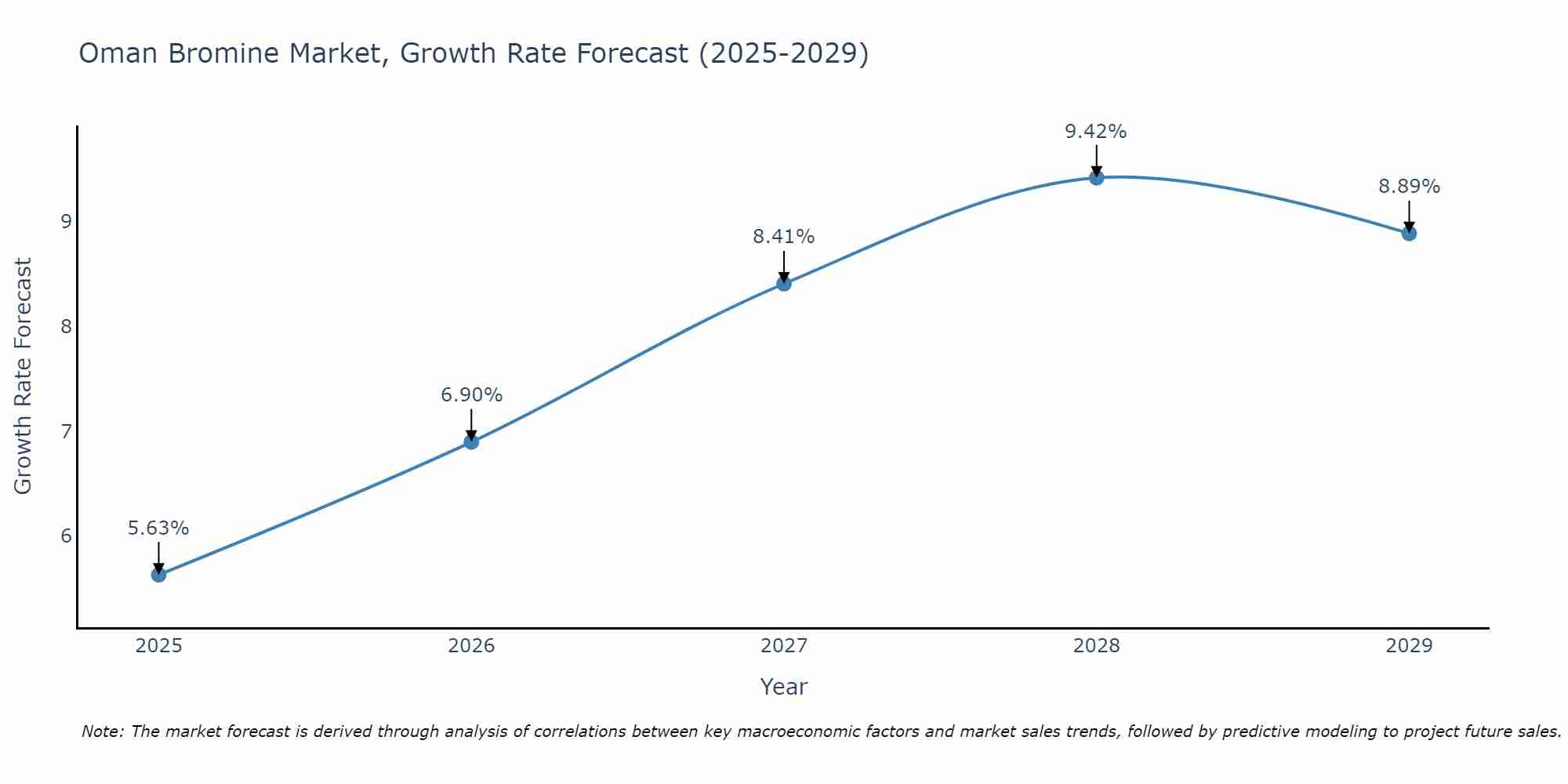
The Oman Bromine Market is projected to witness mixed growth rate patterns during 2025 to 2029. Starting at 5.63% in 2025, the market peaks at 9.42% in 2028, and settles at 8.89% by 2029.
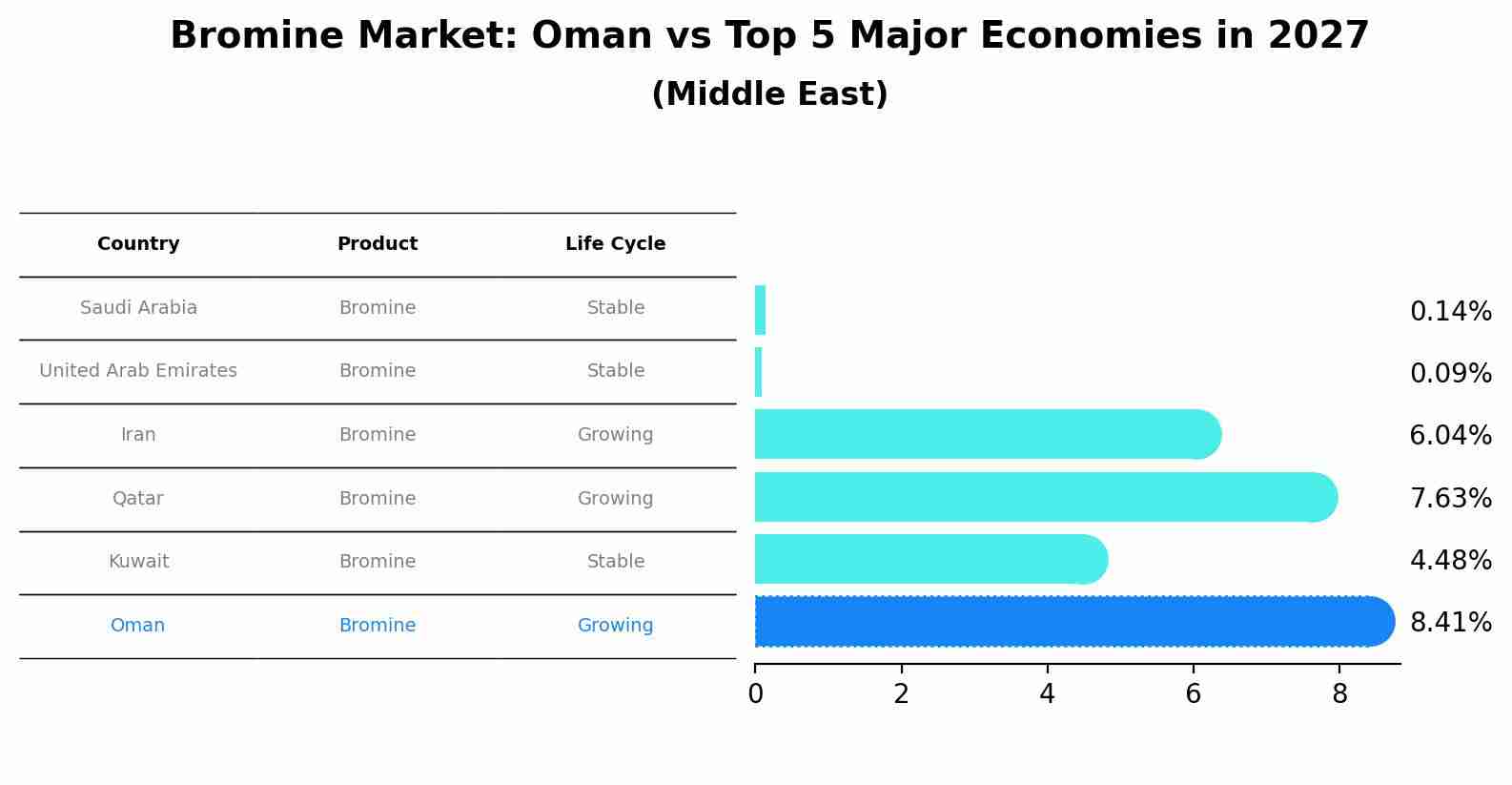
Bromine Market: Oman vs Top 5 Major Economies in 2027 (Middle East)
By 2027, the Bromine market in Oman is anticipated to reach a growth rate of 8.41%, as part of an increasingly competitive Middle East region, where Saudi Arabia remains at the forefront, supported by United Arab Emirates, Iran, Qatar and Kuwait, driving innovations and market adoption across sectors.
Oman Bromine Market Overview
The Oman Bromine market is experiencing significant growth due to increasing demand from various industries such as oil & gas, pharmaceuticals, and agriculture. Oman is one of the largest producers of bromine globally, with abundant reserves and efficient production facilities. The country`s strategic location near key markets in Asia and Europe also contributes to its strong position in the global bromine market. The growth of end-user industries, coupled with ongoing research and development activities to expand the applications of bromine compounds, is expected to drive further expansion of the Oman Bromine market. Additionally, the government`s supportive policies and initiatives to promote industrial growth and investment in the sector are likely to fuel market growth in the coming years.
Oman Bromine Market Trends
The Oman Bromine Market is witnessing several key trends. One of the prominent trends is the increasing demand for bromine derivatives in various industries such as oil and gas, pharmaceuticals, and flame retardants. This demand is driven by the growing awareness of the benefits of bromine-based products for improving fire safety and as key components in several industrial processes. Another trend is the focus on sustainable bromine production methods to address environmental concerns and regulatory requirements. Additionally, the market is experiencing innovations in bromine extraction techniques and product development to enhance efficiency and performance. Overall, the Oman Bromine Market is expected to continue growing, driven by these trends and the expanding applications of bromine derivatives across industries.
Oman Bromine Market Challenges
In the Oman Bromine Market, some of the key challenges faced include intense competition from other global players, price volatility due to fluctuations in raw material costs, and regulatory constraints governing the use and production of bromine. Additionally, limited availability of skilled labor and infrastructure constraints in remote production areas pose challenges for market growth. Furthermore, the market is highly dependent on the oil and gas industry, making it vulnerable to fluctuations in oil prices and global economic conditions. To stay competitive and overcome these challenges, companies in the Oman Bromine Market need to focus on innovation, product diversification, and strategic partnerships to secure their position in the market and drive sustainable growth.
Oman Bromine Market Investment Opportunities
The Oman Bromine Market offers several investment opportunities due to its significant global presence in the bromine industry. With Oman being one of the largest producers of bromine in the world, investors can consider opportunities in bromine extraction and production facilities, as well as in the development of bromine-based products such as flame retardants, drilling fluids, pharmaceuticals, and more. Additionally, the increasing demand for bromine in various industries such as oil and gas, agriculture, and healthcare further enhances the investment potential in the Oman Bromine Market. Collaborating with local bromine producers, exploring strategic partnerships, and staying updated on market trends and regulations can help investors capitalize on the growth prospects offered by the Oman Bromine Market.
Oman Bromine Market Government Policy
Government policies related to the Oman Bromine Market include regulations on production, export, and environmental impact. The Ministry of Commerce and Industry oversees licensing and permits for bromine producers, ensuring compliance with safety and quality standards. The government also imposes export quotas to control the supply of bromine in the international market. Environmental regulations aim to mitigate the impact of bromine production on air and water quality, with strict guidelines on waste disposal and emissions. Additionally, the government may provide incentives or subsidies to encourage investment in the bromine industry, such as tax breaks or financial assistance for research and development projects. Overall, government policies in Oman seek to promote sustainable growth and responsible practices within the bromine market while supporting the industry`s competitiveness on a global scale.
Oman Bromine Market Future Outlook
The future outlook for the Oman Bromine Market appears positive, with steady growth anticipated in the coming years. Increasing demand for bromine in various industries such as oil and gas, pharmaceuticals, and flame retardants is expected to drive market expansion. Oman`s strategic location and abundance of bromine resources further support its position as a key player in the global bromine market. Additionally, ongoing research and development efforts to explore new applications for bromine, along with technological advancements in bromine production processes, are likely to create new opportunities for market growth. Overall, the Oman Bromine Market is poised for a promising future with potential for sustained growth and profitability.
Key Highlights of the Report:
- Oman Bromine Market Outlook
- Market Size of Oman Bromine Market, 2021
- Forecast of Oman Bromine Market, 2031
- Historical Data and Forecast of Oman Bromine Revenues & Volume for the Period 2021 - 2031
- Oman Bromine Market Trend Evolution
- Oman Bromine Market Drivers and Challenges
- Oman Bromine Price Trends
- Oman Bromine Porter's Five Forces
- Oman Bromine Industry Life Cycle
- Historical Data and Forecast of Oman Bromine Market Revenues & Volume By Derivative for the Period 2021 - 2031
- Historical Data and Forecast of Oman Bromine Market Revenues & Volume By Organobromine for the Period 2021 - 2031
- Historical Data and Forecast of Oman Bromine Market Revenues & Volume By Clear Brine Fluids for the Period 2021 - 2031
- Historical Data and Forecast of Oman Bromine Market Revenues & Volume By Hydrogen Bromide for the Period 2021 - 2031
- Historical Data and Forecast of Oman Bromine Market Revenues & Volume By Application for the Period 2021 - 2031
- Historical Data and Forecast of Oman Bromine Market Revenues & Volume By Flame Retardants for the Period 2021 - 2031
- Historical Data and Forecast of Oman Bromine Market Revenues & Volume By Oil & Gas Drilling for the Period 2021 - 2031
- Historical Data and Forecast of Oman Bromine Market Revenues & Volume By PTA Synthesis for the Period 2021 - 2031
- Historical Data and Forecast of Oman Bromine Market Revenues & Volume By Water Treatment & Biocides for the Period 2021 - 2031
- Historical Data and Forecast of Oman Bromine Market Revenues & Volume By Pesticides for the Period 2021 - 2031
- Historical Data and Forecast of Oman Bromine Market Revenues & Volume By HBr Flow Batteries for the Period 2021 - 2031
- Historical Data and Forecast of Oman Bromine Market Revenues & Volume By Pharmaceuticals for the Period 2021 - 2031
- Historical Data and Forecast of Oman Bromine Market Revenues & Volume By Others for the Period 2021 - 2031
- Oman Bromine Import Export Trade Statistics
- Market Opportunity Assessment By Derivative
- Market Opportunity Assessment By Application
- Oman Bromine Top Companies Market Share
- Oman Bromine Competitive Benchmarking By Technical and Operational Parameters
- Oman Bromine Company Profiles
- Oman Bromine Key Strategic Recommendations






































