Oman Building Construction Market Size, Share & Growth Rate
The Oman Building Construction Market was estimated at USD 243 Million in 2025 and is projected to reach USD 328 Million by 2032, growing at a CAGR of 4.4% from 2026 to 2032. This growth trajectory is propelled by significant government investments in infrastructure, which are complemented by a burgeoning demand for both residential and commercial properties. As urbanization accelerates, the quest for modern construction techniques and sustainable practices intensifies, further fueling this upward trend in Oman.
Oman Building Construction Market Year-wise Growth Rate and Key Drivers
This graph highlights how the Oman Building Construction Market has steadily grown over the years, supported by major growth factors.
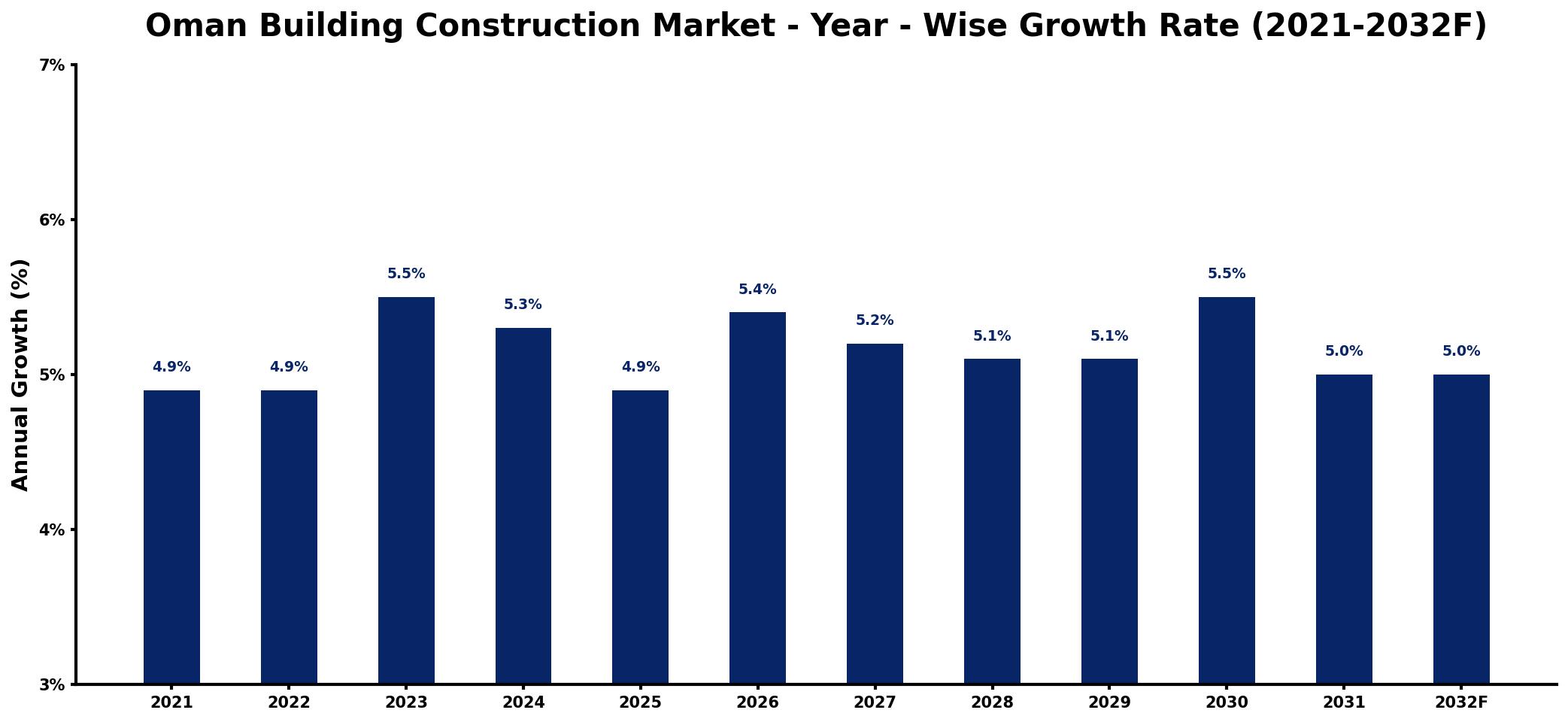
The table below presents the year‑wise growth rates along with the key drivers influencing the market
| Year | Growth Rate | Major Drivers |
| 2021 | 4.9% | Increased infrastructure investment initiatives |
| 2022 | 4.9% | Rising demand for residential properties |
| 2023 | 5.5% | Expansion of renewable energy projects |
| 2024 | 5.3% | Growth in tourism sector projects |
| 2025 | 4.9% | Urbanization driving housing development |
| 2026 | 5.4% | Government incentives for private investment |
| 2027 | 5.2% | Technological advancements in project management |
| 2028 | 5.1% | rising export shipment volumes |
| 2029 | 5.1% | Increased foreign direct investments |
| 2030 | 5.5% | Rise in public-private partnerships |
| 2031 | 5.0% | Enhanced regulatory support for projects |
| 2032 | 5.0% | Growing demand for commercial spaces |
Note: Market size estimations and growth projections presented in this report are based on 6Wresearch's proprietary forecasting methodology, utilizing the latest available industry data, government publications, and primary research inputs.
Oman Building Construction Market Synopsis
Currently, the Oman Building Construction Market is thriving, supported by a robust pipeline of infrastructure projects including airports, hotels, and residential complexes. The market benefits from a confluence of factors such as population growth, urban migration, and increased investment in sustainable construction practices.
Local and international investors are increasingly attracted to the opportunities presented in this market. The emphasis on innovation, efficiency, and environmental sustainability is reshaping the construction landscape, ensuring that Oman remains an appealing destination for construction-related ventures.
Oman Building Construction Market Key Takeaways
- Steady growth anticipated, backed by substantial government infrastructure investments.
- Shifts toward sustainable and green building practices are becoming mainstream.
- Increasing demand for smart technologies and automation in construction projects.
- High potential for investment in mixed-use developments that combine various functionalities.
- Foreign partnerships are enhancing market growth and technological advancements.
Evaluation of Restraints in Oman Building Construction Market
Despite its favorable growth prospects, the Oman Building Construction Market faces notable challenges. Regulatory changes can introduce uncertainties, often complicating compliance for construction firms. Additionally, fluctuations in material costs can disrupt budgets, while a shortage of skilled labor, especially in specialized areas, may hinder project timelines and quality. The complexities surrounding project approval processes can also lead to delays, increasing overall costs. These factors require that stakeholders implement robust risk management strategies and prioritize investment in workforce development to navigate the landscape effectively.
Oman Building Construction Market Trends
The market is witnessing significant trends that are reshaping its future. A key trend is the increasing emphasis on sustainable construction methods, aligned with government initiatives aimed at promoting environmental responsibility. Smart building technologies are gaining traction, improving operational efficiency and enhancing occupant experiences.
Moreover, there is a growing inclination towards modular and prefabricated construction techniques that shorten project timelines and reduce costs. This trend dovetails with the rising interest in mixed-use developments, designed to foster vibrant urban living by integrating residential, commercial, and leisure spaces.
Oman Building Construction Market Opportunities
Investment opportunities abound in the Oman Building Construction Market, driven by several favorable conditions. With a strategic location and a stable political climate, Oman presents an attractive proposition for investors. Urbanization continues to escalate, resulting in robust demand for diverse property types, spanning residential, commercial, and industrial sectors.
Furthermore, the nation's commitment to diversifying its economy away from oil dependence is catalyzing investments in sectors like tourism and manufacturing, creating an urgent need for construction services. Opportunities in real estate development, supply of construction materials, and advancements in sustainable building technologies are particularly noteworthy.
Government Initiatives in the Oman Building Construction Market
The Omani government has established various policies to bolster the building construction sector. These initiatives focus on sustainable development and strict adherence to building codes while also aiming to enhance the overall quality of infrastructure. Efforts have been made to streamline the permitting process, promote safety standards, and encourage the adoption of eco-friendly construction practices, thereby creating an environment conducive to growth and innovation in the industry.
Future Insights of the Oman Building Construction Market
Looking ahead to the period from 2026 to 2032, the Oman Building Construction Market is expected to continue its trajectory of growth. The government's focus on extensive infrastructure development and urbanization will sustain demand for construction services. Major initiatives, such as the Oman Vision 2040 program, are poised to invigorate key sectors, including tourism and logistics, thus further stimulating construction activity.
The integration of sustainable practices and technological advancements will redefine industry standards, shaping a future where construction is not only efficient but also environmentally responsible. However, stakeholders must remain vigilant to external factors such as fluctuating oil prices and regulatory changes that may influence market dynamics.
Oman Building Construction Market Latest Developments (2025 - 2026)
Recent developments in the Oman Building Construction Market indicate a continued alignment with global trends toward sustainability and innovation. A marked increase in public and private partnerships is evident, with several projects underway that emphasize modern construction techniques. Additionally, there is a noticeable push for integrating smart technologies into building designs, enhancing both efficiency and user experience.
Oman Building Construction Market - Key Attractiveness of the Report
- 10 Years of Market Numbers
- Historical Data Starting from 2022 to 2025
- Base Year: 2025
- Forecast Data until 2032
- Key Performance Indicators Impacting the Market
- Major Upcoming Developments and Projects
Key Highlights of the Report:
- Oman Building Construction Market Outlook
- Market Size of Oman Building Construction Market, 2025
- Forecast of Oman Building Construction Market, 2032
- Historical Data and Forecast of Oman Building Construction Revenues & Volume for the Period 2022-2032F
- Oman Building Construction Market Trend Evolution
- Oman Building Construction Market Drivers and Challenges
- Oman Building Construction Price Trends
- Oman Building Construction Porter's Five Forces
- Oman Building Construction Industry Life Cycle
- Historical Data and Forecast of Oman Building Construction Market Revenues & Volume By Type for the Period 2022-2032F
- Historical Data and Forecast of Oman Building Construction Market Revenues & Volume By Residential for the Period 2022-2032F
- Historical Data and Forecast of Oman Building Construction Market Revenues & Volume By Non-residential for the Period 2022-2032F
- Historical Data and Forecast of Oman Building Construction Market Revenues & Volume By Construction Type for the Period 2022-2032F
- Historical Data and Forecast of Oman Building Construction Market Revenues & Volume By New Construction for the Period 2022-2032F
- Historical Data and Forecast of Oman Building Construction Market Revenues & Volume By Renovation for the Period 2022-2032F
- Historical Data and Forecast of Oman Building Construction Market Revenues & Volume By Application for the Period 2022-2032F
- Historical Data and Forecast of Oman Building Construction Market Revenues & Volume By Owned for the Period 2022-2032F
- Historical Data and Forecast of Oman Building Construction Market Revenues & Volume By Rental for the Period 2022-2032F
- Historical Data and Forecast of Oman Building Construction Market Revenues & Volume By End User for the Period 2022-2032F
- Historical Data and Forecast of Oman Building Construction Market Revenues & Volume By Private for the Period 2022-2032F
- Historical Data and Forecast of Oman Building Construction Market Revenues & Volume By Public for the Period 2022-2032F
- Oman Building Construction Import Export Trade Statistics
- Market Opportunity Assessment By Type
- Market Opportunity Assessment By Construction Type
- Market Opportunity Assessment By Application
- Market Opportunity Assessment By End User
- Oman Building Construction Top Companies Market Share
- Oman Building Construction Competitive Benchmarking By Technical and Operational Parameters
- Oman Building Construction Company Profiles
- Oman Building Construction Key Strategic Recommendations






































