Oman Ceiling Tiles Market Size, Share & Growth Rate
The Oman Ceiling Tiles Market was estimated at USD 1179 Million in 2025 and is projected to reach USD 1712 Million by 2032, growing at a CAGR of 5.5% from 2026 to 2032. This growth trajectory is primarily fueled by a robust construction sector, spurred by government investments in infrastructure and a booming commercial real estate market. The expanding demand for aesthetically pleasing and sustainable design solutions further enhances the market landscape, as both residential and commercial sectors increasingly adopt innovative ceiling tile technologies.
Oman Ceiling Tiles Market Year-wise Growth Rate and Key Drivers
This graph highlights how the Oman Ceiling Tiles Market has steadily grown over the years, supported by major growth factors.
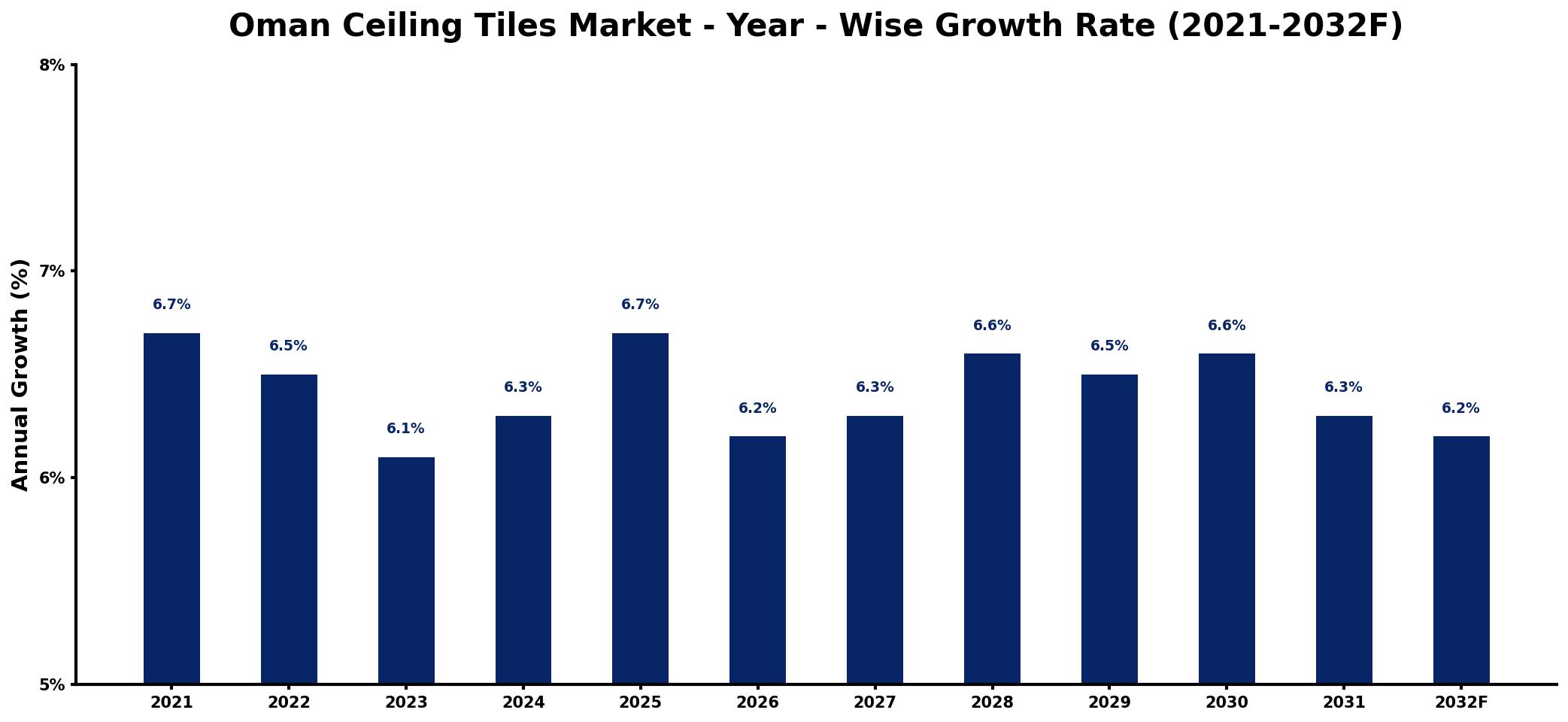
The table below presents the year‑wise growth rates along with the key drivers influencing the market
| Year | Growth Rate | Major Drivers |
| 2021 | 6.7% | Rising construction sector investments |
| 2022 | 6.5% | Growing demand for sustainable materials |
| 2023 | 6.1% | Increasing urbanization and infrastructure projects |
| 2024 | 6.3% | Expansion of commercial real estate |
| 2025 | 6.7% | rising infrastructure development spending |
| 2026 | 6.2% | Boost in hospitality sector developments |
| 2027 | 6.3% | Growing awareness of aesthetic designs |
| 2028 | 6.6% | Increase in government construction initiatives |
| 2029 | 6.5% | Rising disposable income levels |
| 2030 | 6.6% | Growth in residential building projects |
| 2031 | 6.3% | expanding manufacturing base activity |
| 2032 | 6.2% | Increased investment in green buildings |
Note: Market size estimations and growth projections presented in this report are based on 6Wresearch's proprietary forecasting methodology, utilizing the latest available industry data, government publications, and primary research inputs.
Oman Ceiling Tiles Market Synopsis
The Oman ceiling tiles market is currently witnessing a significant transformation driven by evolving consumer preferences and increasing construction activities. Enhanced focus on interior aesthetics, coupled with a strong demand for eco-friendly materials, is reshaping the offerings in this sector.
Manufacturers are rising to the challenge by introducing diverse products that blend functionality with modern design. As safety regulations tighten, innovation in materials and installation processes is becoming paramount to maintain compliance while still delivering on aesthetic expectations.
Oman Ceiling Tiles Market Key Takeaways
- The ongoing expansion of the construction industry is a vital driver of growth in the Oman ceiling tiles market.
- Innovations in materials and design are catering to the rising demand for sustainable and visually appealing solutions.
- Economic fluctuations and material cost volatility present challenges for manufacturers in the sector.
- Government regulations are shaping market dynamics, emphasizing safety, quality, and environmental impact.
- Future trends indicate a shift towards more integrated and technology-driven ceiling solutions.
Evaluation of Restraints in Oman Ceiling Tiles Market
Despite the growth potential, the Oman ceiling tiles market faces notable constraints that may impede progress. Fluctuations in raw material prices—particularly gypsum and mineral fiber—create uncertainty for manufacturers. Such volatility can compromise profit margins and influence pricing strategies. Moreover, geopolitical factors can further exacerbate supply chain issues, complicating the procurement of essential materials. Lastly, stringent building regulations regarding fire safety and acoustic performance compel manufacturers to adopt rigorous compliance measures, adding to the cost burden while challenging the pursuit of innovation.
Oman Ceiling Tiles Market Trends
A wave of current and emerging trends is redefining the Oman ceiling tiles market. The growing emphasis on sustainability is pushing manufacturers toward eco-friendly materials and production processes. Smart building technologies are beginning to influence design, with ceiling tiles integrating acoustic and thermal functionalities. Additionally, the rise of modular construction techniques is promoting quicker installation and adaptability, reflecting the demands of modern projects.
Oman Ceiling Tiles Market Opportunities
Investment opportunities in the Oman ceiling tiles market are rich and varied. The governments commitment to infrastructure development offers a fertile ground for new projects, with demand anticipated from both public and private sectors. Additionally, as consumer preferences shift towards sustainable materials, manufacturers who can innovate to meet these demands stand to gain significant market share. There is also potential for expansion into the renovation sector, where updating older buildings with modern ceiling solutions can enhance value and performance.
Government Initiatives in the Oman Ceiling Tiles Market
The Omani government is actively implementing regulations and standards to ensure the safety and quality of construction materials, including ceiling tiles. These regulations encompass fire safety, structural integrity, and environmental considerations. Policies are increasingly promoting the use of sustainable and locally sourced materials, aimed at reducing reliance on imports and fostering domestic industries. Furthermore, initiatives targeting recycling and environmentally responsible disposal of construction materials are gaining traction, contributing to a more sustainable construction ecosystem.
Future Insights of the Oman Ceiling Tiles Market
Looking ahead to the period between 2026 and 2032, the Oman ceiling tiles market is poised for continued growth. Factors driving this future landscape include an accelerating pace of urbanization, ongoing government investment in infrastructure, and a rising consumer preference for aesthetic and functional design solutions. Innovations in manufacturing technologies are likely to facilitate cost-effective production while adhering to stringent safety standards, allowing for diverse and quality offerings to meet market demands.
Oman Ceiling Tiles Market Latest Developments (2025 - 2026)
Recent developments in the Oman ceiling tiles market point towards a shift in industry focus towards sustainable practices and innovation. Manufacturers are increasingly adopting advanced technologies to enhance product offerings, with a specific emphasis on eco-friendly materials. Additionally, there is a noticeable increase in collaborative efforts between stakeholders to address regulatory compliance and safety standards, ensuring that new products meet both consumer and governmental expectations.
Oman Ceiling Tiles Market - Key Attractiveness of the Report
- 10 Years of Market Numbers
- Historical Data Starting from 2022 to 2025
- Base Year: 2025
- Forecast Data until 2032
- Key Performance Indicators Impacting the Market
- Major Upcoming Developments and Projects
Key Highlights of the Report:
- Oman Ceiling Tiles Market Outlook
- Market Size of Oman Ceiling Tiles Market, 2025
- Forecast of Oman Ceiling Tiles Market, 2032
- Historical Data and Forecast of Oman Ceiling Tiles Revenues & Volume for the Period 2022-2032F
- Oman Ceiling Tiles Market Trend Evolution
- Oman Ceiling Tiles Market Drivers and Challenges
- Oman Ceiling Tiles Price Trends
- Oman Ceiling Tiles Porter's Five Forces
- Oman Ceiling Tiles Industry Life Cycle
- Historical Data and Forecast of Oman Ceiling Tiles Market Revenues & Volume By Material Type for the Period 2022-2032F
- Historical Data and Forecast of Oman Ceiling Tiles Market Revenues & Volume By Mineral Wool for the Period 2022-2032F
- Historical Data and Forecast of Oman Ceiling Tiles Market Revenues & Volume By Metal for the Period 2022-2032F
- Historical Data and Forecast of Oman Ceiling Tiles Market Revenues & Volume By Gypsum for the Period 2022-2032F
- Historical Data and Forecast of Oman Ceiling Tiles Market Revenues & Volume By Others for the Period 2022-2032F
- Historical Data and Forecast of Oman Ceiling Tiles Market Revenues & Volume By Application for the Period 2022-2032F
- Historical Data and Forecast of Oman Ceiling Tiles Market Revenues & Volume By Residential for the Period 2022-2032F
- Historical Data and Forecast of Oman Ceiling Tiles Market Revenues & Volume By Non-residential for the Period 2022-2032F
- Oman Ceiling Tiles Import Export Trade Statistics
- Market Opportunity Assessment By Material Type
- Market Opportunity Assessment By Application
- Oman Ceiling Tiles Top Companies Market Share
- Oman Ceiling Tiles Competitive Benchmarking By Technical and Operational Parameters
- Oman Ceiling Tiles Company Profiles
- Oman Ceiling Tiles Key Strategic Recommendations






































